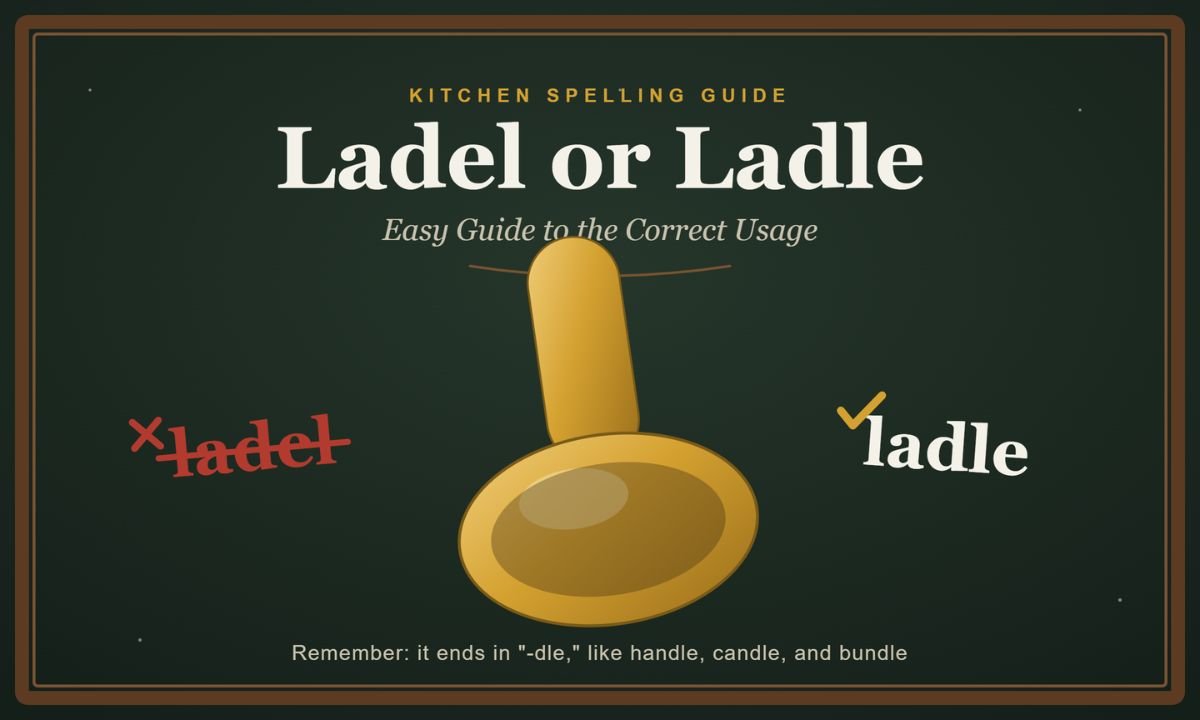
Ladel or Ladle: Easy Guide to the Correct Usage
You are writing a recipe, texting a friend about soup night, or labeling a kitchen tool on Amazon, and suddenly you freeze. Is it ladel or ladle? Your fingers want to type one thing, but your eyes tell you it looks wrong. This tiny spelling mix-up trips up more people than you would expect, and it can make your writing look careless even when everything else is spot on. The good news: the fix takes less than a minute to learn.
Quick Answer
Ladle is the correct spelling. Ladel is a common misspelling with no dictionary meaning of its own. A ladle is a long-handled spoon with a deep bowl, used to serve liquids like soup, stew, or sauce. If you remember that the word ends in “-dle,” like “candle” or “handle,” you will never misspell it again.
Ladel vs Ladle: The Simple Rule
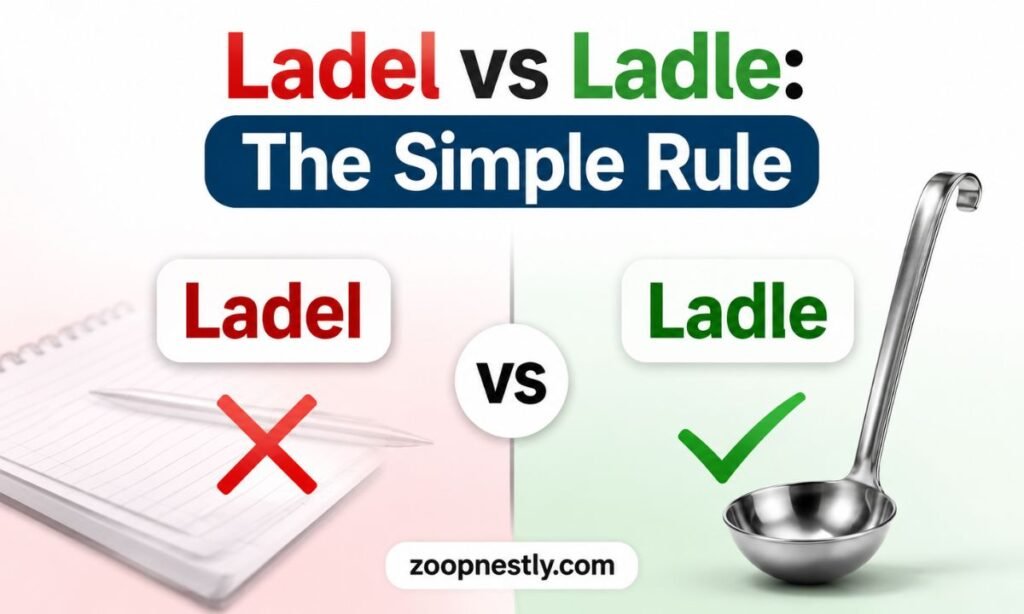
Only one of these two words exists in standard English dictionaries, and that word is ladle. “Ladel” is not a recognized variant, an old spelling, or a regional form. It is simply an error that happens when people type or write quickly and swap the letter order near the end of the word.
Here is the direct comparison:
| Word | Correct? | Meaning |
| Ladle | Yes | A long-handled spoon with a deep bowl, used for serving liquids |
| Ladel | No | Misspelling of “ladle”; has no meaning of its own |
If you are ever unsure while writing, a safe trick is to say the word out loud slowly. You will hear “lay-dl,” which matches the “dle” ending, not “del.”
What Does Ladle Actually Mean?
A ladle is a kitchen tool with two main parts: a deep, rounded bowl and a long handle. The bowl holds the liquid, and the handle keeps your hand away from heat and mess while you serve.
As a noun, it refers to the tool itself. As a verb, “to ladle” means to scoop and pour a liquid using this tool, or even using a cup or bowl in a pinch.
Example sentences:
- She reached for the ladle to serve the soup.
- He ladled the gravy generously over the mashed potatoes.
- The soup kitchen volunteer stood behind the pot, ladle in hand.
Why Ladle Matters in the Kitchen
A ladle is not just another spoon. Its shape solves a specific problem: moving liquid from a pot to a bowl or plate without spilling half of it on the way.
Where a ladle earns its place:
- Serving soups and stews – The deep bowl holds enough liquid in one scoop, so you are not making five trips per bowl.
- Portioning sauces and gravies – A ladle helps you pour evenly instead of dumping too much at once.
- Punch bowls and beverages – Long handles keep your hand clear of a full bowl.
- Professional kitchens – Standardized ladle sizes (measured in ounces) help chefs keep portions consistent, which matters for both cost control and presentation.
Pronunciation: How to Say Ladle Correctly
Ladle is pronounced LAY-dl (rhymes with “cradle” and “table”). It has two syllables, with the stress on the first one.
| Syllable | Sound |
| First | “LAY” (like the word “lay”) |
| Second | “dl” (a soft, quick “duhl” sound) |
There is no “el” sound anywhere in the word, which is part of why writing it as “ladel” is a mismatch between how some people expect it to look and how it is actually spelled.
Why Do People Write “Ladel” Instead of “Ladle”?
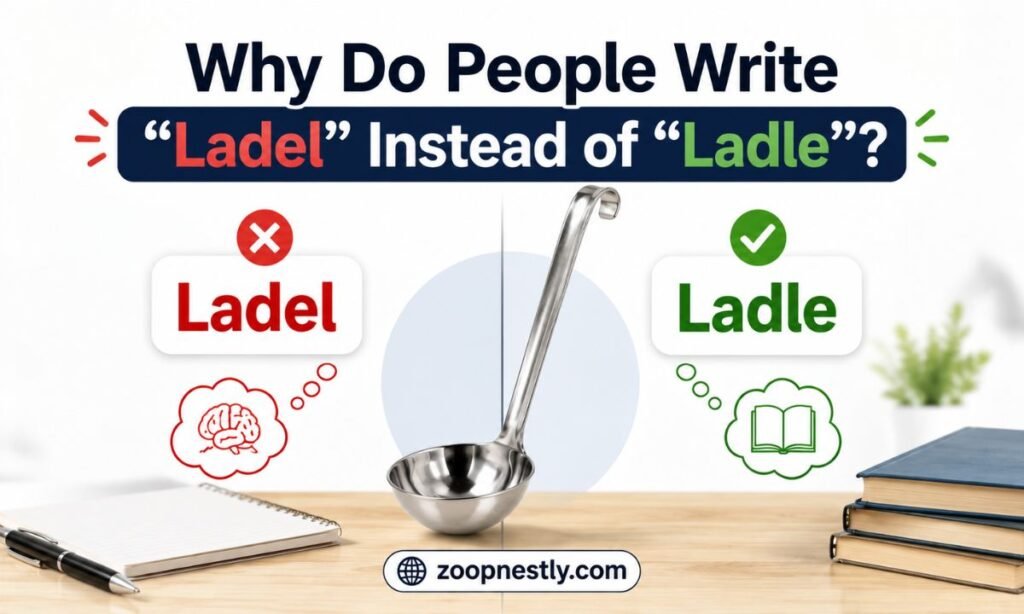
This mistake is a form of metathesis, a common language pattern where two sounds or letters swap places, usually because it feels more natural to say or type that way. English has plenty of words ending in “-el” (like “towel” or “novel”), so writers sometimes default to that familiar pattern instead of the less common “-le” ending.
Common reasons this happens:
- Autocorrect and predictive text sometimes reinforce the wrong version if it has been typed incorrectly before.
- Non-native English speakers may apply spelling patterns from words like “towel” or “label.”
- Fast typing on a phone often scrambles letter order near the end of a word.
- The word is heard more often than read, so people guess at the spelling.
Once you know the “-dle” pattern connects ladle to words like handle, candle, and bundle, the correct spelling becomes much easier to remember.
A Quick Look at the Word’s History
Ladle comes from Old English hlædel, related to the verb “to load” or “to lade,” meaning to load or dip out liquid. Over centuries, the spelling simplified into the modern “ladle” we use today. This root also explains why the tool’s job (scooping and loading liquid) matches its name so closely. There has never been a standard historical spelling close to “ladel,” so this is a modern typing error rather than an older variant.
DISCOVER MORE : Scarey vs Scary: Quick Guide to the Correct Spelling
Ladle as a Noun and a Verb
Ladle works as both a noun and a verb, and knowing the difference helps with sentence structure.
| Form | Function | Example |
| Noun | Names the object | “Pass me the ladle.” |
| Verb (present) | Describes the action | “Please ladle the soup carefully.” |
| Verb (past tense) | Describes a completed action | “She ladled the broth into bowls.” |
Note that the past tense is ladled, not “ladeled” or “laddled.”
Types of Ladles You Might Come Across
Not all ladles look or work the same way. Here are the common types:
- Soup ladle – Standard deep bowl, medium handle, used for everyday serving.
- Gravy ladle – Smaller bowl for controlled pouring.
- Punch ladle – Wide, shallow bowl designed for beverages, often with a hook to rest on the bowl’s rim.
- Slotted ladle – Includes small holes to drain excess liquid while serving solids like dumplings.
- Sauce ladle – Compact size for precise plating in restaurants.
Words Related to Ladle
A few related terms show up often in cooking content and can help clarify meaning:
| Term | Relationship to Ladle |
| Scoop | Broader term; a ladle is a type of liquid scoop |
| Dipper | Informal synonym, mainly used regionally |
| Server | General term for any serving utensil |
| Spoon | Related but not deep enough for large liquid portions |
Common Mistakes People Make With This Word
Beyond the ladel vs ladle spelling issue, a few other errors show up regularly:
- “Laddle” – Adding an extra “d” by mistake.
- “Ladle’s” – Using an apostrophe when the plural “ladles” is meant.
- Mixing up verb tense, such as writing “ladel” for the verb form instead of “ladled.”
Reading your sentence back slowly, or using a spell checker, catches almost all of these instantly.
Where You’ll See the Word Ladle Used
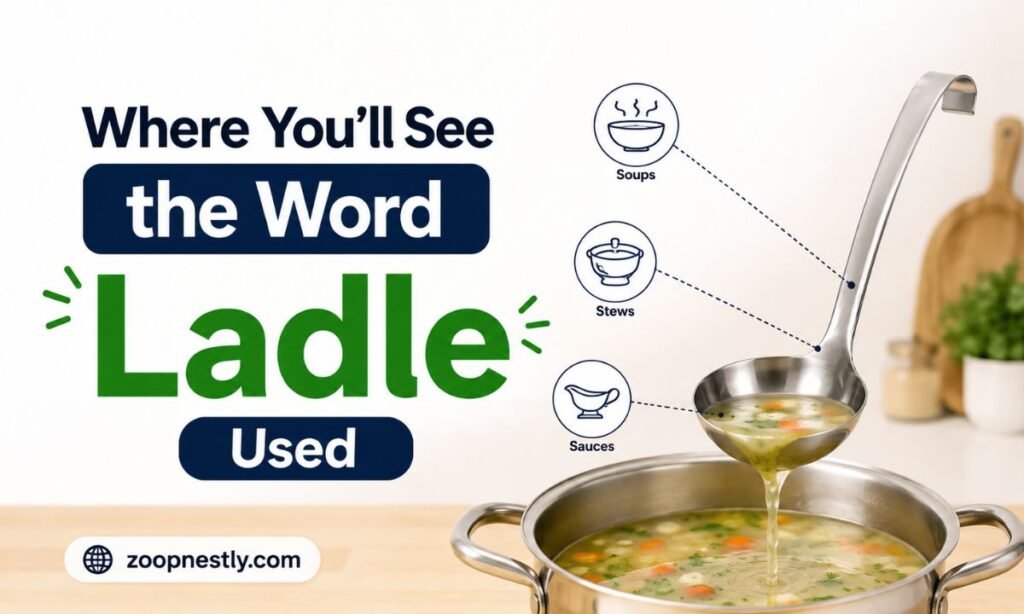
Beyond home kitchens, “ladle” shows up in a surprising number of everyday contexts:
- Recipe blogs and cookbooks, describing serving instructions
- Restaurant menus and kitchen training materials
- Product listings for kitchenware and cookware sets
- Idiomatic or figurative writing, such as “ladling out praise,” meaning to give something generously
This last use shows how the word has stretched beyond the kitchen into everyday figurative speech, always keeping its sense of generous, scooped-out portions.
Summary: Ladel vs Ladle
| Point | Detail |
| Correct spelling | Ladle |
| Incorrect spelling | Ladel |
| Pronunciation | LAY-dl |
| Word type | Noun and verb |
| Simple memory trick | Ends in “-dle,” like “handle” |
Frequently Asked Questions
Is “ladel” ever an accepted alternate spelling?
No. “Ladel” is not listed in any major English dictionary. It is always considered a misspelling of ladle.
What is a ladle used for?
A ladle is used to scoop and serve liquids such as soup, stew, sauce, or punch, thanks to its deep bowl and long handle.
How do you spell the past tense of ladle?
The past tense is ladled, as in “She ladled the soup into bowls.”
Why do so many people misspell ladle as ladel?
It usually comes down to typing habits, autocorrect errors, or applying the more familiar “-el” ending pattern from other English words.
Is ladle a noun, a verb, or both?
Ladle is both. As a noun, it names the utensil. As a verb, it describes the action of scooping and serving liquid.
Final Thoughts
The ladel vs ladle debate really has a one-word answer: ladle. Once you connect it to familiar words like handle and candle, the correct spelling sticks for good. Whether you are writing a recipe, a menu description, or just texting about soup night, using “ladle” correctly is a small detail that makes your writing look polished and accurate.

James Walker is a content writer and language researcher with over 5 years of experience in meanings, definitions, and language-related topics. He enjoys simplifying complex terms into clear, easy-to-understand explanations. Through ZoopNestly.com, he helps readers find accurate and reliable information.