Scarey vs Scary: Quick Guide to the Correct Spelling
You typed it, stared at it, and something felt off. Was it scarey or scary? You are not imagining things. This mix-up trips up even confident writers because the word sounds like it should end in “ey,” similar to “homey” or “matey.” The problem is that spelling by sound alone does not always work in English, and this is one of those cases where guessing costs you credibility. Here is the clear answer, explained simply.
Quick Answer
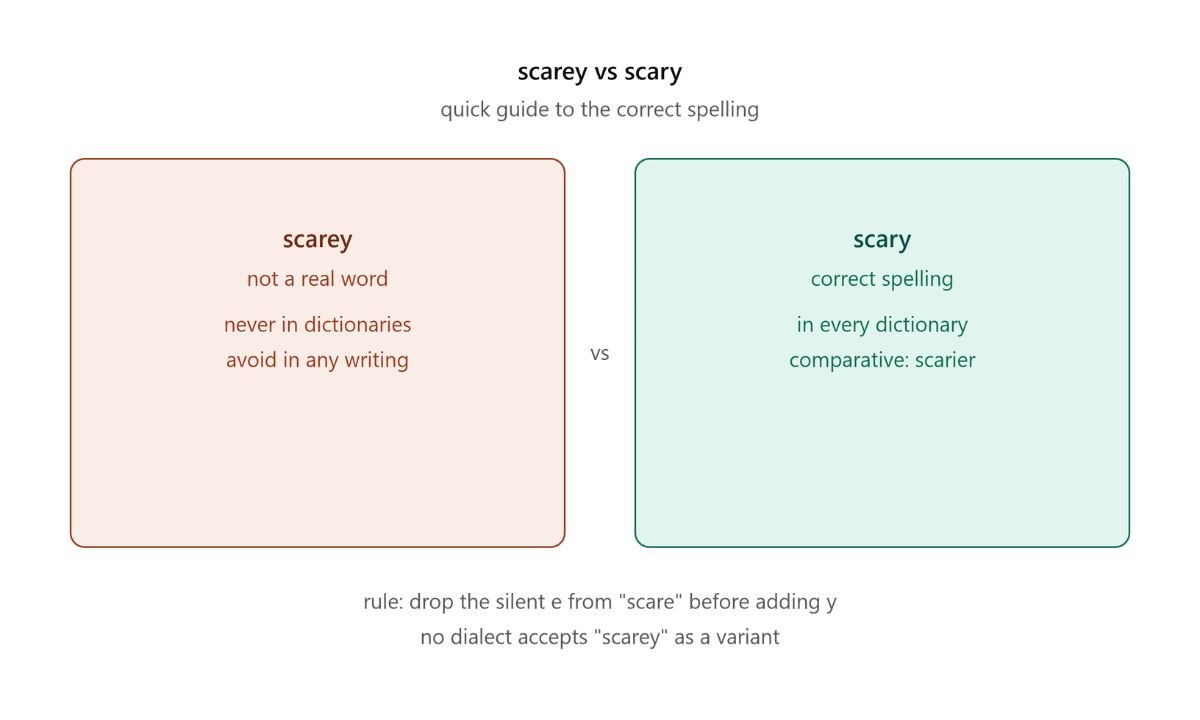
Scary is the correct spelling. Scarey is a common misspelling that shows up in casual writing, texts, and social media, but it is not accepted in standard American or British English. Dictionaries, style guides, and editors all recognize only scary as the proper form.
Is Scarey a Word?
No, scarey is not a real word in standard English. It does not appear in major dictionaries like Merriam-Webster or Oxford as an accepted spelling. People write it this way because English has other adjectives that end in “-ey,” such as “homey” and “matey,” so the brain assumes “scary” should follow the same pattern. It simply does not.
If you search for “scarey” online, you will find it in old forum posts, casual texts, and informal comments. That does not make it correct. It just shows how common the mistake is.
What Does Scary Mean?
Scary is an adjective that describes something causing fear, alarm, or unease. It can apply to physical danger, emotional discomfort, or even uncertainty about the future.
Examples of what “scary” can describe:
- A horror movie with jump scares
- A dark, empty parking lot at night
- A job interview you feel unprepared for
- A medical test you are waiting on results for
The word covers both literal fear (monsters, storms, heights) and figurative fear (change, risk, the unknown).
Why the Confusion Happens: The Spelling Rule Behind It
English adjectives formed from short words ending in a consonant plus “y” usually drop the final “y” and add “-y” again correctly as one unit, without inserting an “e.” Here is the simple rule:
Base word + “y” = adjective, no extra “e” added.
| Base Word | Correct Adjective | Incorrect Version |
| scare | scary | scarey |
| space | spacy | spacey* |
| grace | gracy | gracey |
*Note: “spacey” is actually an accepted informal variant in some dictionaries, which adds to the confusion. But “scarey” never received that same acceptance. This is why relying on pattern matching alone can mislead you, and why checking the specific word matters more than applying a blanket rule.
The takeaway: not every “-e” word behaves the same way when you add “y.” Scary dropped the silent “e” from “scare” before adding “y.” That is the standard rule for most words in this family, and it is the one that applies here.
Scarey vs Scary: Side-by-Side Comparison
| Feature | Scary | Scarey |
| Correct spelling | Yes | No |
| Found in dictionaries | Yes | No |
| Accepted in formal writing | Yes | Never |
| Common in casual/text writing | Sometimes | Frequently (incorrectly) |
| Used by editors and publishers | Yes | No |
Scary in Real Sentences
Seeing the word in context makes it easier to remember correctly.
- “That basement is genuinely scary at night.”
- “Public speaking is scary for a lot of people, even experienced ones.”
- “The scariest part of the movie was the silence right before the jump scare.”
- “She admitted the diagnosis felt scary, but she stayed hopeful.”
- “It’s scary how fast that storm rolled in.”
Notice how “scary” flexes into forms like “scarier” and “scariest” without ever needing that extra “e.” That consistency is another clue that “scarey” was never the right foundation.
Common Mistakes People Make With This Word
Beyond the basic spelling, a few related errors show up often:
- Adding an apostrophe: Writing “scarey’s” or “scary’s” when there is no possession or contraction involved.
- Confusing it with “scare”: “Scare” is a verb or noun (“Don’t scare me,” “That gave me a scare”), while “scary” is the adjective form.
- Overusing “scary” in formal writing: In professional or academic contexts, stronger or more specific words like “alarming,” “unsettling,” or “daunting” often communicate more precisely.
- Doubling the comparative incorrectly: Writing “more scarier” instead of just “scarier.”
Scary vs Creepy vs Spooky vs Frightening
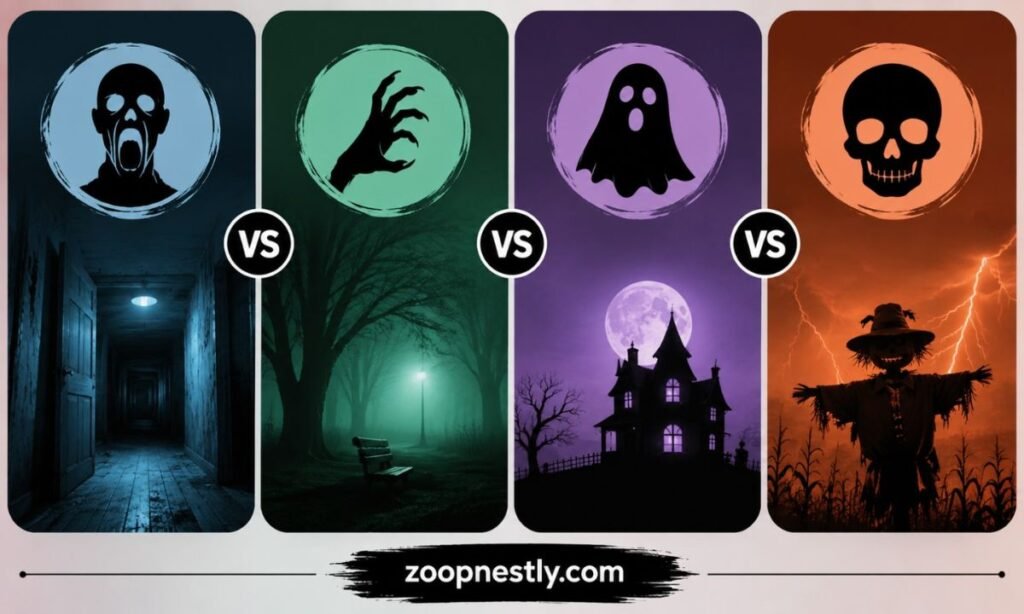
These words often get used interchangeably, but they carry slightly different tones.
- Scary: General fear-inducing quality, works in almost any context.
- Creepy: Suggests something unsettling or unnatural, often with a slow-building discomfort rather than sudden fear.
- Spooky: Lighter and often playful, commonly used around Halloween or ghost stories.
- Frightening: More formal and intense, often used for serious or urgent situations.
Choosing the right word depends on tone. A haunted house is “spooky.” A stalker following you home is “creepy.” A car accident you narrowly avoided is “scary” or “frightening,” depending on how serious the moment felt.
DISCOVER MORE : Grately vs Greatly: Simple Guide to the Correct Spelling
Useful Synonyms for Scary
Expanding your vocabulary helps you avoid repeating the same word in longer pieces of writing.
- Frightening
- Alarming
- Terrifying
- Chilling
- Unnerving
- Intimidating
- Dreadful
- Menacing
Each carries a slightly different intensity, so pick based on how strong the fear or discomfort actually is. “Unnerving” fits a quiet, uneasy feeling, while “terrifying” fits something intense and overwhelming.
Scary vs Frightened: Know the Difference
This is a related mix-up worth clearing up. Scary describes something that causes fear. Frightened describes how a person feels because of that fear.
- The movie was scary. (describes the movie)
- I felt frightened watching it. (describes the person)
Mixing these up is a common grammar slip, especially for English learners, since both words relate to fear but serve different grammatical roles: one describes the cause, the other describes the emotional state.
Other Similar Word Confusions Worth Knowing
If “scarey vs scary” tripped you up, these related pairs might too:
- Grey vs Gray: Both are accepted, but “gray” is more common in American English while “grey” is more common in British English.
- Judgment vs Judgement: “Judgment” is standard in American English; “judgement” is common in British English.
- Advisor vs Adviser: Both are used, though “adviser” appears more often in formal and journalistic writing.
Unlike these examples, “scarey” is not a regional variant. It is simply a misspelling, regardless of which English dialect you use.
Why “Scarey” Still Shows Up So Often

Even though it is incorrect, “scarey” keeps appearing in casual writing for a few practical reasons:
- Phonetic guessing: The word sounds like it needs an “e” before the “y.”
- Autocorrect gaps: Not every keyboard or app flags it as wrong.
- Repeated exposure: Once people see it written incorrectly in comments or posts, they assume it is a valid alternative spelling.
None of these reasons make it correct. They just explain why the mistake spreads so easily online.
Quick Practice: Test Yourself
Fill in the blank with the correct spelling.
- That old house looks genuinely _______ at night.
- Public speaking used to feel _______ to me before I got used to it.
- The storm got _______ faster than the forecast predicted.
Answers: scary, scary, scarier
If you filled in “scary” for all three, you have already got the rule down.
Frequently Asked Questions
Is “scarey” ever correct in any dialect of English?
No. Unlike words such as “grey” or “colour” that vary between American and British English, “scarey” is not accepted as a regional spelling anywhere. Scary is the only correct form.
Why does “scarey” look right even though it isn’t?
Because English has other “-ey” adjectives like “homey,” “matey,” and “gooey,” your brain applies that same pattern to “scary.” The rule does not carry over consistently across all words, which is why checking specific spellings still matters.
What is the comparative and superlative form of scary?
The comparative is scarier and the superlative is scariest. Neither form includes an extra “e.”
Can “scary” be used to describe people, not just situations?
Yes. You can describe a person as “scary” if their behavior, tone, or presence causes fear or unease, such as “He has a scary temper.”
Is it okay to use “scary” in professional writing?
It works in conversational or general business writing, but in formal reports or academic writing, more precise words like “alarming,” “concerning,” or “daunting” often fit better.
Final Thoughts
The spelling debate between scarey and scary has a simple resolution: scary is correct, and scarey is not a recognized word in any standard dictionary. The confusion comes from English’s inconsistent spelling patterns, not from any real grammatical debate. Once you remember that “scare” simply drops its silent “e” before adding “y,” the correct spelling becomes automatic. Keep that rule in mind, and you will never second-guess this word again.

James Walker is a content writer and language researcher with over 5 years of experience in meanings, definitions, and language-related topics. He enjoys simplifying complex terms into clear, easy-to-understand explanations. Through ZoopNestly.com, he helps readers find accurate and reliable information.