Persue or Pursue? The Correct Spelling Explained
You’re typing an email, a resume, or a college essay, and suddenly you freeze. Is it “persue your dreams” or “pursue your dreams”? Your fingers hover over the keyboard while doubt creeps in. This tiny spelling slip is more common than you’d think, and it can quietly undercut your credibility in writing that matters. The good news: persue or pursue confusion has a simple, permanent fix.
Quick Answer
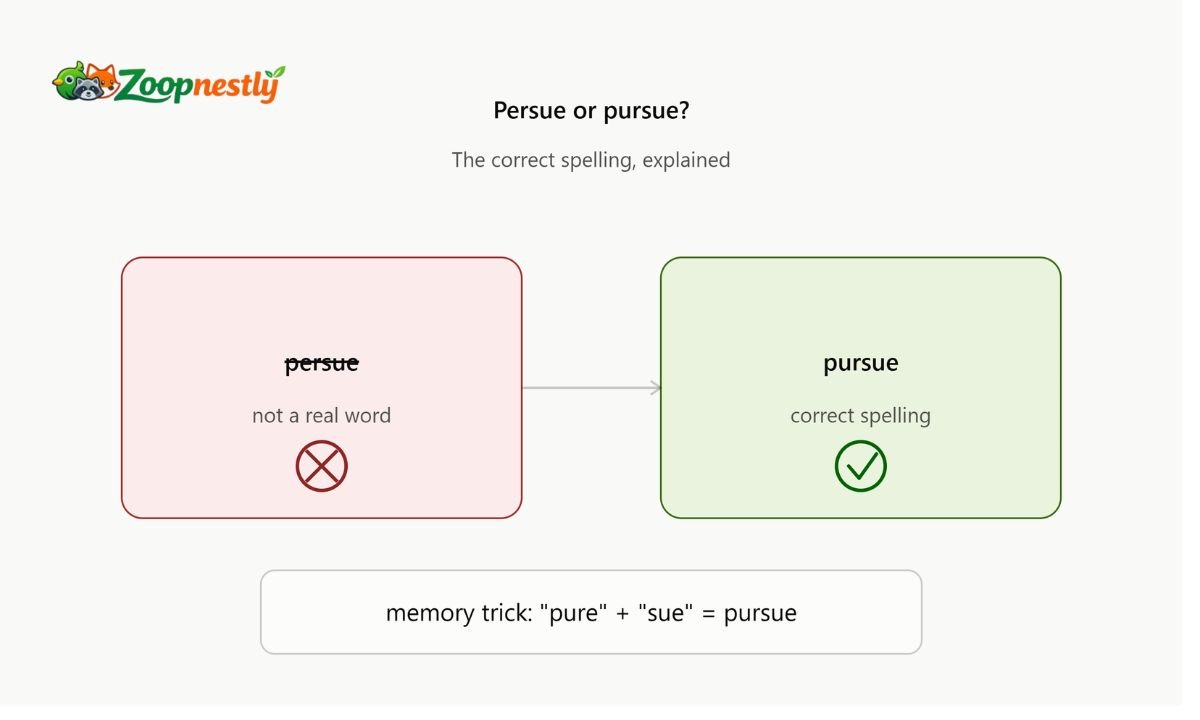
Pursue is the correct spelling. Persue is not a real word in standard English, it’s simply a common misspelling. Pursue means to follow, chase, or work toward something, like a goal, a career, or a person. Whenever you’re unsure, remember: only pursue appears in the dictionary.
Why Do People Misspell Pursue as Persue?
Spelling mistakes rarely happen by accident. There’s usually a reason, and with this word, the reason is your ears.
It Comes Down to Pronunciation
Say “pursue” out loud. The first syllable sounds a lot like “per,” which naturally nudges people toward writing “per” instead of “pur.” English spelling doesn’t always match pronunciation, and this word is a textbook example of that mismatch.
Where the Mistake Shows Up Most
This error tends to appear in fast typing situations: text messages, social media captions, quick work emails, and first drafts of essays. It also shows up often among non-native English speakers and younger writers who are still building spelling habits. Autocorrect usually catches it, but not always, especially in messaging apps with looser spell-check settings.
What Does Pursue Actually Mean?
Pursue is a verb with a few related meanings, all centered on the idea of moving toward or after something.
To chase or follow: The police pursued the suspect through downtown traffic.
To work toward a goal: She decided to pursue a career in graphic design.
To continue an activity or interest: He pursues photography as a weekend hobby.
To seek or try to obtain: The company is pursuing new investors this quarter.
In every case, pursue carries a sense of direction and effort, you’re going after something, not just thinking about it.
Persue vs Pursue: Side-by-Side Comparison
| Feature | Persue | Pursue |
| Correct spelling | No | Yes |
| Found in dictionaries | No | Yes |
| Part of speech | N/A | Verb |
| Common usage | Misspelling only | Career, goals, hobbies, chasing |
| Example sentence | “I will persue my goals” ❌ | “I will pursue my goals” ✅ |
Key takeaway: Persue has no dictionary entry, no accepted usage, and no exceptions. It’s simply an error, not an alternate spelling or informal variant.
Simple Tricks to Remember the Spelling

Memory tricks work better than rules you have to think about every time. Try one of these.
- Pure + Sue: Break the word into “pur” and “sue.” If you can spell “pure,” you can spell the start of “pursue.”
- U comes before the double letters: Notice the word has a “u” right after “p,” not an “e.” Pursue, not persue.
- Visual repetition: Write the correct word five times in a row. Muscle memory sticks faster than rules do.
- Use it in a sentence you care about: “I will pursue my dream job” lands differently than a random example, and it’s more likely to stick.
A Real Example of Why It Matters
Spelling mistakes can carry more weight than people expect, especially in professional settings. A resume, cover letter, or LinkedIn summary with “persue” instead of “pursue” can signal carelessness to a hiring manager, even if the rest of the application is strong. Recruiters often skim quickly, and a spelling error near the top of a document is an easy reason to move on to the next candidate. Getting this one word right costs nothing and protects your first impression.
DISCOVER MORE : Gage or Gauge: What’s the Difference and Which One Should You Use?
Pursue in Different Contexts
The word shows up across nearly every area of life, which is part of why getting it right matters.
Education: Students pursue degrees, certifications, and areas of study. “She’s pursuing a master’s in psychology.”
Career: Professionals pursue promotions, new roles, or entire career changes. “He’s pursuing a transition into product management.”
Business: Companies pursue partnerships, markets, and growth opportunities. “The startup is pursuing international expansion.”
Personal life: People pursue hobbies, relationships, and passions. “They’ve been pursuing a healthier lifestyle together.”
Pursue Meaning in a Relationship
Outside of careers and goals, “pursue” also has a common social meaning. When someone “pursues” another person romantically, it means they’re actively showing interest, making effort, and trying to build a connection, through conversation, dates, or consistent attention. This usage is common in dating advice and relationship writing, and it follows the same core idea as every other use of the word: moving toward something with intention.
Common Examples of Correct Usage
Everyday conversation: “I’m finally going to pursue guitar lessons this year.”
Academic writing: “The researchers pursued a new methodology to test their hypothesis.”
Business writing: “Our team will pursue three potential vendors before the deadline.”
Notice that pursue works comfortably in casual and formal writing alike. It’s a flexible, professional-sounding verb, which is exactly why it shows up so often in resumes, essays, and workplace communication.
How to Catch This Mistake Before You Hit Send
A quick habit check can prevent this error from ever reaching your reader.
- Write naturally first. Don’t slow down to second-guess every word during a first draft.
- Run a spell checker. Most tools flag “persue” automatically, but don’t rely on this alone.
- Read your work aloud. Hearing the sentence often catches errors your eyes skip past.
- Look up any word you hesitate on. A five-second search beats a sloppy final draft.
- Keep a personal list of tricky words. If you’ve misspelled “pursue” before, you’ll likely do it again unless you track it.
Other Commonly Confused Word Pairs
If “persue vs pursue” trips you up, these similar pairs are worth reviewing too.
- Accept vs Except: Accept means to receive; except means excluding.
- Advice vs Advise: Advice is the noun; advise is the verb.
- Loose vs Lose: Loose describes something not tight; lose means to misplace or fail to win.
- Affect vs Effect: Affect is usually a verb (to influence); effect is usually a noun (a result).
Learning these together builds a stronger overall sense for tricky English spelling patterns, not just this one word.
Synonyms for Pursue

Depending on context, you can also use: chase, seek, follow, strive for, aim for, work toward, or go after. Swapping in a synonym can help you double-check meaning if you’re ever unsure whether “pursue” fits your sentence.
Quick Self-Test
Try these before moving on, no pressure, just a fast check.
- Fill in the blank: “She wants to ___ a career in law.” (persue / pursue)
- True or false: “Persue” is an acceptable informal spelling.
- Which sentence is correct: “He is pursuing his passion” or “He is persuing his passion”?
- What part of speech is pursue?
- Name one synonym for pursue.
(Answers: 1. pursue, 2. false, 3. “He is pursuing his passion,” 4. verb, 5. chase, seek, or strive for)
Frequently Asked Questions
Is persue ever correct in any dialect of English?
No. Persue is not recognized in American, British, or any other standard dialect of English. It’s a spelling error, not a regional variation.
Why does pursue have a “u” after the “p”?
The spelling comes from its Latin and French roots, where the “pur-” prefix was standard. English kept that spelling even though pronunciation shifted over time.
Is pursuing or persuing correct for the -ing form?
Pursuing is correct. Since pursue ends in a silent “e,” you drop the “e” and add “-ing,” giving you pursuing, never persuing.
Does autocorrect always catch persue?
Not always. Some messaging apps and quick-typing tools miss it, especially if predictive text has learned the error from previous typos.
What’s an easy way to explain this to someone else?
Tell them to think of “pure” plus “sue.” If they can spell “pure,” they already know the trickiest part of “pursue.”
Final Thoughts
Between persue and pursue, only one is real, and it’s pursue, every time, in every context. Once the “pure + sue” trick clicks, this spelling stops being a guessing game. Whether you’re writing a resume, a text to a friend, or a business proposal, spelling this word correctly is a small detail that quietly signals care and attention, exactly the kind of thing worth getting right.

James Walker is a content writer and language researcher with over 5 years of experience in meanings, definitions, and language-related topics. He enjoys simplifying complex terms into clear, easy-to-understand explanations. Through ZoopNestly.com, he helps readers find accurate and reliable information.