Long Term or Longterm: Common Mistakes and Correct Spelling
You’re halfway through an email or a report, and you stop mid-sentence. Is it “long term” or “longterm”? Maybe you’ve even seen “long-term” and wondered if that’s just a typo. This tiny word choice trips up more writers than you’d think, and getting it wrong in a resume, a business proposal, or a school paper can make your writing look careless. The good news: long term or longterm confusion has a simple, permanent fix once you know the rule.
Quick Answer
Longterm is not a standard English word. The correct forms are long term (two words, no hyphen) when it acts as a noun, and long-term (hyphenated) when it acts as an adjective before a noun. Which one you need depends entirely on the job the phrase is doing in your sentence.
Long Term vs Long-Term: The Core Difference
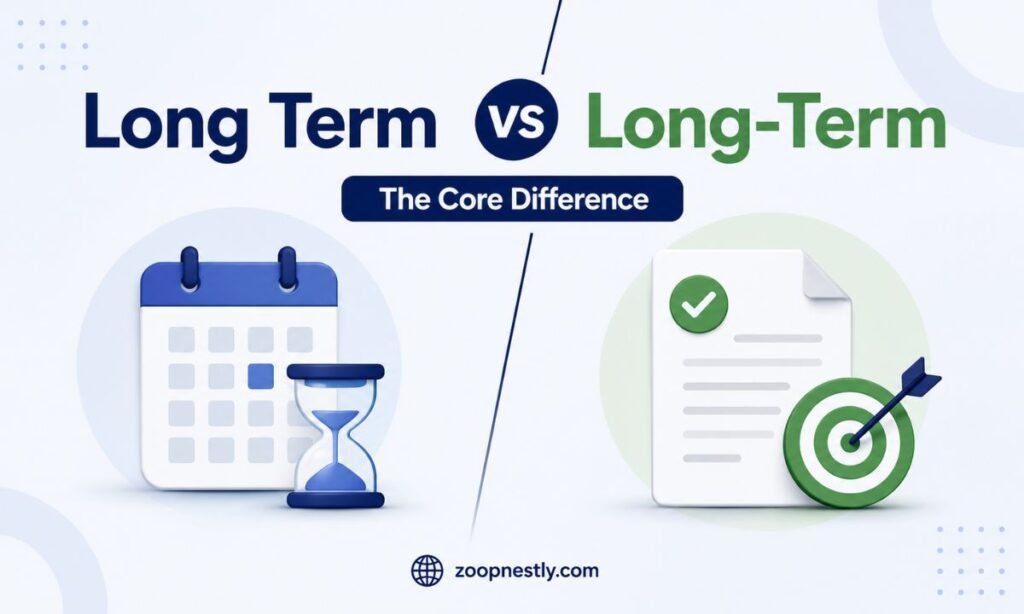
English handles this phrase two different ways depending on grammar, not personal preference.
| Form | Part of Speech | Example |
| Long term | Noun phrase | We’re investing for the long term. |
| Long-term | Compound adjective | This is a long-term investment. |
| Longterm | Not standard | Avoid using this form. |
Long term (no hyphen) works as a noun. It answers “what” or “when,” usually following a preposition like “in” or “for.”
Long-term (with a hyphen) works as an adjective. It describes a noun that comes right after it, like a compound modifier.
Longterm (one word, no hyphen) shows up occasionally online, but it isn’t recognized as standard by major dictionaries or style guides. Treat it the same way you’d treat “alot” instead of “a lot.”
Why People Get Confused
The mix-up happens for a few honest reasons, not because anyone is bad at grammar.
English compound words evolve over time. Words like “email” started as “e-mail” and eventually dropped the hyphen entirely. Writers naturally assume “long term” might be following the same path. It hasn’t, at least not yet, and dictionaries still list it as either two separate words or a hyphenated compound depending on function.
Autocorrect and casual texting also play a role. When you’re typing fast, hitting the space bar or hyphen key feels like an extra step, so “longterm” slips through. It reads fine in a text message. It reads wrong in a report.
When to Use “Long Term” (No Hyphen)
Use the open, two-word form when the phrase functions as a noun, meaning it’s naming a period of time rather than describing something.
Examples:
- She’s focused on the long term, not quick wins.
- Over the long term, consistent saving beats timing the market.
- In the long term, this decision will pay off.
Notice the pattern: in each sentence, “long term” follows a preposition (over, in, for) and stands on its own as a thing, not a description.
DISCOVER MORE : Submission vs Submittion: Which Spelling Is Correct and Why?
When to Use “Long-Term” (With a Hyphen)
Use the hyphenated form when the phrase functions as a compound adjective, directly modifying a noun that follows it.
Examples:
- The company signed a long-term contract.
- Doctors recommended a long-term treatment plan.
- Investors should think about long-term goals, not daily price swings.
Here, “long-term” is glued to the noun right after it (contract, plan, goals). The hyphen signals to the reader that these two words are working together as a single descriptive unit.
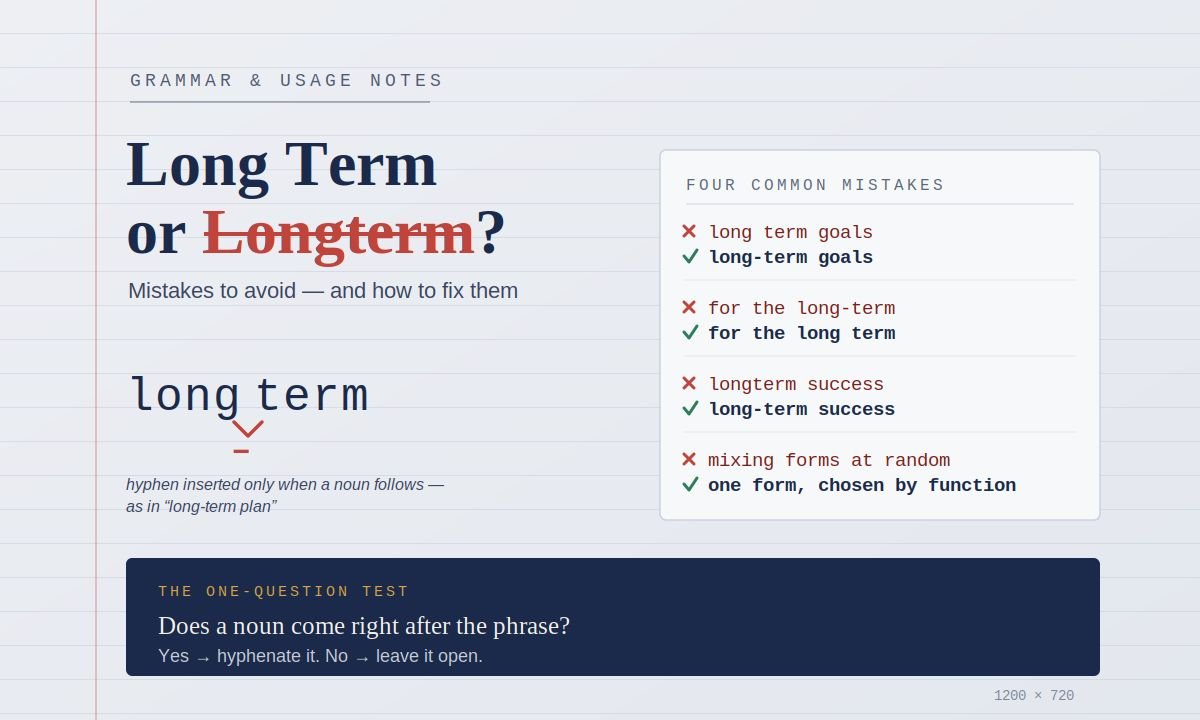
The Simple Test: Ask “Is a Noun Coming Right After?”
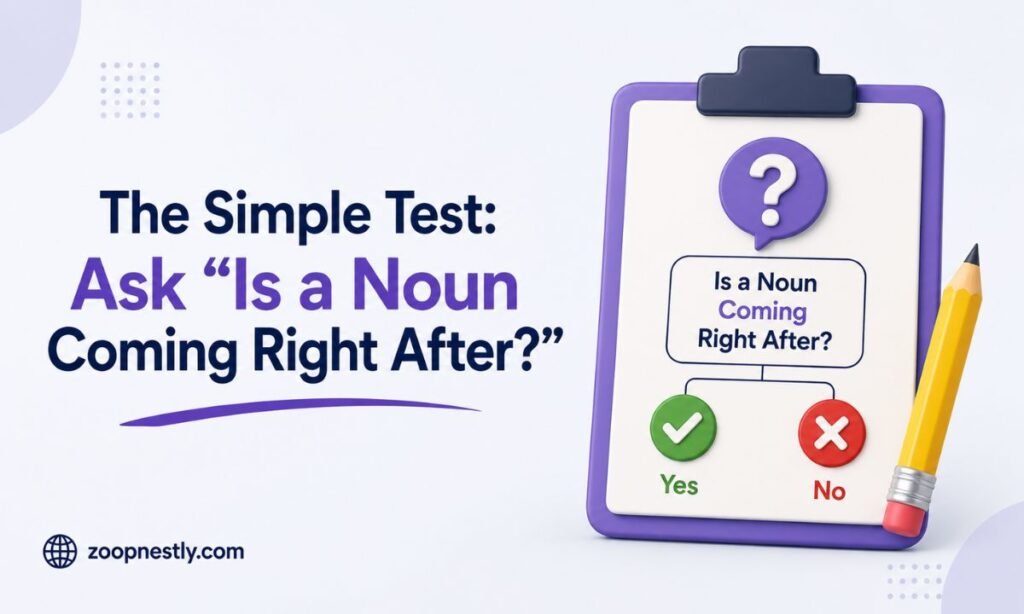
You don’t need to memorize grammar terms to get this right every time. Just ask one question: does a noun immediately follow the phrase?
- If yes, hyphenate it. → “long-term plan”
- If no, leave it open. → “planning for the long term“
This single test resolves almost every case you’ll run into, whether you’re writing an email, an essay, or a business plan.
Real-World Examples by Context
Seeing the rule applied across different fields makes it stick faster.
Business: The startup needs a long-term strategy to survive its first five years, but leadership also has to manage the short term without burning out the team.
Finance: Financial advisors often say the long term rewards patience, which is why a long-term investment portfolio usually outperforms frequent trading.
Healthcare: Chronic conditions sometimes require long-term care, and patients are told to think about their health in the long term, not just this week.
Relationships: Couples discussing a long-term commitment are really asking whether they see each other in their long term.
Common Mistakes to Avoid
Mistake 1: Dropping the hyphen before a noun Wrong: long term goals Right: long-term goals
Mistake 2: Adding a hyphen when it’s not needed Wrong: We’re planning for the long-term. Right: We’re planning for the long term.
Mistake 3: Writing it as one solid word Wrong: longterm success Right: long-term success
Mistake 4: Switching forms within the same document Pick the correct form each time based on function, don’t just copy whatever you used in the last paragraph. Consistency matters, but accuracy matters more.
Does This Rule Apply to Similar Compound Words?
Yes. This same noun-versus-adjective pattern applies to plenty of other compound time and duration phrases, which is genuinely useful to know once instead of relearning it every time:
- short term / short-term (works exactly the same way)
- full time / full-time
- part time / part-time
- long standing / long-standing
If you can apply the “noun right after” test to long term, you already know how to handle all of these.
What Style Guides and Dictionaries Say
Major dictionaries and widely used style guides, including those followed in journalism and academic writing, consistently treat this phrase the same way: open when it’s a noun, hyphenated when it’s an adjective before a noun. None of the major references list “longterm” as a standard alternate spelling. If you’re writing anything formal, professional, or published, sticking to the two recognized forms is the safer choice.
Merriam-Webster confirms “long-term” as the standard adjective form .
A Quick Mental Shortcut
If you’re still unsure mid-sentence, try this shortcut: say the sentence out loud and see if “long term” could be replaced with just “time” or “the future.” If it fits smoothly as a standalone idea, leave it open. If instead it feels like it’s describing the very next word, like an adjective glued to a noun, add the hyphen. This shortcut works because compound adjectives function as a single descriptive unit right before what they modify.
Frequently Asked Questions
Is “longterm” ever correct?
No. Longterm as one solid word isn’t recognized by standard dictionaries or style guides. Always use either long term (two words) or long-term (hyphenated), depending on how it functions in your sentence.
Is “long-term” one word or two?
Long-term is technically two words joined by a hyphen when used as an adjective before a noun, such as “long-term goals.” It is never written as a single solid word without the hyphen.
What is a synonym for “long-term”?
Depending on context, synonyms include extended, lasting, enduring, ongoing, or prolonged. For example, “long-term care” could be rephrased as “extended care” in some contexts.
Does Grammarly flag “longterm” as incorrect?
Grammar checking tools generally flag longterm as a spelling or usage error and suggest either long term or long-term, since neither major dictionaries nor style guides recognize it as a standard word.
How do I know if I need a hyphen with “long term”?
Check whether a noun immediately follows the phrase. If it does, hyphenate it, as in “long-term plan.” If the phrase stands alone or follows a preposition like “in” or “for,” leave it open, as in “in the long term.”
Final Takeaway
The rule behind long term or longterm comes down to one simple check: is the phrase describing a noun right next to it, or standing on its own as a noun itself? Get that answer right, and you’ll never second-guess the hyphen again. Skip “longterm” altogether, since it isn’t a recognized word in standard English, and your writing will read cleaner and more polished no matter where it shows up.

James Walker is a content writer and language researcher with over 5 years of experience in meanings, definitions, and language-related topics. He enjoys simplifying complex terms into clear, easy-to-understand explanations. Through ZoopNestly.com, he helps readers find accurate and reliable information.