All Is Well vs All Is Good: The Complete Usage Guide
You type out a quick reply to a friend checking in on you. Your fingers hover over the keyboard. Should you say “all is well” or “all is good”? Both feel right, yet only one seems to fit the moment. This tiny hesitation trips up more people than you’d expect, especially when writing something formal like an email. The good news is the choice between all is well or all is good comes down to a few clear rules, not guesswork.
Quick Answer
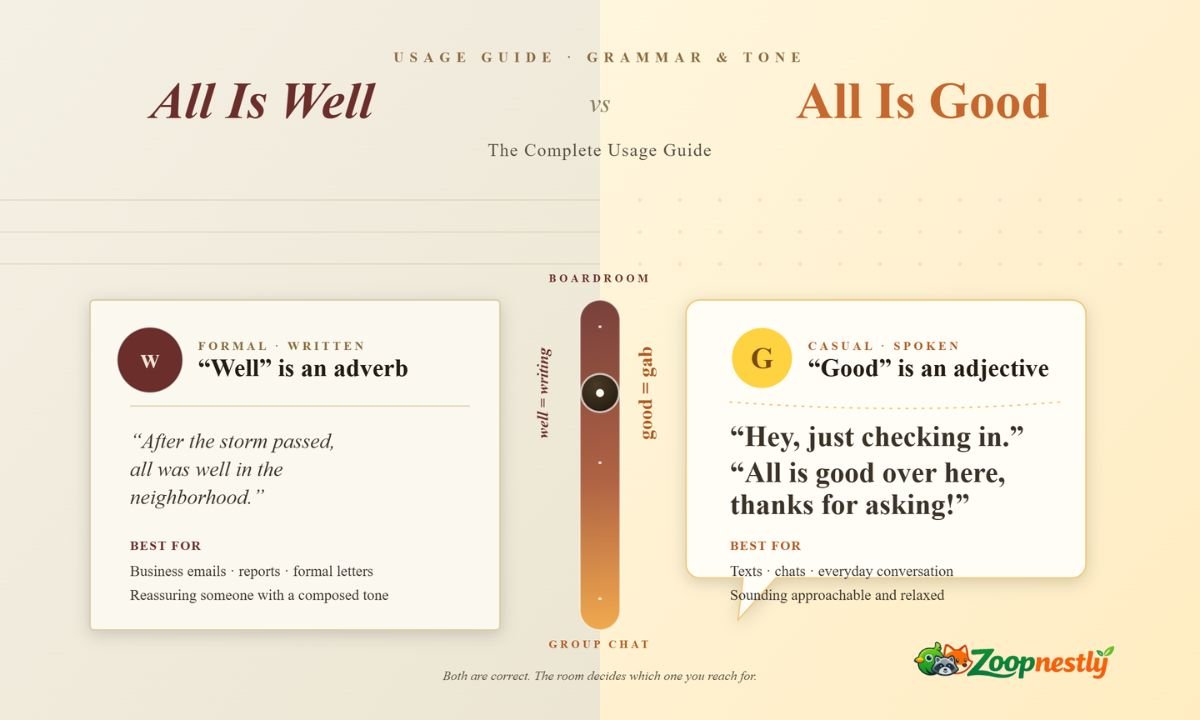
All is well is grammatically traditional and fits formal or written contexts, since “well” functions as an adverb describing a state of being. All is good is more casual and widely accepted in spoken English, where “good” acts as an adjective meaning satisfactory or fine. Both phrases are correct; the difference lies in tone and setting, not accuracy.
What “All Is Well” Actually Means
“All is well” is a classic, slightly formal way of saying that everything is in order. It has been used in English for centuries, showing up in literature, formal letters, and even the well-known phrase “all’s well that ends well.” The word “well” here works as an adverb, matching the grammatical pattern most style guides consider correct after a linking verb like “is.”
Think of it as the version you’d use in a status update to your boss or a note to reassure someone that a situation is under control. It carries a calm, settled tone.
What “All Is Good” Actually Means
“All is good” delivers the same basic message but in a more relaxed, conversational package. “Good” is technically an adjective, and some traditional grammarians argue it should follow a linking verb only when describing a noun’s quality, not a general state. Still, this phrase is everywhere in everyday speech, texting, and casual writing, and it sounds natural to native speakers.
If “all is well” is a firm handshake, “all is good” is a casual fist bump. Same message, different energy.
All Is Well or All Is Good: Key Differences
Here’s a side-by-side look to make the distinction easy to scan.
| Feature | All Is Well | All Is Good |
| Grammar role | “Well” is an adverb | “Good” is an adjective |
| Tone | Formal, traditional | Casual, conversational |
| Best for | Business emails, formal writing | Texts, chats, everyday speech |
| Common usage | Slightly less frequent today | Very common in modern English |
| Example | “All is well at the office.” | “All is good, thanks for asking.” |
The Grammar Behind the Two Phrases
The rule most grammar books point to involves linking verbs. Words like “is,” “seems,” or “feels” often connect the subject to a description of its condition, and traditionally that description takes an adjective, not an adverb. This is why “I feel good” is usually preferred over “I feel well” when talking about your general state, since “well” traditionally refers to health specifically.
“All is well” seems to break that pattern on the surface, but it survives because of long-standing usage and its idiomatic status. Language doesn’t always follow rules cleanly, and this phrase is a good example of tradition winning out over strict grammar logic.
When to Use “All Is Well”
Reach for “all is well” when:
- Writing something formal, like a report, letter, or professional email
- You want a slightly poetic or old-fashioned tone
- Referencing the well-known idiom “all’s well that ends well”
- Reassuring someone in a calm, composed way
Example: “After the storm passed, all was well in the neighborhood.”
When to Use “All Is Good”
Choose “all is good” when:
- Texting a friend or chatting casually
- Speaking out loud in everyday conversation
- You want the message to sound approachable and relaxed
- Responding quickly to a check-in message
Example: “Hey, just checking in.” “All is good over here, thanks!”
Example Sentences in Everyday Context

Seeing both phrases in action makes the difference easier to remember.
All is well:
- “The doctor confirmed all is well after the checkup.”
- “All is well on the home front.”
- “She wrote to say all was well despite the delay.”
All is good:
- “No worries, all is good between us.”
- “All is good with the new schedule.”
- “Just wanted to let you know all is good here.”
Notice how the “all is good” examples sound like something you’d say out loud, while “all is well” reads slightly more composed.
Common Mistakes People Make
A few habits trip up even confident writers.
- Overcorrecting in casual speech. Saying “all is well” in a text to a friend can sound stiff or oddly formal.
- Using “all is good” in formal documents. This can come across as too relaxed for business writing.
- Mixing the idiom incorrectly. The phrase is “all’s well that ends well,” not “all’s good that ends good.”
- Assuming one version is wrong. Both phrases are grammatically acceptable in modern English; context decides which fits better.
Formal Writing vs Casual Conversation
Context is really the deciding factor here, more than strict grammar. In formal writing, such as cover letters, official statements, or academic work, “all is well” tends to fit the expected tone. In casual writing and speech, “all is good” blends in naturally and doesn’t sound overly stiff.
If you’re ever unsure, picture the setting. A courtroom or boardroom leans toward “well.” A group chat leans toward “good.”
DISCOVER MORE : Do Not vs Don’t: What’s the Real Difference?
Regional and Everyday Usage Differences
In American English, “all is good” has become extremely common in daily conversation, partly through its heavy use in texting and social media. “All is well” still holds strong in written English and in more traditional or older-generation speech patterns. Neither version is regional in a strict dialect sense, but usage does shift depending on how formal the communication is and who’s writing it.
This is a good example of language evolving through common usage rather than rulebooks alone. Dictionaries and style guides increasingly note that both phrases are standard, even if their grammatical roots differ.
Simple Ways to Remember Which One to Use
Here are a few memory tricks that make the choice automatic over time:
- Well = writing. Both start with “w,” and “well” fits written, formal contexts.
- Good = gab. Both start with “g,” and “good” fits casual talk.
- If you’d say it in a text message, “good” usually works.
- If you’d print it on paper, “well” usually works.
Once one of these sticks, you won’t have to think twice again.
Related Phrases Worth Knowing

A few similar expressions carry the same underlying meaning and can add variety to your writing:
- “Everything is fine.”
- “All is in order.”
- “Things are okay on this end.”
- “Nothing to worry about here.”
Mixing these into conversation keeps your language from sounding repetitive, especially in longer messages or written updates.
Conclusion
Both all is well and all is good communicate the same reassuring message, just with a different level of formality. “All is well” leans traditional and fits polished writing, while “all is good” feels natural in everyday speech and casual messages. Once you match the phrase to the setting, the choice stops feeling like a grammar puzzle and starts feeling automatic.
Frequently Asked Questions
Is it grammatically correct to say “all is good”?
Yes. While “good” is technically an adjective, this phrase is widely accepted in modern English, especially in casual speech and writing.
Which phrase is more formal, “all is well” or “all is good”?
“All is well” is generally considered more formal and fits professional or written communication better than “all is good.”
Can I use “all is well” and “all is good” interchangeably?
In most everyday situations, yes. The meaning stays the same; only the tone shifts slightly depending on which one you choose.
Where does the phrase “all’s well that ends well” come from?
It’s a well-known idiom, popularized by the title of a Shakespeare play, meaning a difficult situation is fine as long as the outcome turns out okay.
Does “all is good” sound unprofessional in emails?
It can come across as a bit too casual in formal business emails, so “all is well” or a neutral alternative like “everything is fine” is often a safer choice in that setting.

James Walker is a content writer and language researcher with over 5 years of experience in meanings, definitions, and language-related topics. He enjoys simplifying complex terms into clear, easy-to-understand explanations. Through ZoopNestly.com, he helps readers find accurate and reliable information.