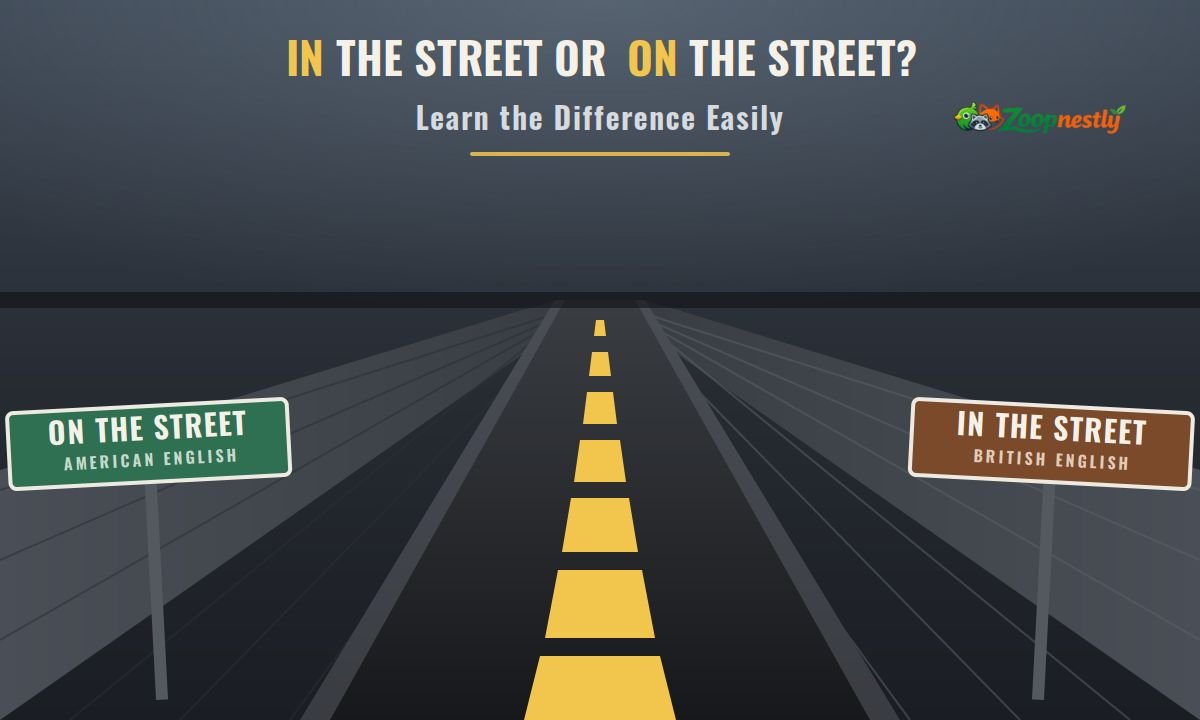
In the Street or On the Street? Learn the Difference Easily
Ever typed a sentence, paused, and stared at it wondering if you picked the wrong preposition? You’re not alone. The phrase in the street or on the street trips up even confident English speakers, because both versions sound correct in casual conversation. The problem is that using the wrong one can quietly change your meaning or make your writing feel off to a native reader. Once you know the rule, though, you’ll never second-guess it again.
Quick Answer
On the street is the standard American English choice and simply means “outside, in a public area near the road.” In the street is more common in British English and can also mean “physically standing on the road’s surface,” which sometimes implies danger. In everyday US writing, stick with on the street unless you specifically mean someone is standing in the roadway.
In the Street vs On the Street: The Core Difference
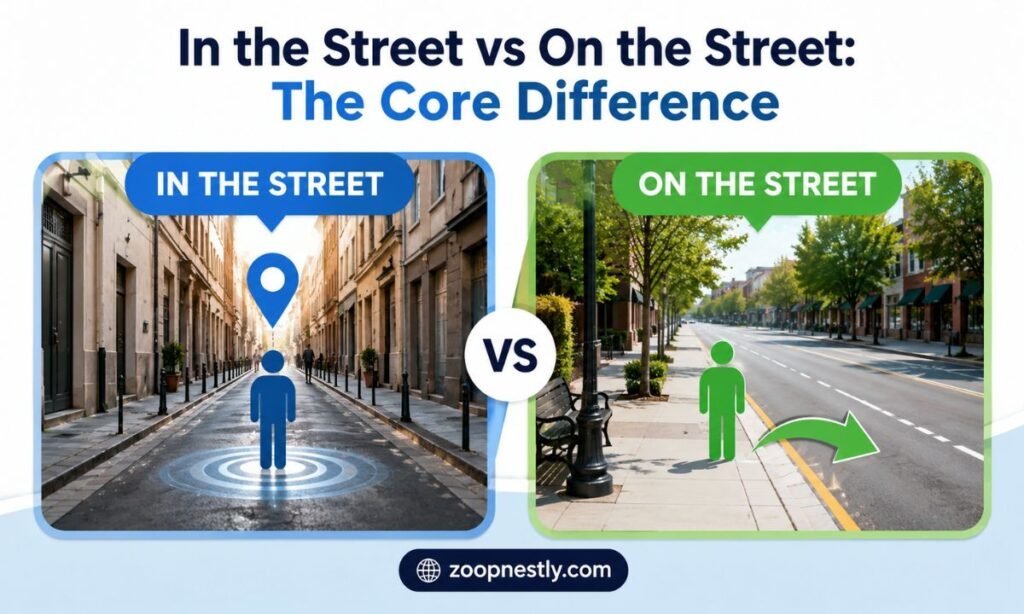
The difference comes down to two things: which English dialect you’re using and what you’re actually describing.
In American English, “on the street” is the default. It describes anything happening in a public outdoor area, a neighborhood, or along a road, without suggesting the person is literally standing on the asphalt.
In British English, “in the street” carries that same everyday meaning. A British speaker might say “I saw her in the street” the same way an American says “I saw her on the street.”
But there’s a second layer. In both dialects, “in the street” can also describe someone who is physically inside the roadway itself, often where cars drive. That version usually shows up in warnings or safety contexts, like telling a child not to play where vehicles pass.
So the choice isn’t random. It depends on your audience and your intended meaning.
DISCOVER MORE : Reevaluation vs Re-evaluation: Which Form Should You Use?
When to Use “On the Street”
Use on the street when you mean:
- A general public location (a shop, a person, an event happening outdoors)
- Something located along a specific road
- A casual, everyday reference to being outside
Examples:
- “There’s a great coffee shop on the street near my apartment.”
- “I ran into my old neighbor on the street yesterday.”
- “The parade moved slowly on the street downtown.”
This is the version most American readers expect, and it works for nearly every everyday situation.
When to Use “In the Street”
Use in the street when you mean:
- Someone is physically standing or walking on the road surface, not the sidewalk
- A British English speaker is describing a general outdoor location
- A safety warning about traffic or danger
Examples:
- “The kids were playing in the street, and a car had to stop.”
- “Don’t stand in the street, you’ll get hit.”
- (British English) “I bumped into an old friend in the street.”
Notice how the American safety-warning version and the British everyday version look identical on paper. Context tells you which meaning applies.
American English vs British English: Does the Rule Change?

Yes, and this is the biggest source of confusion. Dialect changes which phrase feels “default.”
| Region | Default Phrase | Typical Meaning |
| American English | on the street | General public/outdoor location |
| British English | in the street | General public/outdoor location |
| Both dialects | in the street | Literally standing on the road surface |
| Both dialects | on the street | Rarely used for “standing in traffic” |
If you’re writing for a US audience, business, or website, default to on the street. If you’re writing British fiction, dialogue, or content for a UK audience, in the street will sound more natural for general references.
Comparison Table: In the Street vs On the Street
| Feature | In the Street | On the Street |
| Common in | British English (general use), both dialects (literal road) | American English (general use) |
| Meaning | Standing on the road, or general location (UK) | General public location, near a road |
| Formality | Neutral to slightly literal | Neutral, everyday |
| Safety context | Often used in warnings | Rarely used this way |
| Example | “He was standing in the street.” | “The store is on the street corner.” |
Example Sentences in Real Context
Seeing the phrases in full sentences makes the difference easier to remember.
On the street (American, general):
- “There are food trucks on the street every Friday.”
- “She lives on the street behind the library.”
In the street (literal, road surface):
- “A dog ran in the street and nearly caused an accident.”
- “Never leave your bike in the street overnight.”
In the street (British, general):
- “I met my teacher in the street this morning.”
- “There was a small crowd gathered in the street.”
Common Mistakes with Street Prepositions
A few mistakes show up again and again, even among fluent speakers.
Mistake 1: Using “in the street” for a general US location. Incorrect: “The bakery is in the street next to the bank.” Correct: “The bakery is on the street next to the bank.”
Mistake 2: Using “on the street” to describe danger. Incorrect: “Get out of on the street, a car is coming!” Correct: “Get out of the street, a car is coming!” (Note: in urgent warnings, English speakers often drop the preposition entirely and just say “the street.”)
Mistake 3: Mixing dialects inconsistently. If you’re writing one article, email, or story, stay consistent. Switching between American and British phrasing mid-text looks like an error, even when both forms are technically correct.
Mistake 4: Confusing “on the street” with “on street.” “On street parking” is a compound adjective used before a noun (as in “on-street parking”), which is different from the phrase “on the street” used in a sentence.
Other Prepositions Used with “Street”
“In” and “on” aren’t the only options. Knowing these helps you avoid overusing the same two phrases.
- Down the street: movement or distance (“The pharmacy is just down the street.”)
- Along the street: describing something stretched out (“Trees line the sidewalk along the street.”)
- Across the street: location on the opposite side (“The bank is across the street from my office.”)
- Up the street: similar to “down the street,” direction-based
These alternatives are useful when “in” or “on” doesn’t quite fit what you’re describing.
How to Remember In the Street vs On the Street
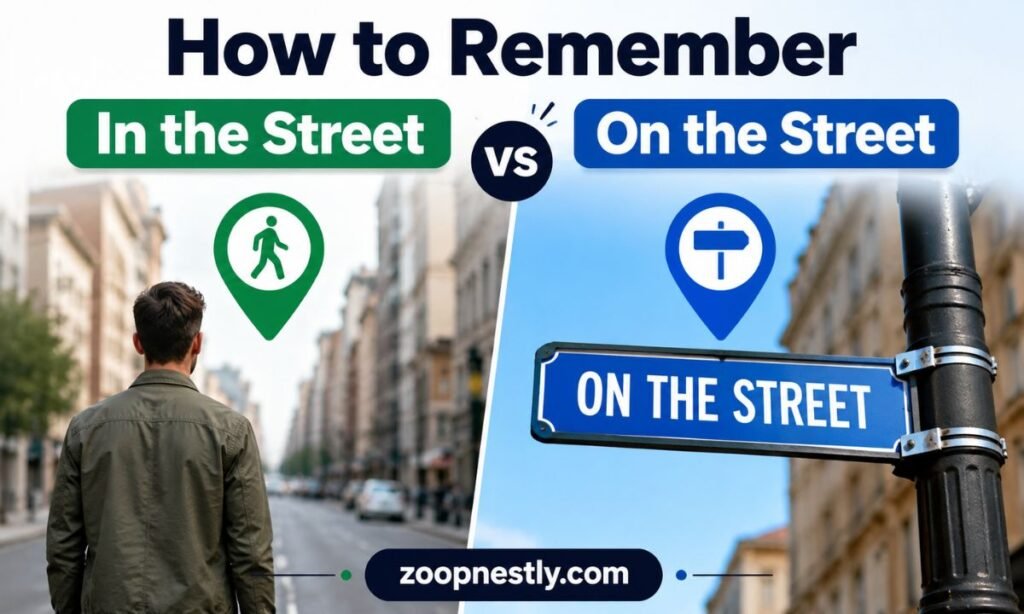
Here’s a simple trick that sticks:
“On” is for outside. “In” is for inside the road.”
If you picture the sidewalk, a shop, or a general neighborhood scene, that’s the on the street picture for American English. If you picture someone standing between painted lane lines with cars nearby, that’s the in the street picture, no matter which dialect you speak.
For British English learners, simply remember that “in the street” replaces the American “on the street” for everyday use, and the literal, road-surface meaning still applies on top of that.
Why Context Matters More Than Memorization
English prepositions rarely follow one rigid rule. The same words can shift meaning depending on the sentence around them. Instead of memorizing a strict formula, ask yourself two quick questions before you write:
- Am I talking about a general public area, or literally the road surface?
- Am I writing for an American or British audience?
Answering those two questions almost always points you to the correct phrase.
FAQs
Is it “in the street” or “on the street” in American English?
American English almost always uses on the street for general references. In the street is reserved for describing someone literally standing on the road surface, often in a warning.
Is “in the street” grammatically correct?
Yes. It’s correct in both American and British English, but the meaning shifts. In British English it’s a common everyday phrase, while in American English it usually implies standing in the actual roadway.
Why do British and American speakers use different prepositions here?
This is simply a dialect difference, similar to “on the weekend” versus “at the weekend.” Neither version is wrong, they’re regional preferences that developed over time.
What does “in the street” mean in Cambridge Dictionary style definitions?
Standard dictionary definitions typically list “in the street” as the British English form for general location, and note that American English favors “on the street” for the same meaning.
Can I use “in the street” and “on the street” interchangeably?
Not always. If you’re writing for a US audience, they aren’t interchangeable, since “in the street” implies literal road placement. If you’re writing British English, “in the street” works for general use just like “on the street” does in the US.
Conclusion
The choice between in the street or on the street isn’t about right versus wrong. It’s about dialect and precise meaning. American English leans on “on the street” for everyday references and saves “in the street” for literal, road-surface situations. British English uses “in the street” for both. Once you match your phrase to your audience and your intended meaning, this small grammar detail stops being a source of hesitation and becomes second nature.

James Walker is a content writer and language researcher with over 5 years of experience in meanings, definitions, and language-related topics. He enjoys simplifying complex terms into clear, easy-to-understand explanations. Through ZoopNestly.com, he helps readers find accurate and reliable information.