City vs Town vs Village: What’s the Real Difference Explained
You’re filling out a form, writing a school report, or just describing your hometown to someone new, and you pause. Do you call it a city, a town, or a village? Most people use these words interchangeably, but they actually mean different things. That confusion can lead to real mistakes in writing, legal documents, and even casual conversation. The good news is that city vs town vs village comes down to a handful of clear factors: population, government structure, and infrastructure.
Quick Answer
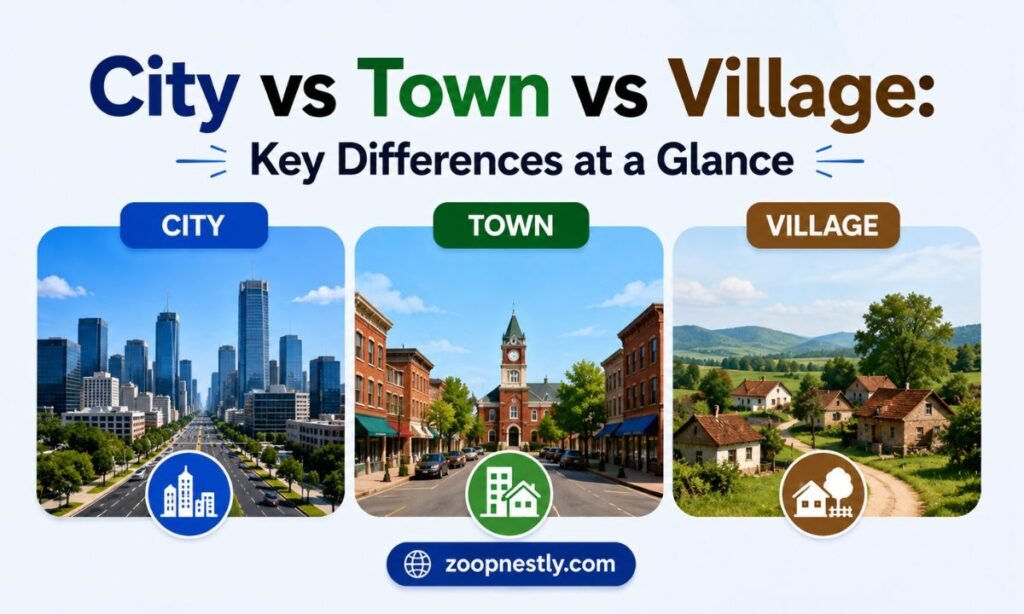
A city is a large, densely populated settlement with formal government, extensive infrastructure, and legal status granted by a state or country. A town is mid-sized, with some local government and basic services but less complexity than a city. A village is small, rural, and usually informal, with limited infrastructure and a close-knit community. The main differences are population size, governance, and available services.
Why These Terms Get Confused
Part of the problem is that there’s no single global rulebook. A “city” in the United Kingdom might have fewer people than a “town” in Texas. Legal definitions vary by country, and everyday speech doesn’t always match official classifications. People also use these words loosely in casual conversation, calling any place with a downtown a “city” even if it technically isn’t one. Understanding the actual criteria clears up most of the confusion fast.
City vs Town vs Village: Key Differences at a Glance
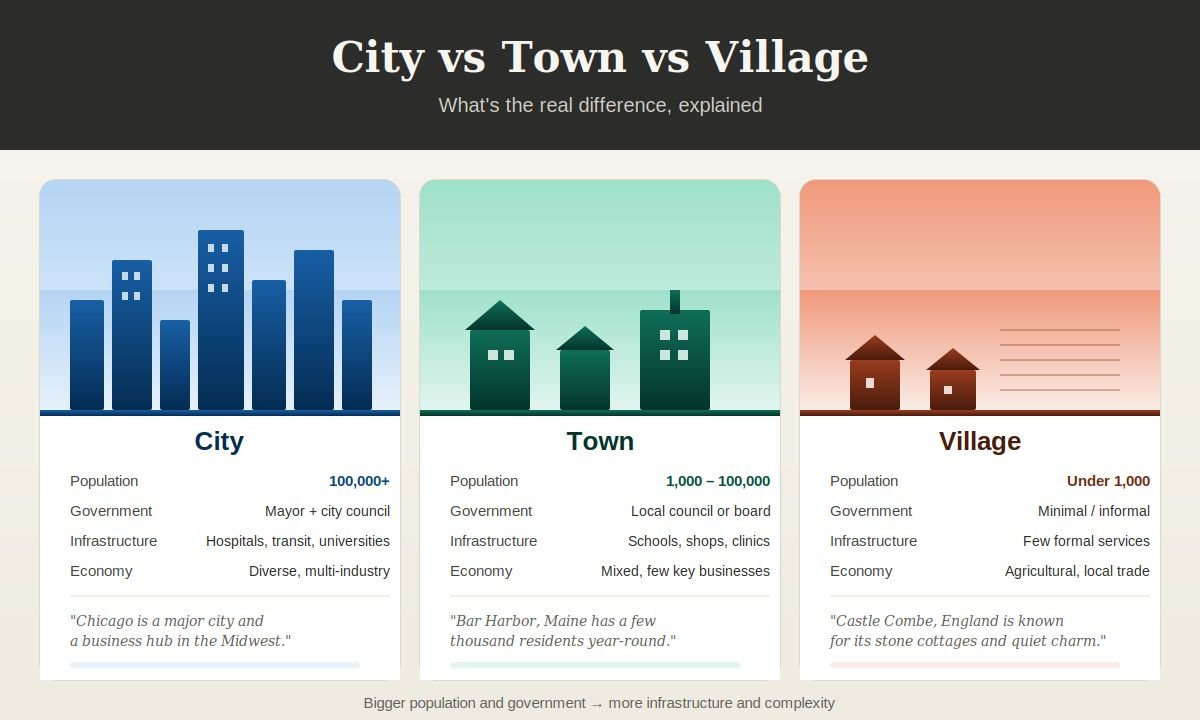
| Feature | City | Town | Village |
| Population | Typically 100,000+ (varies by country) | Roughly 1,000 to 100,000 | Usually under 1,000 |
| Government | Full municipal government, mayor, city council | Local council or town board | Minimal or informal governance |
| Infrastructure | Hospitals, universities, public transit, business districts | Basic schools, shops, some public services | Few formal services, often relies on nearby town or city |
| Economy | Diverse, multiple industries | Mixed, often centered on a few key businesses | Mostly agricultural or small-scale local trade |
| Legal status | Requires charter or official designation in most countries | May or may not need formal incorporation | Rarely has independent legal status |
This table is a general guide, not a strict rule. Exact thresholds shift depending on where you are in the world, which we’ll cover shortly.
What Is a City?
A city is the largest and most complex type of settlement. It typically has a high population density, a formal government with elected officials, and infrastructure built to support large numbers of people, think hospitals, universities, airports, and public transportation systems. In many countries, a settlement only becomes a “city” once it receives official recognition, often called a charter.
Cities also tend to have diverse economies. Instead of relying on one industry, a city usually has a mix of finance, technology, healthcare, education, and manufacturing sectors working together.
Example sentence: “Chicago is a major city known for its architecture and its role as a business hub in the Midwest.”
What Is a Town?
A town sits between a village and a city in both size and complexity. It usually has a local government, though it’s often smaller and less bureaucratic than a city’s. Towns have basic infrastructure like schools, grocery stores, medical clinics, and local businesses, but they lack the scale of a full city.
Towns often serve as hubs for surrounding rural areas. People from nearby villages might travel to the nearest town for shopping, healthcare, or schooling.
Example sentence: “The town of Bar Harbor, Maine, has a permanent population of just a few thousand people but swells with tourists each summer.”
What Is a Village?
A village is the smallest and most rural type of settlement discussed here. It’s typically home to a small, tight-knit community with limited formal infrastructure. Villages often rely on farming, fishing, or small-scale trade, and residents may need to travel to a nearby town or city for services like hospitals or higher education.
Villages usually don’t have independent legal status. Instead, they may fall under the administrative umbrella of a larger town or county.
Example sentence: “The village of Castle Combe in England is known for its stone cottages and quiet, unpaved charm.”
Population Thresholds Around the World
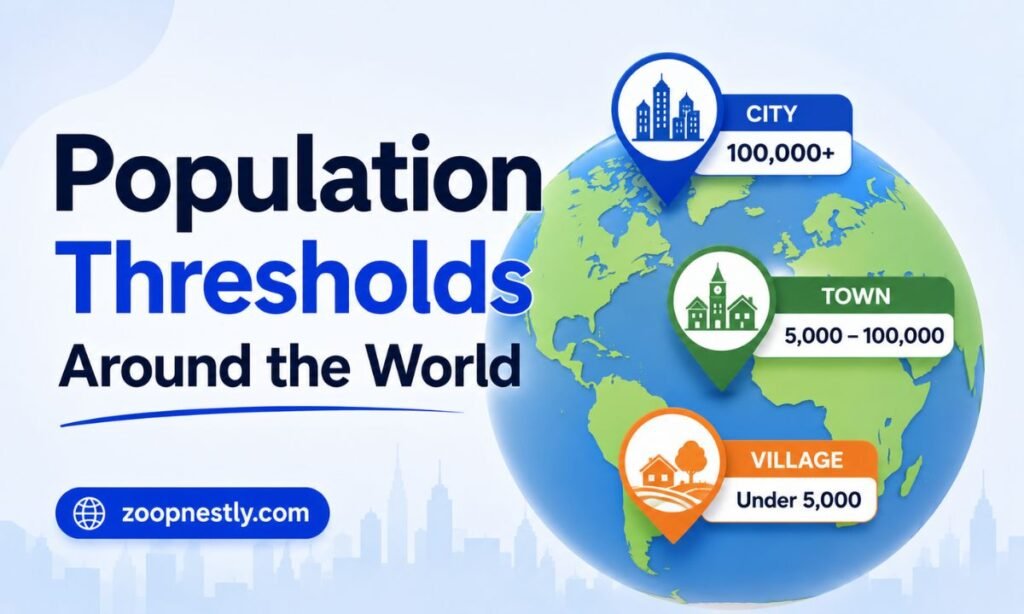
Population is the most common factor people use to tell these settlements apart, but the exact numbers differ by country.
United States
There’s no single federal rule. Each state defines “city,” “town,” and “village” differently. In New York, a village is a small incorporated area within a town, while in other states, “town” and “village” are used almost interchangeably.
United Kingdom
In the UK, city status is granted by the monarch and isn’t strictly about population. Some UK cities have fewer residents than large towns. Historically, having a cathedral was a common (though not universal) marker of city status.
Other Countries
In many parts of Europe and Asia, population thresholds are more standardized. For example, some countries set a minimum population (like 10,000 or more) for a settlement to be legally called a city, while smaller numbers apply to towns and villages. Because there’s no international standard, always check local definitions when precision matters.
DISCOVER MORE : Mine As Well vs Might As Well vs Mind As Well: The Correct Usage Explained
Government and Administrative Differences
Beyond population, governance is one of the clearest ways to separate these three terms.
- Cities usually have a mayor, a city council, and departments handling police, fire services, zoning, and utilities.
- Towns often have a smaller governing board or council, sometimes called a town board or parish council, with fewer formal departments.
- Villages frequently lack independent government entirely and are managed as part of a larger municipal or county structure.
This matters for things like voting, taxation, and public services. Knowing whether you live in an incorporated town or an unincorporated village can affect everything from your property taxes to who picks up your trash.
Infrastructure and Lifestyle Differences
Infrastructure tends to scale directly with settlement size. Cities offer public transit, multiple schools, hospitals, and entertainment options. Towns typically have the basics: a school, a few shops, maybe a clinic, but residents often drive to a nearby city for specialized needs. Villages may have a general store or a small church, but residents usually rely on a nearby town for groceries, healthcare, or fuel.
Lifestyle follows a similar pattern. City life tends to be faster paced with more anonymity, town life offers a balance of convenience and community, and village life is typically slower, quieter, and built around close relationships between neighbors.
City vs Town vs Village vs Hamlet: Where Do Hamlets Fit?
A hamlet is even smaller than a village. It’s usually a cluster of homes without its own church, school, or local government. Hamlets often exist within the boundaries of a larger village or town and may not even have an official name recognized on all maps. Think of the settlement hierarchy this way:
City → Town → Village → Hamlet
Each step down represents a smaller population, simpler infrastructure, and less formal governance.
Common Mistakes People Make
- Assuming population alone decides the label. Governance and legal status matter just as much, especially in the UK, where city status isn’t population-based.
- Using “city” for any urban-feeling place. A place can feel busy without meeting the legal or population criteria for a city.
- Mixing up US and UK rules. A “town” in the US context doesn’t follow the same rules as a “town” in the UK.
- Ignoring local legal definitions. For official writing, always check how the specific state or country defines these terms rather than assuming a general rule applies.
How to Choose the Right Word in Writing
When you’re not sure which term to use, ask three quick questions: How many people live there? Does it have its own local government? What level of infrastructure does it have? If you’re still unsure, check the settlement’s official designation, many places list this on government or municipal websites. For casual writing, matching how locals refer to their own community is usually a safe bet.
Frequently Asked Questions
What is the main difference between a city, town, and village?
The main differences are population size, government structure, and infrastructure. Cities are the largest and most developed, towns are mid-sized with basic services, and villages are small and mostly rural.
Can a village become a town or city over time?
Yes. As population grows and infrastructure develops, a village can be reclassified as a town, and a town can eventually become a city if it meets the legal requirements in its country or state.
Is there a universal population number that defines a city?
No. There’s no single global standard. Population thresholds vary by country, and some places, like the UK, don’t base city status on population at all.
What’s smaller than a village?
A hamlet is typically smaller than a village. It usually lacks its own church, school, or formal governance and often exists within a larger village or town’s boundaries.
Why does the city vs town vs village distinction matter?
It matters for legal, administrative, and practical reasons, including taxation, voting districts, census data, and accurate writing in reports, travel content, or official documents.
Conclusion
Understanding city vs town vs village isn’t just about picking the “right sounding” word. It comes down to real differences in population, government, and infrastructure that vary depending on where you are in the world. Once you know what to look for, choosing the correct term becomes second nature, whether you’re writing a report, filling out a form, or just describing where you’re from.

James Walker is a content writer and language researcher with over 5 years of experience in meanings, definitions, and language-related topics. He enjoys simplifying complex terms into clear, easy-to-understand explanations. Through ZoopNestly.com, he helps readers find accurate and reliable information.