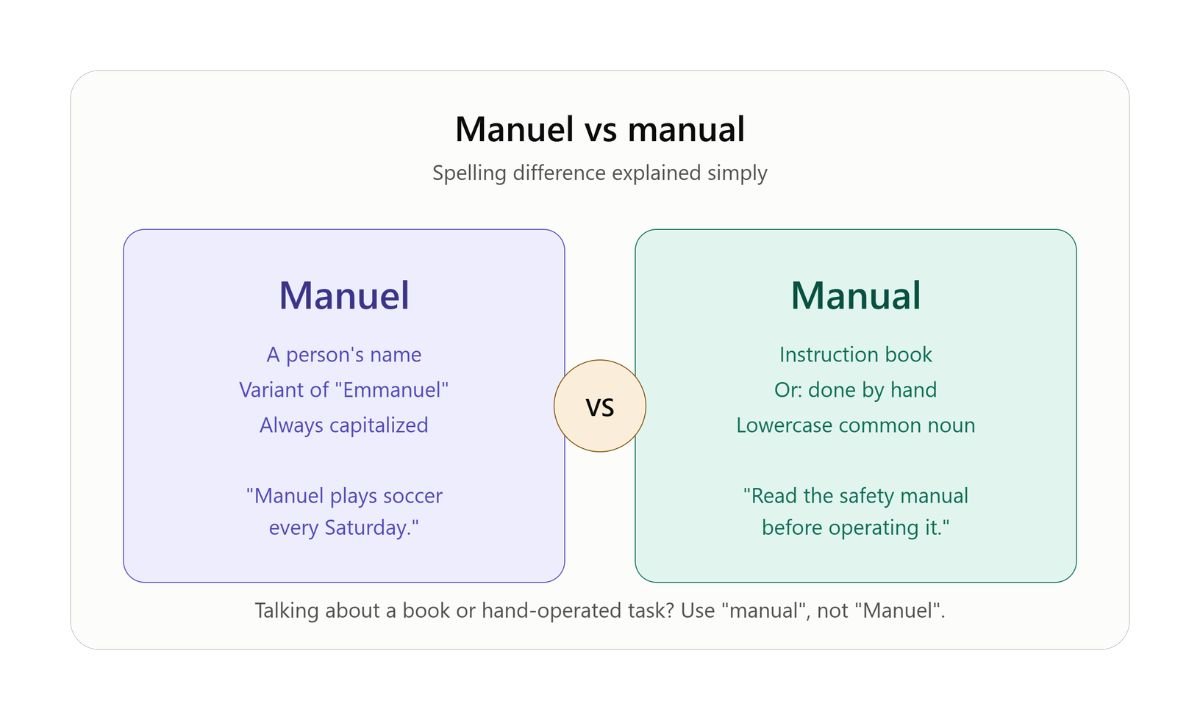
Manuel vs Manual: Spelling Difference Explained Simply
You typed a quick email, hit send, and then it hit you: did you write “Manuel” or “Manual”? It happens more often than people admit. The confusion between Manuel vs Manual trips up even careful writers because the words look and sound almost identical. One mix-up in a formal document or resume can make you look careless. This guide clears up the confusion for good, with simple rules you’ll actually remember.
Quick Answer
Manual is an English word that means a handbook of instructions, or something done by hand rather than by machine. Manuel is a personal name, a variant of “Emmanuel,” and is not a standard English word. If you’re describing a guide, a process, or a hand-operated task, you want manual, not Manuel.
Manuel vs Manual at a Glance
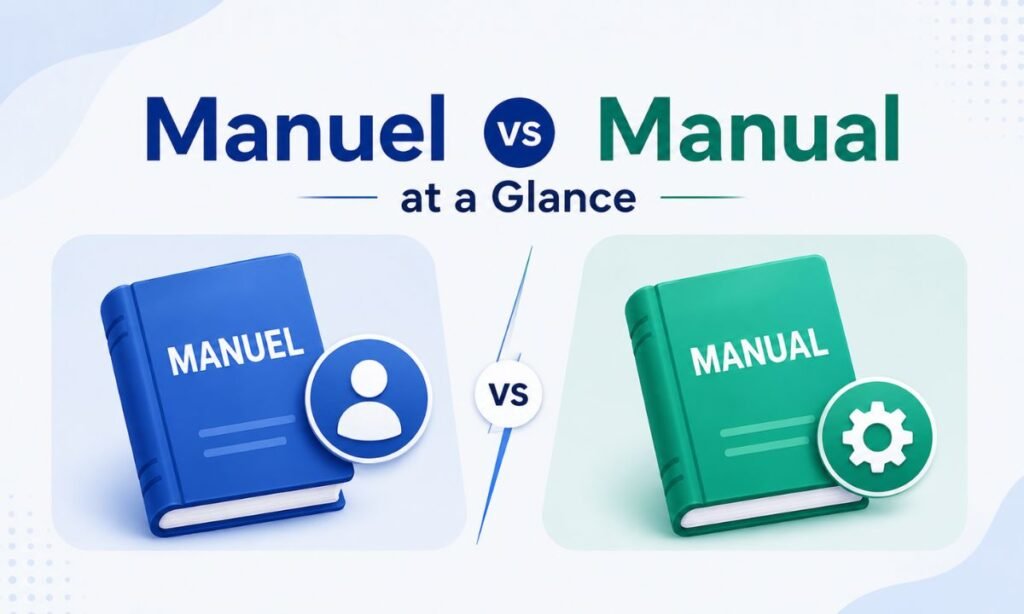
Here’s a side-by-side breakdown before we dig into the details.
| Feature | Manual | Manuel |
| Part of speech | Noun / Adjective | Proper noun (name) |
| Meaning | Instruction book; done by hand | A person’s first name |
| Common use | Writing, tech, workplaces | Introductions, names, biographies |
| Capitalized? | Only at sentence start | Always capitalized |
| Correct in formal writing? | Yes, when referring to guides or hand-operated tasks | Only when referring to a specific person named Manuel |
What Does Manual Mean?
Manual functions as both a noun and an adjective, and the meaning shifts depending on how it’s used in a sentence.
Manual as a Noun
As a noun, a manual is a book or document that explains how to use, operate, or assemble something. Think of the booklet that comes with a new blender or the guide your employer hands you on your first day.
Examples:
- “Check the owner’s manual before changing the oil.”
- “The IT department updated the training manual last month.”
- “She lost the manual for her sewing machine years ago.”
Manual as an Adjective
As an adjective, manual describes something operated by hand rather than by an automated system, or work that requires physical effort.
Examples:
- “He prefers manual transmission over automatic.”
- “The job involves a lot of manual labor.”
- “This door has a manual lock, not a keypad.”
What Does Manuel Mean?
Manuel is a given name, most common in Spanish, Portuguese, and French-speaking cultures. It’s a shortened form of “Emmanuel,” a name with Hebrew roots meaning “God is with us.” Manuel is not a recognized English word outside of its use as a name, so it never substitutes for “manual” in standard writing.
Examples:
- “Manuel moved to Chicago last spring.”
- “My neighbor’s name is Manuel, and he runs a bakery downtown.”
Why People Confuse Manuel and Manual
The mix-up isn’t random. A few real reasons explain why this error keeps showing up in writing.
- They look almost identical. Only one letter separates them, so a quick glance (or a quick typo) is easy to miss.
- Autocorrect doesn’t always catch it. Since Manuel is a valid name, spell-check tools often let it pass without flagging anything.
- Pronunciation overlap. In casual speech, especially with a fast pace or an accent, the two words can sound close enough to blur together.
- Familiarity with the name. If you know someone named Manuel, your brain may default to that spelling out of habit.
The Most Common Mistake: Writing Manuel Instead of Manual
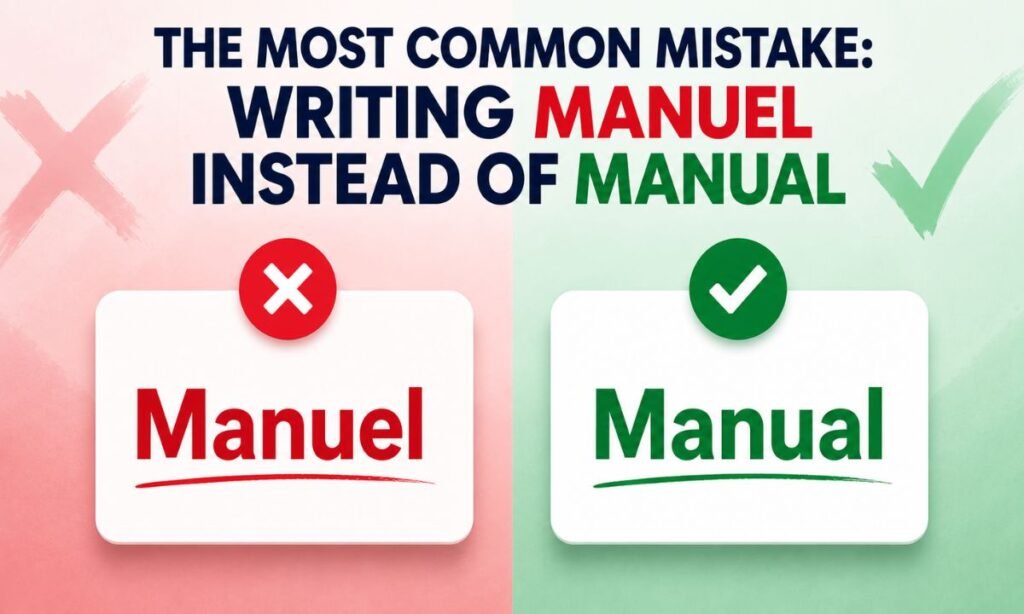
This is the error that causes the most confusion in professional and academic writing.
Incorrect: “Please refer to the Manuel for setup instructions.”
Correct: “Please refer to the manual for setup instructions.”
Unless you’re literally talking about a person named Manuel, the word you need is almost always “manual.” This mistake shows up often in resumes, technical documents, and customer support messages, where it can undercut the writer’s credibility.
DISCOVER MORE : Nominator vs Nominee: How Are They Different?
Manuel vs Manual in Real Sentences
Seeing both words used correctly, side by side, makes the difference stick.
Using Manuel (the name):
- “Manuel plays soccer every Saturday.”
- “I asked Manuel to help me move the couch.”
Using Manual (the word):
- “The technician recommended a manual reset of the router.”
- “Read the safety manual before operating the machine.”
Manual vs Automatic: A Related Mix-Up
While we’re on the topic, it’s worth clearing up a nearby point of confusion: manual versus automatic. Manual means something is controlled directly by a person, while automatic means it runs on its own with little or no human input. A manual car requires the driver to shift gears; an automatic car does it for you. This distinction matters in cars, machinery, cameras, and software settings, where “manual mode” usually means you’re in control instead of the system.
Where You’ll See the Word “Manual” in Everyday Life
Understanding the contexts where “manual” shows up helps reinforce the correct spelling.
Technology and software: User manuals explain how to set up devices, troubleshoot errors, or use specific features. Many software programs also include a “manual” or “advanced” setting that lets users override automatic defaults.
Automotive industry: Cars with a manual transmission require the driver to operate the clutch and gearshift, as opposed to automatic vehicles that handle gear changes on their own.
Workplace training: Employee handbooks are often called training manuals. These documents outline procedures, safety rules, and company policies.
Physical labor: Jobs described as “manual work” typically involve using your hands or body, such as construction, farming, or warehouse tasks.
Easy Tricks to Remember the Correct Spelling
If the two words still trip you up, try one of these memory tricks.
- Think “hand.” Manual relates to hands (as in “manu,” the Latin root for hand), while Manuel relates to a name. No hands involved in a name.
- Say it slowly. Manual ends in “-al,” like normal, formal, and casual. Manuel ends in “-el,” like a person’s name would.
- Check the context first. Ask yourself: am I talking about a book, a hand-operated task, or a specific person? That answers the question instantly.
Other English Words People Mix Up in Similar Ways
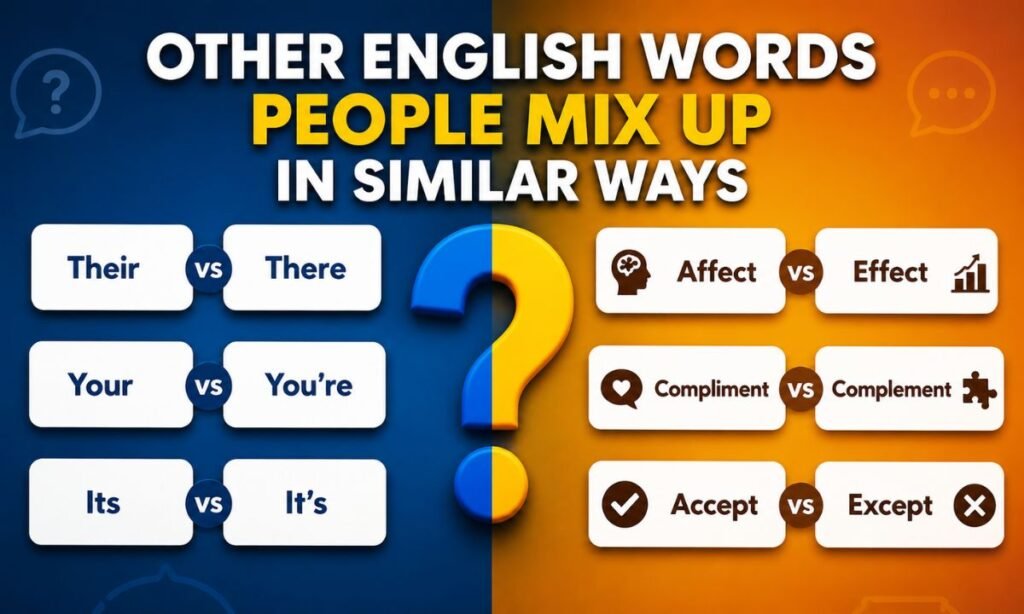
Manuel and Manual aren’t the only pair that causes confusion because of a shared root or similar spelling. A few common ones worth knowing:
- Personal vs. Personnel — one describes something private, the other refers to staff or employees.
- Complement vs. Compliment — one means “to complete,” the other means “to praise.”
- Principal vs. Principle — one refers to a person or amount, the other to a rule or belief.
Recognizing this pattern can help you spot similar spelling traps before they end up in your writing.
Why Getting the Spelling Right Actually Matters
A small spelling slip might seem harmless, but in professional writing, it can create real problems. Using “Manuel” instead of “manual” in a resume, report, or customer message can make readers question your attention to detail. In technical writing especially, precision builds trust. Readers assume that if you got a simple word wrong, other details in the document might be off too. Taking a few extra seconds to proofread protects your credibility.
Frequently Asked Questions
Is Manuel a real English word?
No. Manuel is a personal name used mainly in Spanish, Portuguese, and French-speaking communities. It is not a standard English noun or adjective, so it should never replace “manual” in general writing.
What is the correct spelling: Manuel or Manual book?
The correct term is manual, not “Manuel book.” A manual is a book of instructions, so the correct phrase would be “instruction manual” or simply “manual.”
Can “manual” be used as a verb?
No, manual is not a verb in standard English. It functions only as a noun (an instruction book) or an adjective (done by hand). There is no verb form like “to manual.”
What does “manual instruction” mean?
“Manual instruction” typically refers to written guidance found inside a manual, or to instructions for completing a task by hand rather than with automated tools. It’s often used interchangeably with “manual” as a noun.
Why does spell-check not flag “Manuel” as an error?
Spell-check tools recognize Manuel as a valid name, so they won’t flag it even when you meant to type “manual.” This is exactly why proofreading by eye still matters, especially in formal or technical writing.
Final Thoughts
The difference between Manuel vs Manual comes down to one simple check: are you naming a person, or describing a guide, a hand-operated task, or something done without automation? Manuel is a name. Manual is the word you need for instructions, hands-on work, and non-automatic systems. Keep that distinction in mind, and this common typo won’t catch you off guard again.

James Walker is a content writer and language researcher with over 5 years of experience in meanings, definitions, and language-related topics. He enjoys simplifying complex terms into clear, easy-to-understand explanations. Through ZoopNestly.com, he helps readers find accurate and reliable information.