Dysregulated vs Disregulated: Which One Is Actually Correct?
You’re halfway through an email or a therapy note, you type the word, and something feels off. Is it dysregulated or disregulated? Both look plausible. Both sound like they belong in a sentence about emotions, systems, or behavior. But only one of them is a real English word, and using the wrong one in professional or clinical writing can quietly chip away at your credibility. This guide clears up the confusion for good.
Quick Answer
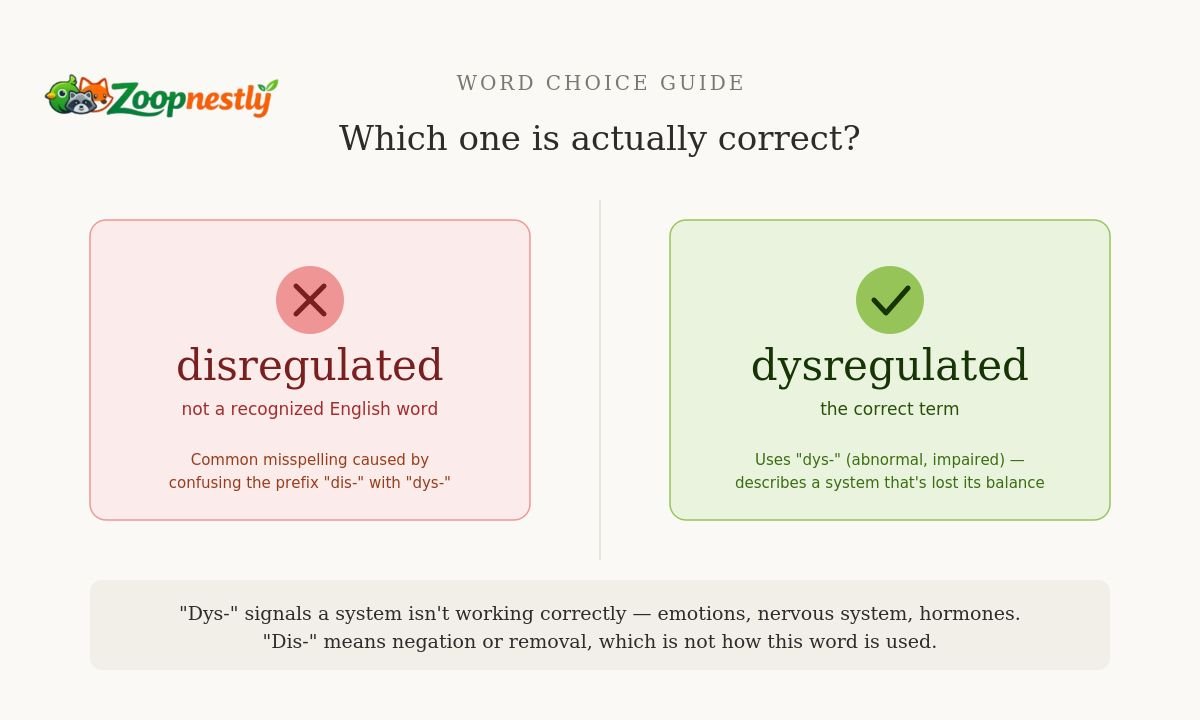
Dysregulated is the correct term. It means something (usually a system, emotion, or bodily process) has lost its normal ability to regulate or control itself. Disregulated is not a standard English word and does not appear in major dictionaries. If you’re describing emotional, nervous system, or biological imbalance, always use “dysregulated.”
The Core Difference in One Sentence
The difference comes down to spelling and prefix, not meaning. “Dysregulated” uses the prefix dys-, meaning abnormal or impaired, while “disregulated” mistakenly swaps in dis-, a prefix that means the opposite of or removal of. Only “dys-” combines correctly with “regulated” to form a recognized word.
What Does Dysregulated Mean?
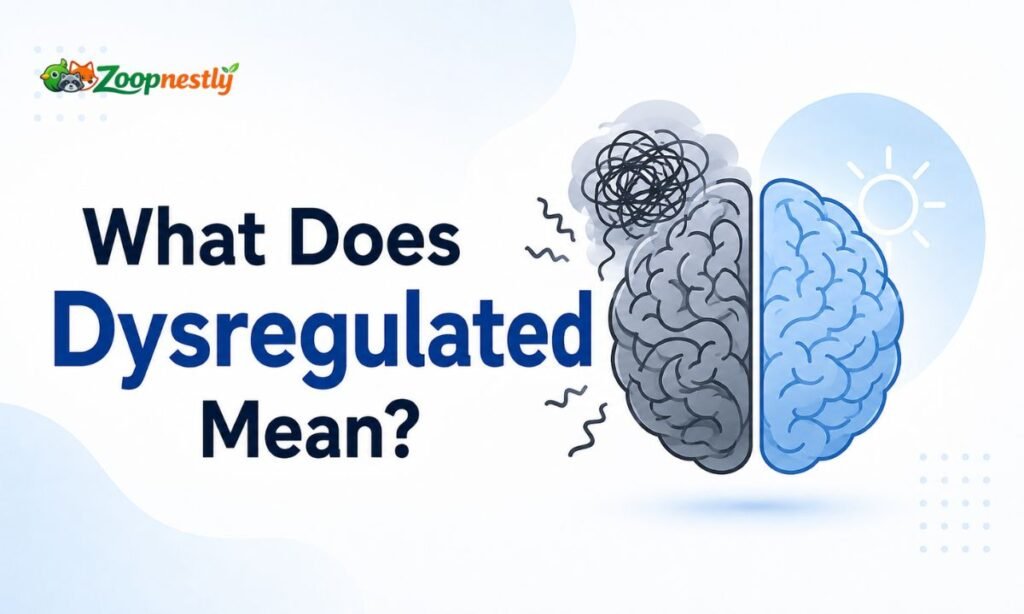
Dysregulated describes a system, process, or response that isn’t working the way it’s supposed to. It’s most often used to describe emotions, the nervous system, hormones, or behavior that has become erratic, extreme, or hard to control.
Plain-English Definition
If something is dysregulated, it has lost its balance or its ability to self-correct. Think of a thermostat that’s stuck, either blasting heat or refusing to turn on at all. A dysregulated emotional state works the same way: reactions come out too big, too fast, or too disconnected from what actually triggered them.
Example sentence: “After the stressful meeting, she felt completely dysregulated and couldn’t focus for the rest of the day.”
Why the Prefix “Dys-” Matters
Prefixes carry meaning, and getting them right changes whether a word exists at all.
| Prefix | Meaning | Example Words |
| Dys- | Bad, abnormal, difficult, impaired | Dysfunction, dyslexia, dysregulated |
| Dis- | Not, opposite of, removal, reversal | Disconnect, disagree, disorganize |
“Dys-” comes from Greek and typically attaches to medical or psychological terms describing something functioning poorly. “Dis-” comes from Latin and usually signals negation or separation. Because “regulate” is about controlling or managing a system, “dys-” fits it correctly. “Dis-” would suggest the opposite of regulation, which isn’t how the word is actually used or defined anywhere.
Why “Disregulated” Keeps Showing Up Anyway
If “disregulated” isn’t a real word, why does it keep appearing in casual writing, social media posts, and even some workplace emails?
Common Reasons People Make This Mistake
- Auto-correct confusion: Some spellcheckers don’t flag it because “dis-” words are so common.
- Sound-alike pattern: Words like “disconnect,” “disorganized,” and “disorder” prime people to expect “dis-” in similar contexts.
- Visual similarity: “Dys” and “dis” look nearly identical at a glance, especially when typing quickly.
- Repetition online: Once a misspelling appears enough times in casual content, it starts to feel familiar and correct.
Is “Disregulated” a Real Word?
No. It does not appear in Merriam-Webster, Cambridge Dictionary, or Oxford dictionaries. It’s a spelling error, not an alternate or informal version of “dysregulated.” Some spellcheckers may not catch it because “regulated” itself is a valid word, so the checker only flags the prefix in context, which it often misses.
What Happens When You Use “Disregulated” by Mistake
Using the wrong spelling isn’t just a technicality. It can affect how your writing is perceived.
- In professional writing: It can read as a typo or a lack of attention to detail, especially in reports, resumes, or client communication.
- In academic or clinical writing: Precision matters. Using an incorrect term in psychology, healthcare, or research writing can undermine trust in the rest of the content.
- In everyday online content: It’s common enough that most readers won’t notice, but search engines and editors increasingly favor correctly spelled, dictionary-backed terms.
Spot the Difference
- ❌ “The patient appeared disregulated after the incident.”
- ✅ “The patient appeared dysregulated after the incident.”
- ❌ “Kids often become disregulated when they’re overtired.”
- ✅ “Kids often become dysregulated when they’re overtired.”
A Simple Way to Remember It
Here’s a memory trick that actually sticks: think of “dys-” as “dysfunction.” If you can swap the word into a sentence about something not working correctly, like “dysfunction” or “dyslexia,” then “dys-” is the prefix you need. “Dis-” belongs with words about disconnecting, disagreeing, or removing something entirely, not with malfunction.
Dysregulated Meaning in Psychology
This is where the term shows up most often, and where getting it right actually matters for clear communication.
Emotional Dysregulation Explained
Emotional dysregulation refers to difficulty managing or responding to emotional experiences in a way that fits the situation. It’s a recognized concept in psychology, often discussed in relation to conditions like ADHD, borderline personality disorder, anxiety, and trauma responses.
What Dysregulated Behavior Looks Like
- Sudden anger or crying that seems disproportionate to the trigger
- Difficulty calming down after being upset
- Emotional reactions that feel disconnected from the actual event
- Trouble shifting from one emotional state to another
Short scenario: A child gets asked to turn off a video game and reacts with a full meltdown, screaming and crying for twenty minutes over something that would normally cause mild disappointment. That intensity and duration, mismatched with the trigger, is a hallmark of dysregulation.
DISCOVER MORE : Really vs Realy: Which Spelling Is Actually Correct?
Dysregulated Emotions vs Normal Emotional Responses
Not every strong emotion is dysregulation. Feeling deeply sad after a loss, or genuinely angry after being treated unfairly, is a normal and proportionate response. The difference lies in intensity, duration, and recovery. A regulated response, even a strong one, tends to fit the situation and fade with time. A dysregulated response is often disproportionate, hard to self-soothe, and lingers well past the triggering event.
The Dysregulated Nervous System
Dysregulation isn’t only emotional. It also describes what’s happening in the body.
Signs of a Dysregulated Nervous System
- Constant feeling of being “on edge” or unable to relax
- Trouble sleeping despite feeling exhausted
- Racing heart or shallow breathing without a clear cause
- Difficulty recovering from stress even after the stressor is gone
What’s Happening Internally
The nervous system normally shifts between alert and calm states depending on what’s needed. When it’s dysregulated, it gets stuck in high alert (fight or flight) or shuts down entirely (freeze), instead of returning to a balanced baseline once the stressful moment passes.
Dysregulation Beyond Emotions: Biology and the Body
The term extends into biology and medicine too, not just psychology.
- Hormonal dysregulation: Imbalances in hormone production, such as irregular cortisol or thyroid levels
- Blood sugar dysregulation: Difficulty maintaining stable glucose levels
- Immune system dysregulation: An immune response that’s either overactive or underactive relative to what the body needs
The core idea stays consistent across all these uses: something isn’t self-correcting the way it should.
Dysregulated vs Unregulated: A Common Mix-Up
These two are related but not interchangeable. Unregulated means there’s no regulation or oversight in place at all, like an unregulated industry with no rules. Dysregulated means regulation exists but isn’t functioning properly, like a system that has rules or mechanisms in place that aren’t working as intended. A dysregulated nervous system still has regulatory processes; they’re just not operating correctly.
Dysregulation in Children and ADHD
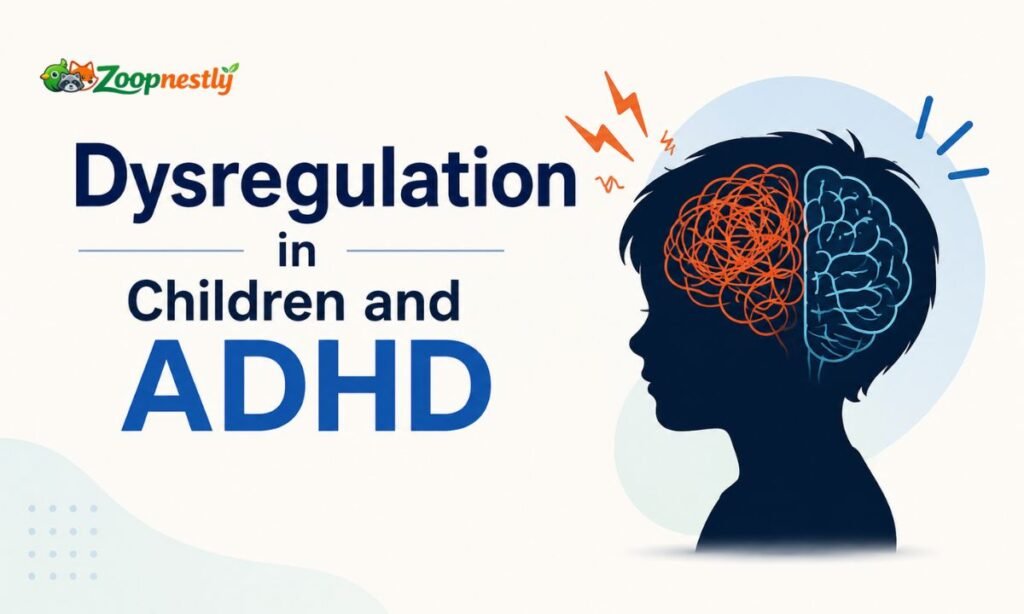
Emotional dysregulation is frequently discussed in the context of children and ADHD because both often involve difficulty managing impulses and emotional intensity.
In children, common signs include frequent meltdowns, difficulty calming down, and strong reactions to minor changes in routine.
In ADHD specifically, dysregulation often shows up as impulsive emotional reactions, quick frustration, and trouble shifting focus away from an emotional trigger. This connection is well recognized in clinical and educational settings, which makes accurate terminology especially important when discussing symptoms or treatment.
Helpful approaches for supporting dysregulation, in both children and adults, often include consistent routines, naming emotions out loud, grounding techniques, and professional support from a therapist or counselor when patterns are persistent or intense.
Quick Practice: Test Yourself
Fill in the blank: “After skipping breakfast and lunch, his blood sugar became _______.” (Answer: dysregulated)
Fix the sentence: “The system became disregulated after the update.” (Fix: The system became dysregulated after the update.)
Key Takeaways
- Dysregulated is correct; disregulated is not a recognized word.
- “Dys-” means abnormal or impaired, which fits how the word is actually used.
- The term applies to emotions, the nervous system, hormones, and other bodily systems.
- Dysregulation differs from being “unregulated,” which implies no regulation exists at all.
Frequently Asked Questions
Is “disregulated” ever acceptable in casual writing?
No. Even in casual contexts, it’s considered a misspelling rather than an informal variant. Dictionaries and style guides consistently point to “dysregulated” as the only correct form.
What is the simplest definition of dysregulated?
It means something has lost its ability to self-regulate or return to a stable, balanced state, whether that’s an emotion, a body system, or behavior.
Is emotional dysregulation a diagnosis?
No. It’s a descriptive term used across psychology and mental health, but it’s not a standalone diagnosis. It’s often a symptom or feature of conditions like ADHD, anxiety, or trauma-related disorders.
Can adults experience dysregulation, or is it just a childhood issue?
Adults experience it too. Stress, trauma, sleep deprivation, and certain mental health conditions can all contribute to emotional or nervous system dysregulation at any age.
How is dysregulation different from just being emotional?
The key difference is proportion and recovery. Being emotional in response to a real event is normal. Dysregulation involves reactions that are disproportionate to the trigger or that take unusually long to settle.
Final Thoughts
The spelling mix-up between dysregulated and disregulated is common, but the fix is simple once the prefix logic clicks. “Dys-” signals something isn’t functioning correctly, which is exactly what the word describes, whether you’re talking about emotions, the nervous system, or a biological process. Stick with “dysregulated,” and you’ll be using a term that’s accurate, professional, and recognized everywhere from casual conversation to clinical writing.

James Walker is a content writer and language researcher with over 5 years of experience in meanings, definitions, and language-related topics. He enjoys simplifying complex terms into clear, easy-to-understand explanations. Through ZoopNestly.com, he helps readers find accurate and reliable information.