Diddo or Ditto: Common Mistake and Correct Usage Guide
Ever typed a quick reply, paused, and thought “wait, is it spelled diddo or ditto?” You’re not alone. This mix-up trips up even confident writers because the word looks like it could have a double letter, similar to “kiddo” or “riddle.” Before you hit send on that text or email, let’s clear up the confusion so you never second-guess this spelling again.
Quick Answer
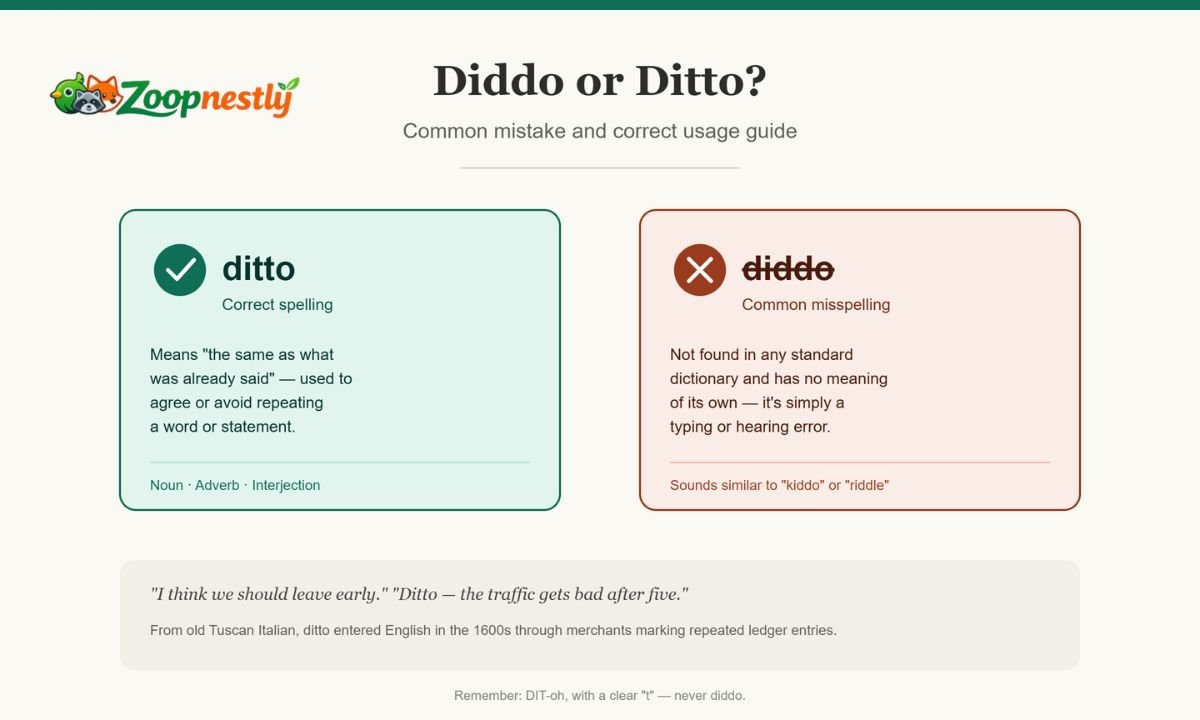
The correct spelling is ditto, not diddo. Diddo is a common misspelling with no meaning of its own. Ditto means “the same as what was already said” and is used to avoid repeating a word or statement. If you meant to agree with something, ditto is always the word you want.
What Does Ditto Actually Mean?

Ditto is used to express agreement or to show that something already stated applies again, without repeating it word for word. It works as a noun, an adverb, and even informally as an interjection.
Say a friend tells you, “I love this song.” You reply, “Ditto.” That single word means “me too” or “same here.” It’s a shortcut that saves you from repeating the whole sentence.
In more formal or written use, ditto refers to repeating a previous item, especially in lists, ledgers, or tables, so the same entry doesn’t need to be written out again.
Where Does the Word Ditto Come From?
Ditto comes from an old Tuscan Italian dialect word, a past participle form related to the Italian verb meaning “to say.” It entered English usage in the 1600s through merchants and clerks who needed a quick way to mark repeated items in account books and records instead of rewriting the same word or date over and over.
Over time, its use expanded beyond bookkeeping. By the 1700s and 1800s, people were using ditto in everyday conversation to mean “same here” or “I agree,” and that casual usage has stuck around ever since.
Is Diddo a Real Word?
No. Diddo is not a recognized English word. It does not appear in standard dictionaries and has no independent meaning. It’s simply a misspelling that happens because of how the word sounds when spoken quickly, or because writers subconsciously borrow the double-letter pattern from similar-sounding words.
If you see “diddo” in a text message, social post, or casual email, it almost always means the writer intended to type ditto.
Why Do People Confuse Diddo and Ditto?
A few simple reasons explain why this mix-up happens so often:
- Sound similarity: When spoken casually, the “t” in ditto can sound softer, almost like a “d,” which makes diddo seem plausible.
- Pattern matching: Words like kiddo, riddle, and diddly all use a double “d,” so writers assume ditto follows the same pattern.
- Autocorrect gaps: Some keyboards and messaging apps don’t flag diddo as an error, which lets the mistake slip through unnoticed.
- Regional speech habits: Fast, informal speech in everyday conversation can blur consonant sounds, making the correct spelling less obvious.
None of these reasons make diddo correct. They just explain why the error is so common.
British English vs American English: Any Difference?
There is no spelling difference between British and American English here. Both varieties of English use ditto, and neither recognizes diddo as an alternate or regional spelling. This is one of the rare cases where American and British English agree completely, unlike words such as “colour” versus “color” or “organise” versus “organize.”
Comparison Table: Diddo vs Ditto
| Feature | Ditto | Diddo |
| Correct spelling | Yes | No |
| Found in dictionaries | Yes | No |
| Meaning | Repeats or agrees with a previous statement | None |
| Word origin | Old Tuscan Italian dialect | N/A (misspelling) |
| Common usage | Casual speech, writing, records, lists | Typing error |
| Part of speech | Noun, adverb, interjection | N/A |
How to Pronounce Ditto
Ditto is pronounced DIT-oh, with the stress on the first syllable. The “t” sound is clear and short, not softened into a “d” sound, even though it can blend that way in fast, casual speech. Saying it slowly and clearly is the easiest way to remember the correct spelling when writing it down.
Ditto Marks: The Symbol Version
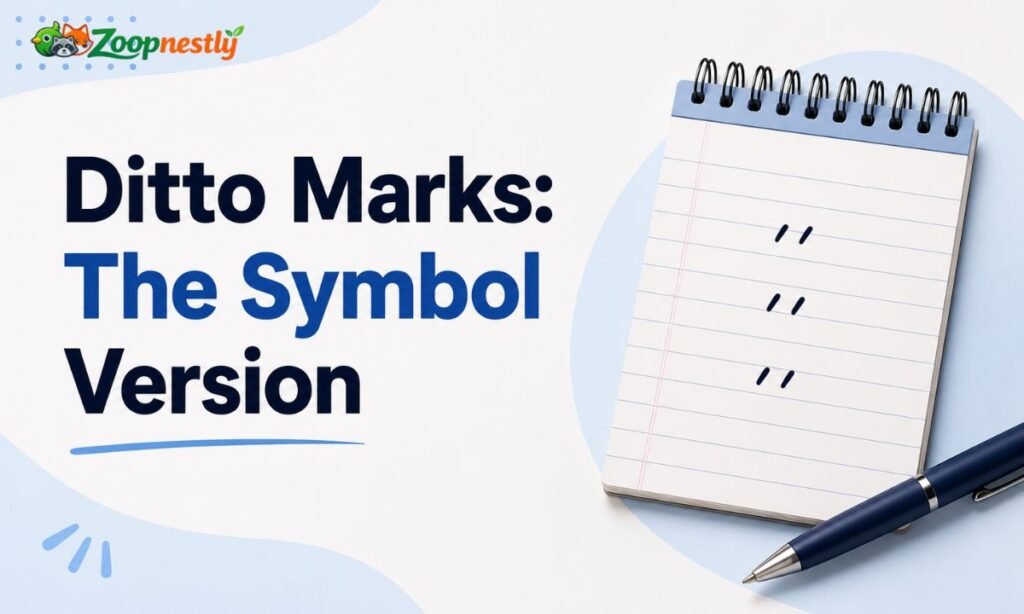
Beyond the word itself, ditto has a symbol form: the ditto mark (“), placed under a word or number to show it repeats from the line above. You’ll often see this in:
- Shopping lists
- Price tables
- Recipe ingredient lists
- Handwritten records and ledgers
For example:
Apples $2.00
Oranges “
Bananas “
Here, the ditto marks under “$2.00” mean oranges and bananas are priced the same as apples, without needing to rewrite the price each time.
Ditto in a Sentence: Real Examples
Seeing the word in context makes it easier to remember. Here are a few natural examples:
- “I think we should leave early.” “Ditto, the traffic gets bad after five.”
- The teacher marked ditto next to each repeated answer on the worksheet.
- “This coffee shop has the best pastries.” “Ditto on that, I get one every visit.”
- He filled in ditto marks under the same job title for every entry on the form.
- “Happy birthday!” “Ditto to you too.”
Notice how ditto replaces an entire repeated phrase, keeping the sentence short and natural.
Common Mistakes to Avoid
Beyond the diddo spelling error, a few other mix-ups are worth knowing:
- Diddo instead of ditto (the most frequent error).
- Dittoe or dito, less common but still incorrect spellings.
- Using ditto as a verb, such as “I’ll ditto that,” which is informal and best avoided in formal writing.
- Confusing the ditto mark (“) with a quotation mark (“), which look similar but serve completely different purposes.
Sticking to ditto as a single, unchanging spelling avoids all of these issues.
When Should You Actually Use Ditto?

Ditto fits best in these situations:
- Casual agreement: Quickly agreeing with something someone said, in speech or informal writing.
- Avoiding repetition in lists: Marking repeated entries in tables, records, or forms using ditto marks.
- Informal texting or chatting: A short, friendly way to say “same” or “me too.”
Avoid using ditto in formal reports, academic writing, or professional documents where a clear, spelled-out response reads better. In those cases, phrases like “the same applies” or “I agree” are more appropriate.
DISCOVER MORE : Sisters or Sister’s: The Complete Guide to Getting It Right Every Time
Why This Spelling Confusion Keeps Showing Up Online
Search interest in this exact question spikes because ditto is used so casually that people rarely see it written down. Most of the time, it’s spoken in conversation, texted quickly, or used as a one-word reply. Without frequent visual exposure to the correct spelling, it’s easy for the incorrect “diddo” version to feel right, even though it isn’t. Reading the word in context, as shown in the examples above, is one of the fastest ways to correct that instinct permanently.
Frequently Asked Questions
Is diddo ever an acceptable alternate spelling of ditto?
No. Diddo is not listed as a variant, regional form, or alternate spelling in any standard English dictionary. It is simply an error.
What part of speech is ditto?
Ditto can function as a noun, an adverb, or an informal interjection, depending on how it’s used in a sentence.
Can ditto be used as a verb?
Informally, yes, as in “I’ll ditto that,” but this is casual usage and should be avoided in formal or professional writing.
What is a ditto mark and how is it different from a quotation mark?
A ditto mark (“) shows that an item repeats from the line above, commonly used in lists and tables. A quotation mark (“) is used to indicate direct speech or a quoted phrase. They look alike but serve different grammatical purposes.
Where did the word ditto originally come from?
Ditto comes from an old Italian dialect term related to saying or stating something, originally used by merchants and record keepers to mark repeated entries without rewriting them.
Conclusion
The next time you’re unsure, remember this: ditto is correct, and diddo is not. Ditto has a clear meaning, a long history, and a real place in both casual conversation and written records, while diddo is simply a spelling slip that carries no meaning of its own. Keep the correct spelling in mind, and you’ll never hesitate over this word again.

James Walker is a content writer and language researcher with over 5 years of experience in meanings, definitions, and language-related topics. He enjoys simplifying complex terms into clear, easy-to-understand explanations. Through ZoopNestly.com, he helps readers find accurate and reliable information.