Thumb In or Thumb Out? The Real Answer, Explained Clearly
Ever caught yourself making a fist and paused, unsure where your thumb is supposed to go? You’re not alone. Getting thumb in or thumb out wrong isn’t just a small habit, it can lead to a painful sprain, a badly fitted mitten, or an awkward moment when someone misreads what you meant. This confusion pops up in sports, sewing, sign language, and even casual slang. Here’s exactly what each version means and when to use it.
Quick Answer
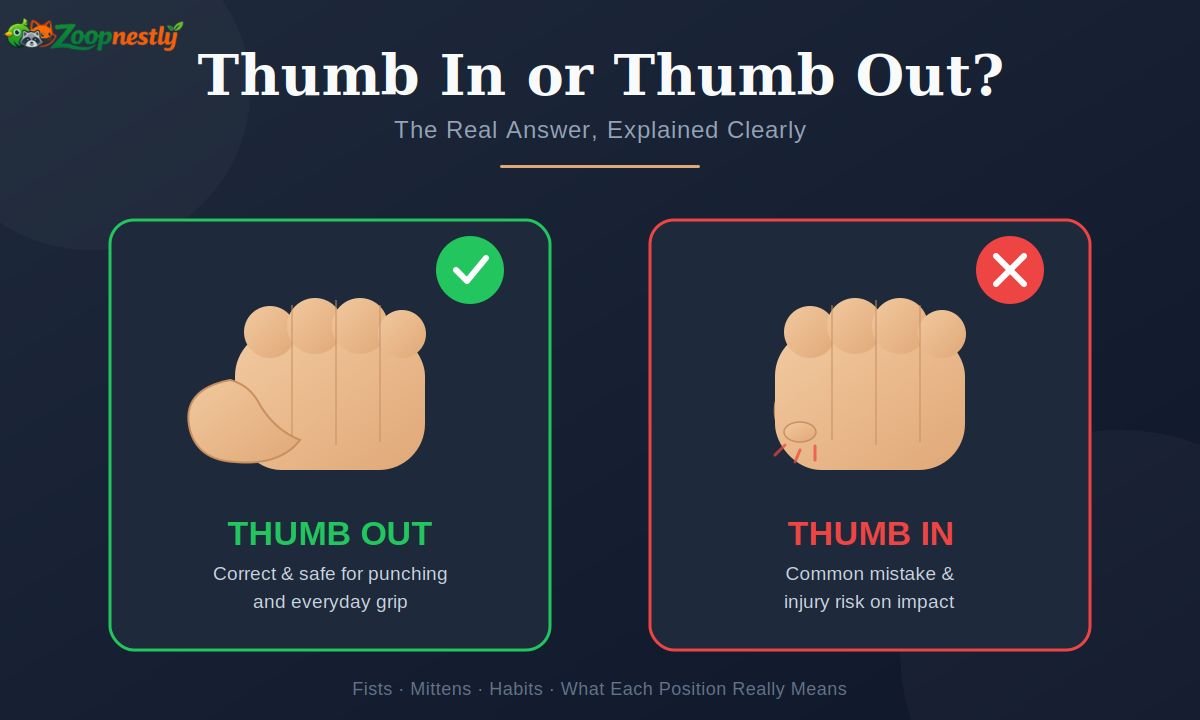
Thumb out means your thumb sits outside your closed fingers, resting alongside your fist, this is the correct and safer position for punching, gripping, and most hand-related tasks. Thumb in means the thumb is tucked inside the curled fingers, which is generally discouraged because it risks injury. The right choice depends on context, but “thumb out” is the standard rule in almost every physical situation.
What Does “Thumb In or Thumb Out” Actually Mean?
At its core, the phrase describes thumb position relative to a closed hand or a piece of clothing. When you make a fist, your four fingers curl toward your palm, and your thumb can either:
- Wrap around the outside of your curled fingers (thumb out), or
- Fold underneath, inside the curled fingers (thumb in)
The same “in or out” idea shows up outside of fists too, in glove design, thumb-sucking habits, and a few slang expressions. The meaning always depends on the situation, so context matters more than memorizing one fixed rule.
Thumb In or Thumb Out When Making a Fist
This is the most searched and most practical version of the question, especially for anyone learning to box, practicing self-defense, or just curious about proper form.
The correct technique is thumb out. Your thumb should rest across the second knuckles of your index and middle fingers, on the outside of your fist, not tucked inside your palm. This keeps your hand structurally sound if it makes contact with something solid.
A properly formed fist looks like this:
- Curl your fingers into your palm.
- Press your fingertips against the base of your fingers.
- Fold your thumb across the outside of your index and middle fingers.
- Keep your wrist straight, not bent.
Why Thumb In Is Considered a Mistake
Tucking your thumb inside your fist feels natural to beginners, but it’s one of the most common and most avoidable injuries in boxing gyms and playgrounds alike.
When the thumb is inside the fist and the hand strikes something, the fingers close in tighter on impact and crush the thumb between them. This can cause:
- Thumb sprains or dislocations
- Broken thumb bones
- Long-term joint damage with repeated impact
Coaches and trainers consistently teach thumb out for this exact reason. It’s not a style preference, it’s a safety rule.
DISCOVER MORE : Patients or Patient’s: The Complete Grammar Guide with Examples
Thumb In or Thumb Out for Mittens and Gloves
Outside of fist mechanics, “thumb in or thumb out” also describes a construction choice in knitting and sewing patterns.
- Thumb out mittens have the thumb gusset positioned on the outer edge of the hand, matching the natural angle of a relaxed hand.
- Thumb in mittens place the thumb closer to the center or palm side, which some crafters find easier to knit symmetrically for both hands.
Neither version is “wrong” here, it’s a design decision. Thumb out tends to fit more naturally, while thumb in can simplify the knitting pattern since both mittens can be made identically instead of as mirrored pairs.
Thumb In or Thumb Out for Babies and Thumb Sucking
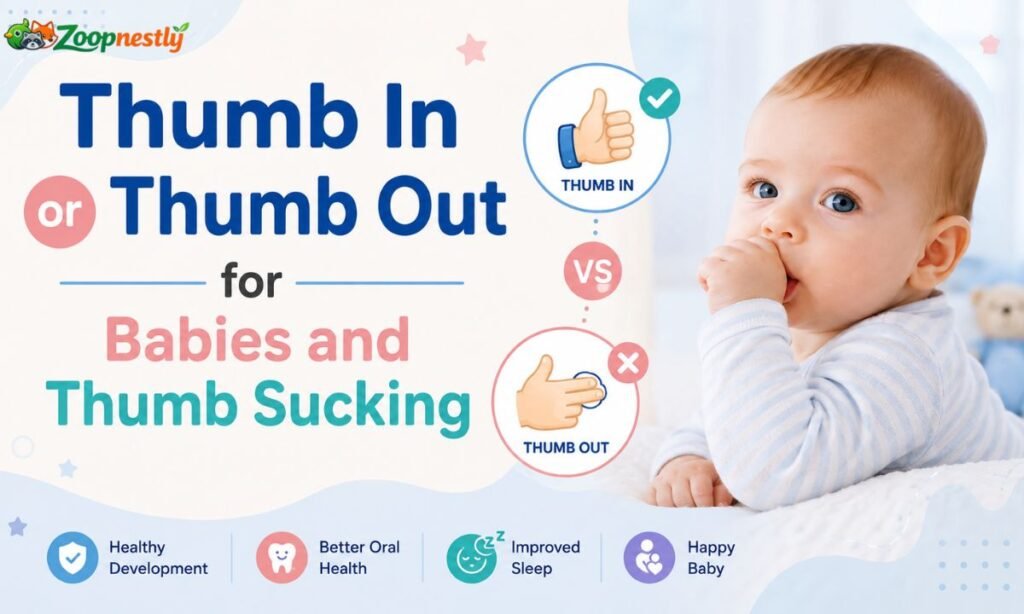
Parents sometimes use “thumb in or thumb out” loosely to describe whether a baby keeps their thumb tucked inside a closed fist or sucks on it outside their mouth. While this isn’t a formal medical term, the general guidance from pediatric sources is that thumb sucking is normal in infancy and early childhood, and most children stop on their own between ages two and four. If a pacifier or thumb habit continues well past that window and starts affecting tooth alignment, a pediatric dentist is the right person to ask, not a general habit guide.
Thumb In or Thumb Out in Everyday Slang
Beyond fists and mittens, you’ll sometimes see “thumb in” or “thumb out” used informally online, often tied to hand gesture memes, hitchhiking references, or as a stand-in phrase in casual conversation. Some slang dictionaries also list “thumb in” with a crude, sexual double meaning tied to gesture-based innuendo. This usage is informal, not standardized, and depends entirely on tone and context, so it’s worth reading the room before using the phrase casually with people you don’t know well.
Thumb In vs Thumb Out: Comparison Table
| Context | Thumb Out | Thumb In |
| Making a fist | Correct, safer technique | Common mistake, injury risk |
| Boxing or self-defense | Standard taught position | Avoided by trainers |
| Mitten knitting | Matches natural hand shape | Easier symmetric pattern |
| Baby thumb sucking | Thumb outside closed fingers | Thumb tucked inside fist |
| Casual slang | Neutral or gesture-based | Sometimes used with innuendo |
Common Mistakes People Make
Mistake 1: Assuming there’s one universal answer. The correct choice changes depending on whether you’re talking about a fist, a mitten, or a habit. Always check the context first.
Mistake 2: Curling the thumb inside a fist out of habit. This is the single most common physical mistake, especially among people who haven’t had formal training.
Mistake 3: Confusing spelling with meaning. Some readers search for “British English vs American English” versions of this phrase, but there isn’t actually a spelling difference here. “Thumb in” and “thumb out” are written the same way in both dialects. The confusion usually comes from unrelated British vs. American spelling patterns (like “colour” vs. “color”), not from this phrase itself.
Mistake 4: Ignoring wrist position. Even with the thumb placed correctly, a bent or twisted wrist can still cause strain. Thumb position and wrist alignment work together.
Example Sentences
- “Remember to keep your thumb out when you throw a punch, or you’ll hurt yourself.”
- “This mitten pattern uses a thumb in gusset, so both hands are knitted the same way.”
- “The instructor corrected her grip because her thumb in was a habit.”
- “He still sleeps with his thumb out, resting against his cheek.”
A Simple Rule of Thumb to Remember
If you only remember one thing from this guide, make it this: for anything involving a closed fist, thumb out is the safe, correct default. For crafting or design contexts, either version can be valid, it’s a construction choice, not a safety issue. When in doubt, picture your thumb resting comfortably alongside your fingers rather than squeezed underneath them.
Frequently Asked Questions
Is thumb in or thumb out correct when punching?
Thumb out is correct. Keeping the thumb across the outside of your curled fingers protects it from being crushed on impact.
Why does tucking my thumb in hurt when I make a fist?
When the thumb is inside a closed fist, the fingers press down on it during impact, which can sprain, dislocate, or fracture the thumb joint.
Does thumb in or thumb out matter for knitting mittens?
Yes, but it’s a design choice rather than a right-or-wrong rule. Thumb out mittens follow the hand’s natural shape, while thumb in mittens are often easier to knit as matching pairs.
Is there a British English vs American English difference between thumb in and thumb out?
No. Both phrases are spelled and used the same way in British and American English. There’s no regional variation for this specific term.
What does thumb in mean in slang?
In casual or informal slang, “thumb in” is sometimes used with a suggestive or joking meaning tied to hand gestures. It’s not a formal or widely standardized term, so its meaning depends heavily on context and tone.
Final Takeaway
“Thumb in or thumb out” isn’t a trick question, it just depends on what you’re doing with your hand. For fists and punches, thumb out is the safe, trained technique. For mittens, either style works depending on the pattern. And in casual conversation, context is everything. Once you know which situation you’re in, the right answer becomes obvious.

James Walker is a content writer and language researcher with over 5 years of experience in meanings, definitions, and language-related topics. He enjoys simplifying complex terms into clear, easy-to-understand explanations. Through ZoopNestly.com, he helps readers find accurate and reliable information.