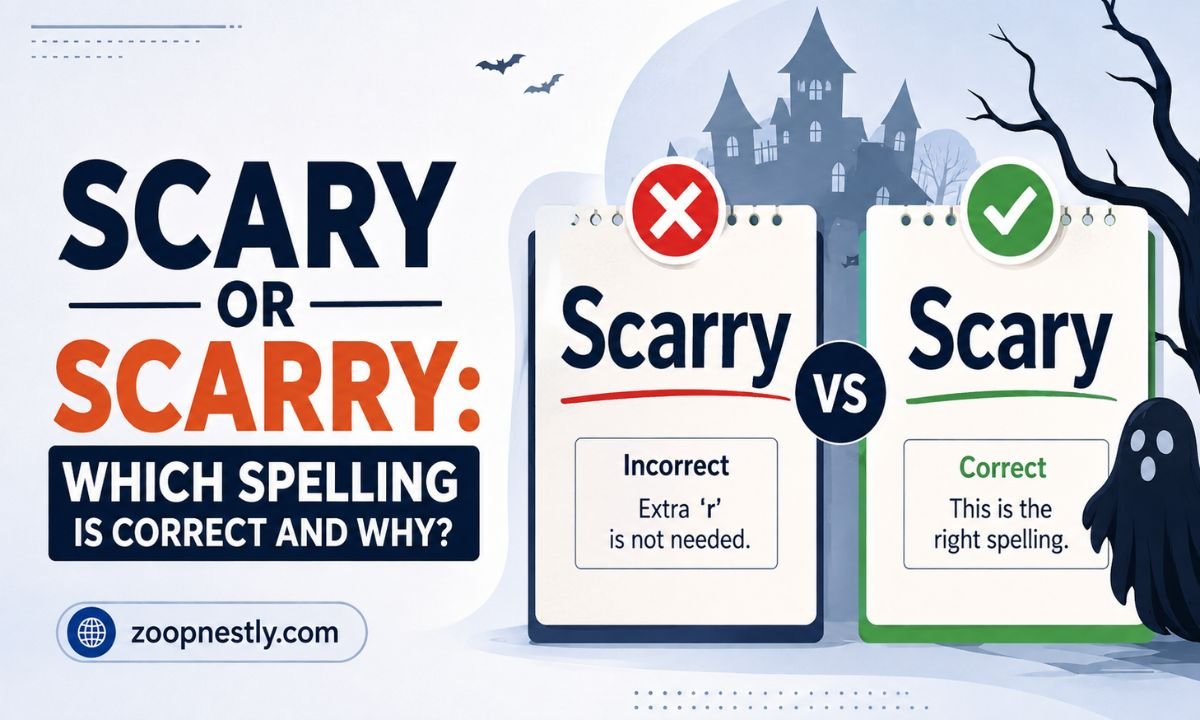
Scary or Scarry: Which Spelling Is Correct and Why?
You’re halfway through writing a Halloween post, a text to a friend, or a short story, and you pause. Is it scary or scarry? Both look plausible once you stare at them long enough, and autocorrect doesn’t always save you.
This mix-up trips up even confident writers, especially when a word ends in a sound that seems to call for a double letter. Here’s the clear answer, so you never second-guess it again.
Quick Answer
Scary is the only correct spelling. It means causing fear or frightening. Scarry is a common misspelling and is not a recognized English word, though it does exist as a surname. If you mean frightening, always write scary.
Which Spelling Is Actually Correct?
There’s no debate among dictionaries here. Scary is listed in every major English dictionary, including Merriam-Webster, Cambridge, and Oxford. Scarry does not appear as a standard adjective in any of them.
The word comes from scare (a noun and verb meaning to frighten) plus the suffix -y, which turns nouns into adjectives. That gives you scar-y, not scarr-y. The extra “r” in scarry has no grammatical reason to exist.
Here’s the pattern:
- scare + y = scary ✅
- scarry ❌ (not a word in standard English)
Why Do People Write “Scarry” by Mistake?
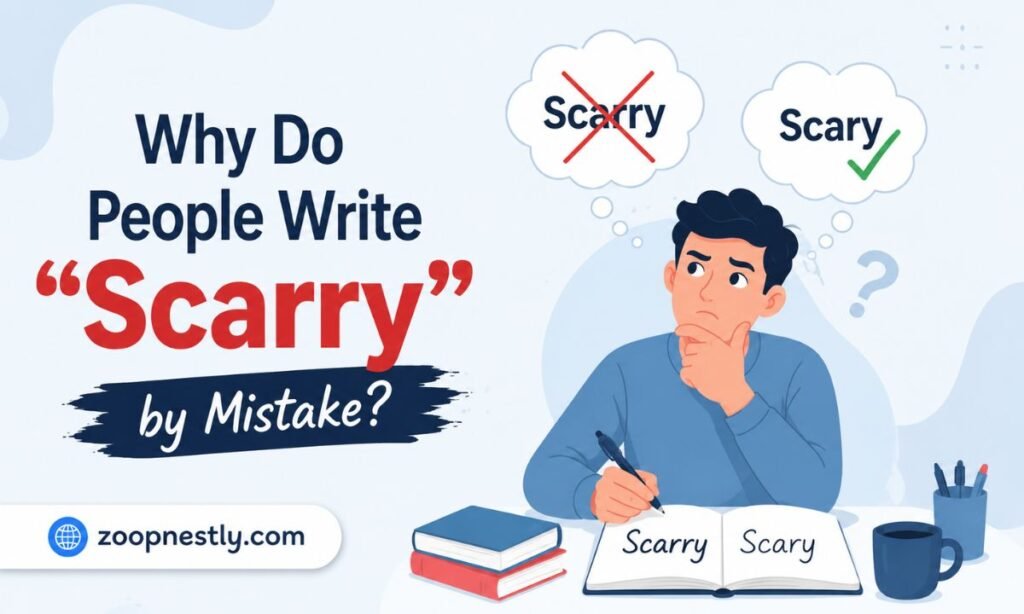
Most misspellings happen because English has other words that double their final consonant before adding a suffix, like run → running or hot → hotter. Writers sometimes apply that same rule to scare, assuming it needs a doubled “r” too.
But the rule for doubling consonants applies to short, one-syllable words with a single vowel right before the final consonant, like run or hot. Scare ends in a silent “e,” and words that end in a silent “e” simply drop the “e” and add the suffix. That’s why you get scary, not scarry, the same way bake becomes baking and not “bakking.”
Auto-correct habits, quick typing, and confusion with the surname “Scarry” (as in author Richard Scarry) also contribute to the mix-up.
Scary vs Scarry: Comparison Table
| Feature | Scary | Scarry |
| Correct spelling | Yes | No |
| Found in dictionaries | Yes | No |
| Meaning | Frightening, causing fear | Not a standard word (surname only) |
| Common use | Adjective in everyday writing | Proper noun (last name) |
| Example | “That movie was scary.” | “Richard Scarry wrote children’s books.” |
Is “Scarry” a Word at All?
Not as an adjective. Scarry isn’t in standard dictionaries and has no accepted meaning tied to fear. The only legitimate use of “Scarry” is as a proper noun, most commonly as a surname. Richard Scarry, the well-known children’s book author and illustrator, is the most recognizable example.
If you see “scarry” used to mean frightening anywhere online, in a text message, or in casual writing, it’s simply a spelling error, not an alternate or informal form of the word.
British English vs American English: Does It Change Anything?
No. Unlike words such as colour/color or favourite/favorite, spelling doesn’t split between British and American English here. Scary is spelled the same way in both. There’s no regional variant, no dialect exception, and no historical alternate spelling that makes “scarry” acceptable anywhere in the English-speaking world.
The Spelling Rule Behind “Scary” (Silent E + Y)
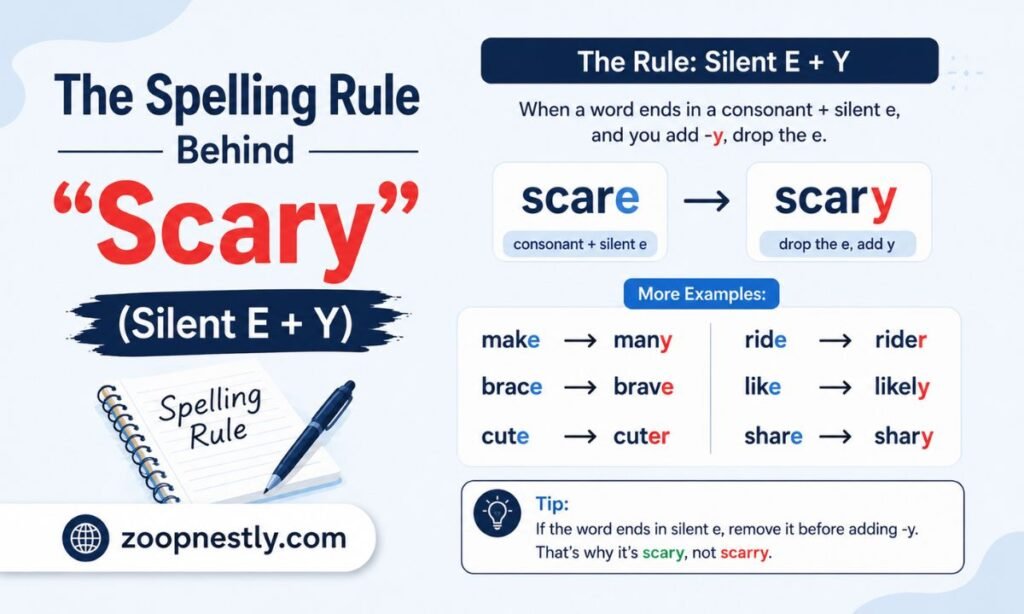
Understanding the underlying rule makes it easy to avoid this mistake with similar words in the future.
Rule: When a word ends in a silent “e,” drop the “e” before adding a suffix that starts with a vowel (like -y, -ing, or -ed).
Examples that follow the same pattern:
- scare → scary
- bone → bony
- shine → shiny
- taste → tasty
None of these double the consonant before the suffix. If you remember this one rule, you’ll spell scary correctly every time, along with a whole family of similar words.
Common Mistakes with Scary vs Scarry
A few patterns show up again and again in real writing:
- Doubling the “r” out of habit: “That was so scarry!” should be “That was so scary!”
- Confusing it with the surname: Using “scarry” to describe a frightening event because it looks similar to the name Scarry.
- Autocorrect not catching it: Some keyboards and apps won’t flag “scarry” as wrong because it resembles a real name, so the red squiggly underline doesn’t always appear.
- Typing fast on mobile: Quick typing on a phone keyboard is one of the most common sources of this error, since the double letter is an easy slip.
A simple fix: if you’re ever unsure, say the word out loud and think of “scare” first. Add just the “y,” and you’re done.
DISCOVER MORE : Eyeing or Eying: Understanding the Difference and Proper Usage
How to Use “Scary” Correctly in Real Writing
Seeing the word in different contexts makes the correct usage stick.
In an email: “The deadline is approaching fast, and honestly, it’s a little scary how much is still left to do.”
In a story or fiction: “The old house at the end of the street had a scary reputation long before anyone dared to knock on its door.”
On social media: “This roller coaster is genuinely scary, and I’m still shaking. “
In formal or academic writing: “Researchers noted that public speaking remains one of the most common scary experiences reported by survey participants.”
Notice that scary works as a standard adjective in casual, creative, and professional writing alike. There’s no formal alternative you need to swap in.
Synonyms for “Scary” (And When to Use Them)
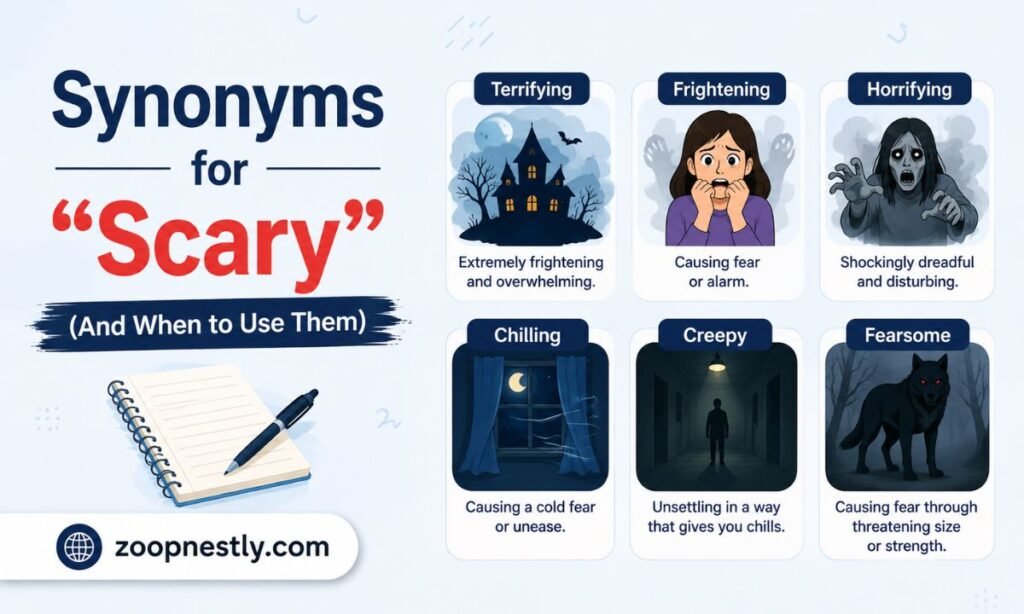
Sometimes scary isn’t the exact tone you’re going for. Here are close alternatives, along with when each fits best:
| Synonym | Best used for |
| Frightening | General fear, slightly more formal |
| Terrifying | Intense, extreme fear |
| Spooky | Light, playful fear (Halloween tone) |
| Creepy | Unsettling rather than outright scary |
| Alarming | Concerning situations, not necessarily supernatural |
| Chilling | Dramatic or suspenseful writing |
Choosing the right synonym depends on intensity. “Spooky” fits a costume party description, while “terrifying” suits a horror movie review.
How to Pronounce “Scary”
Scary is pronounced SKAIR-ee (two syllables, stress on the first). It rhymes with words like hairy, wary, and dairy. There is no version of the pronunciation that includes a rolled or doubled “r” sound, which is another small clue that the double-r spelling doesn’t belong.
A Simple Way to Remember It
If you want one trick to lock this in permanently: think of the phrase “scare turns into scary, no extra letter needed.” Since “scare” already has one “r,” and the silent “e” simply drops away when you add “y,” there’s never a reason to add a second “r.”
Frequently Asked Questions
Is “scarry” ever correct in any context?
Only as a proper noun, typically a surname (such as author Richard Scarry). As an adjective meaning frightening, “scarry” is always incorrect.
Why does “scary” only have one “r”?
Because it’s formed from “scare” (one “r”) plus the suffix “-y,” with the silent “e” dropped. There’s no rule that requires doubling the “r” in this word.
Is “scary” formal enough for professional writing?
Yes. Scary is a standard English adjective and appears in formal, academic, and business writing without issue. It’s not considered slang or overly casual.
What’s the difference between “scary” and “scared”?
Scary describes something that causes fear (a scary movie), while scared describes how a person feels (I am scared). One is about the source of fear, the other is about the emotional state.
Does spellcheck always catch “scarry” as wrong?
Not always. Because “Scarry” is a legitimate surname, some spellcheckers and autocorrect tools won’t flag it as an error, especially if capitalized or used near a name-like context. It’s worth double-checking manually.
Conclusion
Scary is the correct and only accepted spelling when you’re talking about something frightening. Scarry, while it exists as a surname, has no place in standard writing when your intent is to describe fear. Remember the simple rule: scare drops its silent “e” and adds “y,” with no double letter involved. Once that clicks, you’ll never have to pause over this spelling again.

James Walker is a content writer and language researcher with over 5 years of experience in meanings, definitions, and language-related topics. He enjoys simplifying complex terms into clear, easy-to-understand explanations. Through ZoopNestly.com, he helps readers find accurate and reliable information.