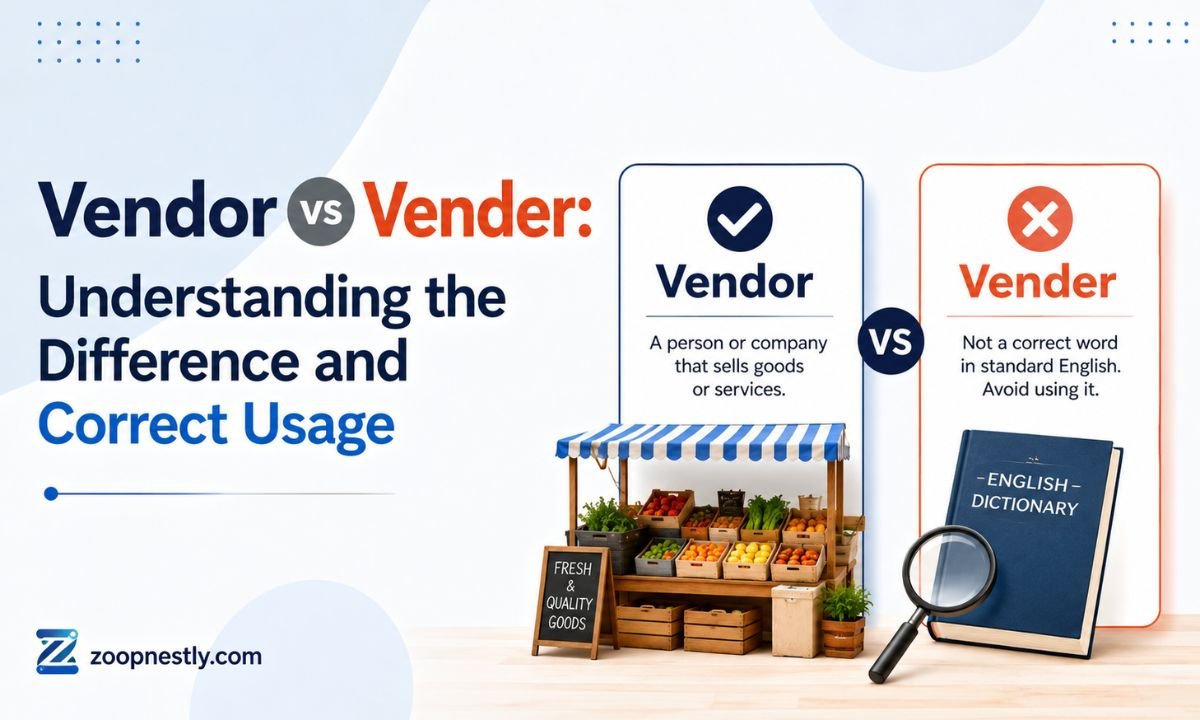
Vendor vs Vender: Understanding the Difference and Correct Usage
You typed an invoice, a contract, or a quick email, and then you paused. Is it “vender” or “vendor”? Spellcheck didn’t flag either one, and now you’re second-guessing yourself in front of a client. This mix-up happens more than people admit, especially in business writing where credibility matters. The good news: the fix for vender or vendor confusion takes less than two minutes to understand.
Quick Answer: Vender or Vendor
Vendor is the correct spelling in standard English for a person or business that sells goods or services. Vender is a rare, older variant that shows up occasionally but is not preferred in modern American or British English. If you’re writing a business document, contract, or professional email, always use vendor.
What Does Vendor Mean?
A vendor is any individual, company, or entity that sells a product or service to a buyer. The word applies broadly, from a street food vendor selling tacos to a software vendor supplying enterprise tools to a corporation.
In business contexts, “vendor” often refers to a supplier in a formal relationship, such as a company that provides raw materials to a manufacturer or a contractor who supplies office equipment. The term appears constantly in procurement, supply chain management, retail, and legal documents.
Example sentences:
- The city hired a new vendor to manage waste collection.
- We compared three vendors before signing the contract.
- The farmers market had over fifty vendors selling fresh produce.
Where Did the Word Vendor Come From?

The word “vendor” traces back to Latin, from vendere, meaning “to sell.” It passed into English through Anglo-French legal and commercial language, where “-or” endings were common for describing a person who performs an action, similar to “actor” or “creditor.”
Because English borrowed heavily from Latin and French for legal and trade vocabulary, “vendor” kept its Latin-style ending rather than shifting to the more Germanic “-er” pattern seen in native English words like “baker” or “seller.”
Is Vender a Real Word?
Yes, technically. Vender appears in some older dictionaries and occasionally in casual writing, but it is considered a nonstandard or archaic spelling today. Some style guides list it as a variant, but virtually no professional publication, legal document, or business style guide recommends using it.
If you search for “vender” online, you’ll notice many results are actually typos of “vendor” or references to unrelated Spanish-language content, which brings up an important distinction below.
British English vs American English: Does the Spelling Change?
No. Unlike words such as “colour/color” or “organise/organize,” vendor does not change between British and American English. Both varieties of English use the same spelling: vendor. This consistency makes it easier for international business writing, since you don’t need to adjust the word based on your audience’s region.
Vender Meaning in Spanish
Here’s where a lot of the confusion actually comes from. Vender is a legitimate word, but it belongs to Spanish, not English. In Spanish, vender is a verb meaning “to sell.”
For example:
- Quiero vender mi coche means “I want to sell my car.”
- Ellos venden ropa means “They sell clothes.”
Because Spanish and English share so much vocabulary through Latin roots, English speakers sometimes borrow the Spanish spelling by mistake when writing “vendor” in English. If you’re bilingual or work in a Spanish-English business environment, this is the most common source of the error.
READ MORE: As Well vs Aswell: What’s the Difference and Which Is Correct?
Common Mistakes When Using Vendor
Here are the mix-ups people run into most often:
- Spelling it “vender” in English documents — almost always a slip from the Spanish verb or simple typo.
- Confusing vendor with supplier — the terms overlap but aren’t identical. A supplier typically provides raw materials or components, while a vendor often sells finished goods or services directly to a buyer or end customer.
- Confusing vendor with vending machine operator only — vendor is a much broader term that covers any seller, not just machine-based sales.
- Adding an extra “e” — some writers mistakenly type “vendour” or “vendoor,” which are not real spellings in any variety of English.
Vendor vs Supplier vs Seller: What’s the Difference?
These three words get used interchangeably, but there are subtle distinctions worth knowing:
| Term | Typical Use | Example |
|---|---|---|
| Vendor | Sells goods/services, often in a business-to-business or retail setting | A software vendor licensing tools to a company |
| Supplier | Provides raw materials, parts, or components used in production | A fabric supplier for a clothing manufacturer |
| Seller | General term for anyone selling anything, formal or informal | A seller on an online marketplace |
In everyday conversation, people often use these words loosely. In legal and procurement documents, though, precision matters, so it’s worth choosing the term that fits your context.
Vendor in Business and Legal Writing

In contracts, invoices, and procurement documents, “vendor” is the standard term. You’ll see phrases like:
- Vendor agreement: a contract outlining terms between a buyer and seller.
- Vendor management: the process of overseeing relationships with suppliers and service providers.
- Approved vendor list: a pre-vetted group of vendors a company is authorized to purchase from.
Using “vender” in any of these contexts would look like a spelling error to anyone reviewing the document, which can undercut professionalism even if the rest of the content is solid.
How to Remember the Correct Spelling
A simple trick: think of other English words that describe a person doing something, like actor, creditor, or director. These all end in “-or,” just like vendor. If you remember that “vendor” follows this Latin-based pattern, you’re less likely to slip into the Spanish “vender” spelling.
Another memory tip: “vendOR” rhymes with “dOOR” the way many other formal business titles end in “-or” rather than “-er.”
Vendor in Everyday Situations
Vendor isn’t just a corporate term. You’ll run into it constantly in daily life:
- Farmers markets: local vendors sell produce, baked goods, and crafts.
- Trade shows: companies set up booths as vendors to showcase products.
- Event planning: caterers, photographers, and decorators are often called event vendors.
- Online marketplaces: platforms list multiple vendors offering similar products.
This range shows why “vendor” is such a commonly searched and commonly used word, spanning casual and formal contexts alike.
Frequently Asked Questions
Is vender a misspelling of vendor?
In English, yes. “Vender” is not the standard or preferred spelling. It occasionally appears in older texts as a variant, but modern English writing, whether academic, business, or casual, should use vendor.
Why do people confuse vender and vendor?
The confusion mostly comes from the Spanish verb vender, which means “to sell.” English speakers who are bilingual or exposed to Spanish-language content sometimes carry that spelling over into English by mistake.
Is vendor used the same way in the US and UK?
Yes. Both American and British English use the identical spelling, vendor, with no regional variation. This is different from many other words that shift spelling across English dialects.
What is the plural of vendor?
The plural is simply vendors, formed by adding an “s,” following standard English pluralization rules.
Can vendor refer to a person and a company?
Yes. Vendor can describe an individual seller, like a street food vendor, or a business entity, like a corporate software vendor. The term applies to both without needing a different word.
Final Thoughts
When it comes down to vender or vendor, the answer is straightforward: use vendor in all English writing, whether it’s a casual email, a formal contract, or marketing copy. Vender only applies as a Spanish verb meaning “to sell,” not as an English noun. Keeping this distinction clear will help you avoid an easy but noticeable mistake, especially in professional and business communication where accuracy reflects on your credibility.

James Walker is a content writer and language researcher with over 5 years of experience in meanings, definitions, and language-related topics. He enjoys simplifying complex terms into clear, easy-to-understand explanations. Through ZoopNestly.com, he helps readers find accurate and reliable information.