Whole Day or All Day: Which Phrase Sounds More Natural?
You just typed a sentence, then froze. Should it be “I worked the whole day” or “I worked all day”? Both sound fine out loud, but only one usually fits the tone you’re going for. That small hesitation is common, and it costs writers clarity and confidence. The good news: whole day or all day comes down to a simple grammar pattern, not a coin flip, and once you see the rule, you’ll never second guess it again.
Quick Answer
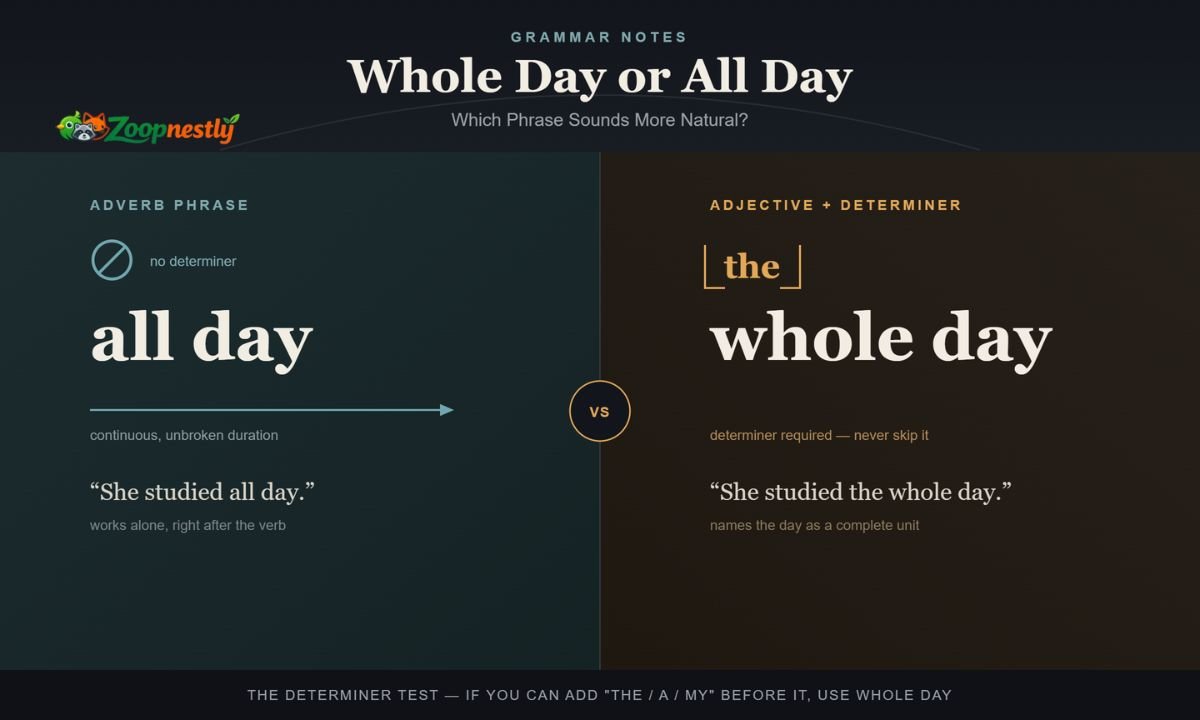
“All day” works as an adverb phrase describing an action that continues without a break (“She studied all day”). “Whole day” is an adjective phrase that needs a determiner like “the,” “a,” or “my” before it (“She studied the whole day”). Use all day for flow and casual tone, and whole day when you want to emphasize completeness or duration as a unit.
The Real Difference Between “Whole Day” and “All Day”

Both phrases describe a full 24-hour stretch, or at least a full waking day, but they behave differently in a sentence. “All day” is already a complete adverbial phrase. You can drop it right after a verb and it works on its own. “Whole day” is not complete by itself. “Whole” is an adjective, and adjectives need a noun phrase structure around them, which means a determiner has to come first.
That is really the whole story grammatically. Everything else in this guide is about tone, emphasis, and avoiding the small mistakes people make when they mix the two patterns.
Basic Meanings and Parts of Speech
| Phrase | Part of Speech | Needs a Determiner? | Typical Role |
| All day | Adverb phrase | No | Describes how long an action lasted |
| Whole day | Adjective + noun | Yes (“the,” “a,” “my,” “this”) | Names the day as a complete unit |
Think of “all day” as answering “for how long?” and “whole day” as answering “which day, and how complete was it?”
Contextual Examples
Seeing the two phrases side by side in real sentences makes the rule click faster than any explanation.
Statement of Duration
- She cleaned the house all day.
- She spent the whole day cleaning the house.
Emphasis With Possessives
- He wasted his whole day waiting for the delivery.
- He waited all day for the delivery.
Negative Contexts
- I didn’t eat all day.
- I didn’t get a single break the whole day.
With Modifiers
- It rained almost all day.
- It rained the entire whole day, which sounds redundant (more on that below).
Questions and Reduced Forms
- “Were you at work all day?” “Yeah, all day.”
- “Did you lose the whole day to that meeting?” “Pretty much.”
Idiomatic and Tone Shifts
- “All day, every day” (informal, upbeat)
- “It felt like the longest whole day of my life” (leans dramatic, slightly less natural than “longest day ever”)
Common Mistakes to Avoid
Most errors with these phrases come from one of five habits.
Mistake 1: Dropping the determiner. “I worked whole day” is incorrect. It needs “the,” “a,” or a possessive: “I worked the whole day.”
Mistake 2: Using “whole day” as a pure adverb. Native speakers rarely say “I slept whole day.” The adverbial slot belongs to “all day.”
Mistake 3: Redundant phrasing. “The entire whole day” or “all day long the whole time” double up on the same meaning. Pick one intensifier.
Mistake 4: Confusing emphasis with correctness. “Whole day” isn’t more formal or more correct than “all day.” They just do different jobs.
Mistake 5: Mixing tenses around time adverbs. “I am working all day yesterday” mismatches present continuous with a past time marker. Match your verb tense to the timeframe: “I worked all day yesterday.”
Grammar Rules Behind Whole Day and All Day

Here’s the pattern broken into simple, teachable rules:
- “All” + noun (no article) creates a fixed time expression: all day, all night, all week, all year.
- “Whole” + article/possessive + noun creates a modified noun phrase: the whole day, a whole day, my whole day.
- “All” can also modify “the” in phrases like “all the day,” but this sounds old-fashioned in modern American English and is rarely used today.
- “Whole” cannot skip the determiner. This is the one rule that trips up learners most often, especially those translating directly from languages where determiners work differently.
American vs British English Differences
Core Meaning Is the Same
Both American and British speakers use “all day” and “whole day” with the same underlying meanings. There’s no split in logic here, just some differences in preference.
Preference and Register
American English leans slightly more on “all day” in casual speech, while “whole day” shows up more often in British English for storytelling or narrative description, especially in phrases like “he spent the whole day at the market.”
Small Regional Variations
Neither version is wrong in either dialect. The difference is closer to word choice comfort than a hard rule, similar to “on the weekend” versus “at the weekend.”
Collocations and Idioms
“All day and all night” is common on both sides of the Atlantic. “A whole day’s work” appears more in British business writing, while American English often shortens it to “a full day’s work.”
Idiomatic Expressions Worth Knowing
“All day” shows up in casual idioms like “I could eat this all day” (meaning repeatedly, not just for 24 hours) and “all day, every day” as an enthusiastic agreement.
“Whole day” rarely appears in idioms on its own, but it pairs naturally with storytelling verbs: “spent the whole day,” “lost the whole day,” “planned the whole day around it.”
Fixed prepositional pairings to remember: “all day long,” “the whole day through” (more literary), “all day at work,” “the whole day at the office.”
More Real-World Examples
- The kids played outside all day and came home exhausted.
- We spent the whole day driving to the coast.
- I’ve been on calls all day, so my voice is gone.
- She dedicated her whole day to finishing the report.
- Nothing happened all day, and then everything happened at once.
- He replayed the whole day in his head before falling asleep.
Notice how “all day” flows directly after the verb, while “whole day” almost always needs a small connector word right before it.
DISCOVER MORE : It Is Must or It Is a Must: What’s the Difference?
Practical Tips for Choosing the Right Phrase
- Run the determiner test. If you can naturally add “the,” “a,” or “my” before it, “whole day” fits. If the phrase stands alone after the verb, use “all day.”
- Keep determiners attached to “whole.” Never let it float without one.
- Match tone to context. Casual writing and speech favor “all day.” Narrative or reflective writing often favors “whole day.”
- Cut redundant intensifiers. Choose “all day” or “the whole day,” not both stacked together.
- Check verb tense agreement whenever you use either phrase with a specific past or future timeframe.
- Rewrite when a sentence feels clunky. If “whole day” sounds forced, “all day” almost always saves the sentence.
- Default to “all day” for continuous actions like working, raining, or waiting.
- Default to “whole day” for completeness, especially when describing how an entire day was used up or dedicated to one thing.
- Add prepositions for variety in longer pieces: “throughout the whole day,” “for all of the day.”
- Use a simple replacement test when teaching or editing: swap in “the entire day.” If it still makes sense, “whole day” is the safer pick.
Fixing Common Sentences

Before: I studied whole day for the exam. After: I studied the whole day for the exam.
Before: She worked all day long the entire time without stopping. After: She worked all day without stopping.
Before: We spent whole day at the beach yesterday and we are tired. After: We spent the whole day at the beach yesterday, and we were tired.
Each fix either restores the missing determiner, trims a redundant phrase, or aligns the verb tense with the timeframe.
Frequently Asked Questions
Is it correct to say “whole day” without “the”?
No. “Whole” is an adjective and needs a determiner such as “the,” “a,” or a possessive pronoun before it. “I worked whole day” should be “I worked the whole day.”
Can “all day” and “whole day” be used interchangeably?
Often yes, but not always. “All day” works better as a straightforward adverb of duration, while “whole day” carries a slightly stronger sense of completeness and usually appears with a determiner.
Which one is more formal, “all day” or “whole day”?
Neither is inherently more formal. “All day” tends to sound more conversational, while “whole day” often appears in descriptive or narrative writing, but both are standard in professional English.
Is “the whole day” the same as “all day long”?
They’re close in meaning, but “all day long” adds emphasis on continuity, almost like “nonstop,” while “the whole day” focuses more on the day as a complete unit.
Why does “whole day” sound wrong in some sentences?
It usually sounds wrong when the determiner is missing or when it’s forced into an adverbial slot that naturally belongs to “all day,” such as directly after a verb without any article.
Final Thoughts
Choosing between whole day and all day isn’t about memorizing exceptions. It’s about recognizing that one is a ready-made adverb and the other is an adjective phrase that always needs a determiner beside it. Once you internalize that single grammar habit, the rest, tone, emphasis, and formality, falls into place naturally. Read your sentence back, run the quick determiner test, and you’ll pick the right phrase every time.

James Walker is a content writer and language researcher with over 5 years of experience in meanings, definitions, and language-related topics. He enjoys simplifying complex terms into clear, easy-to-understand explanations. Through ZoopNestly.com, he helps readers find accurate and reliable information.