To Fast or Too Fast: The Right Choice for Clear Writing
You type a sentence, pause, and stare at that little word before “fast.” One letter is missing from something, but which version is right? This mix-up trips up even confident writers, because to fast or too fast looks like a typo either way you write it. The good news is that the rule behind it is short, logical, and easy to lock in once you see it clearly.
Quick Answer
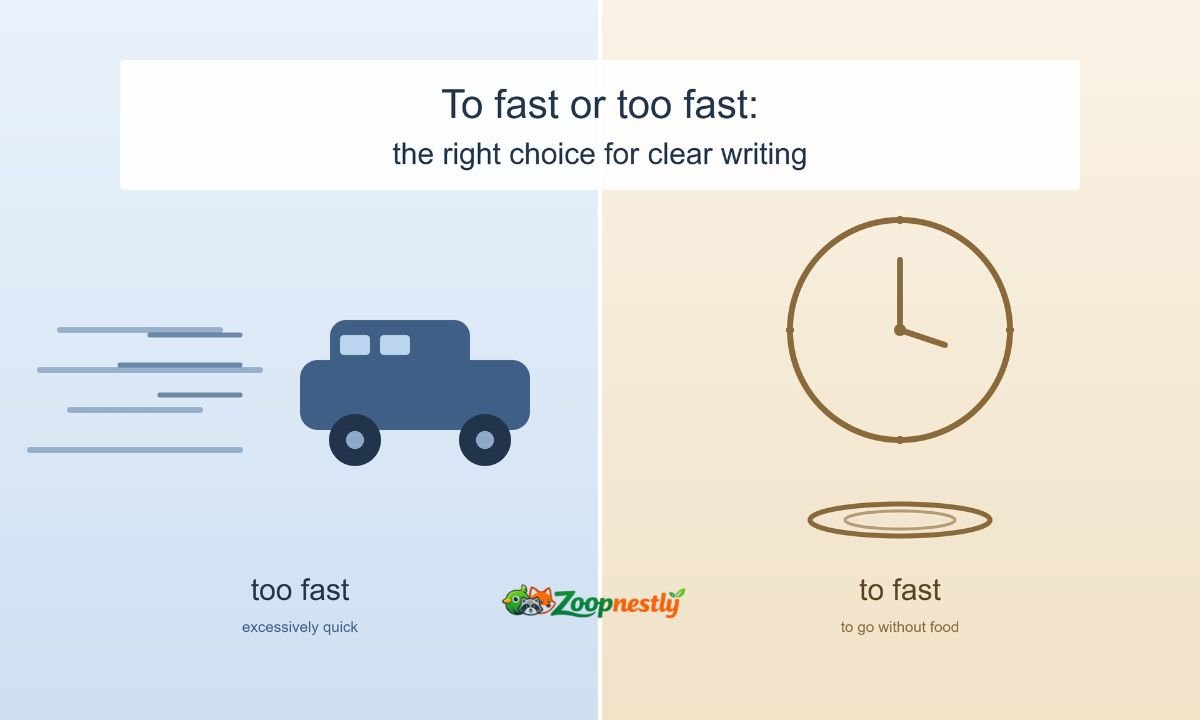
“Too fast” means excessively fast, as in “You’re driving too fast.” “To fast” uses the infinitive verb “fast,” meaning to go without food, as in “He decided to fast for a day.” If you mean “more than is safe or wanted,” use too. If you mean the act of abstaining from eating, use to fast.
To Fast or Too Fast: The Core Difference
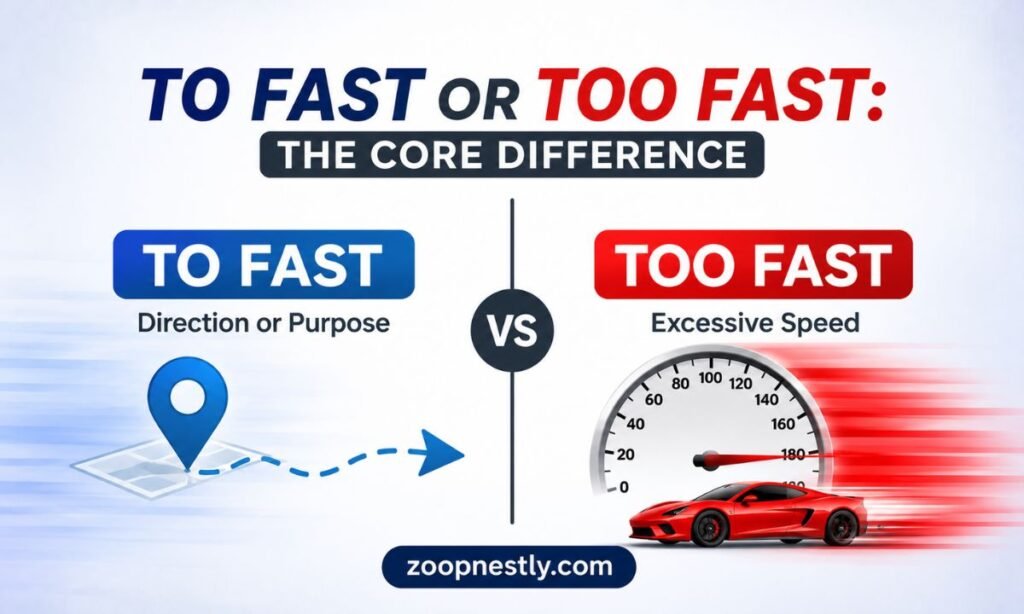
The confusion comes from sound, not grammar. “To” and “too” are pronounced the same, but they do completely different jobs in a sentence.
- Too is an adverb that means “excessively” or “also.” It intensifies an adjective or adverb, as in too fast, too loud, or too soon.
- To is a preposition or part of an infinitive verb. In to fast, it pairs with the verb “fast,” meaning to voluntarily stop eating for a period of time.
Once you separate these two jobs, the rest of the rule falls into place.
What Does “Too Fast” Mean?
Too fast describes speed that goes beyond what is safe, appropriate, or wanted. “Fast” here is an adjective or adverb, and “too” adds emphasis on excess.
Example sentences:
- The car was going too fast for the icy road.
- She read the instructions too fast and missed a step.
- Don’t eat too fast, or you’ll get a stomachache.
In each case, you could remove “too” and the sentence would still make sense, just without the sense of excess. That’s a useful clue you’ll see again in the tips section below.
What Does “To Fast” Mean?
To fast means to abstain from eating, either for religious, medical, or personal reasons. Here, “to” is simply the marker of the infinitive verb “fast.” This use is far less common in everyday writing, which is exactly why people default to “too fast” out of habit, even when they mean the opposite.
Example sentences:
- Many people choose to fast during Ramadan.
- The doctor asked him to fast before the blood test.
- She decided to fast for 24 hours as part of her routine.
Notice that “to fast” almost always follows a verb like “decide,” “choose,” “ask,” or “need,” because infinitives typically complete another verb’s meaning.
How to Choose: A Simple Test
If you’re stuck mid-sentence, run one of these quick checks:
- Remove the word and see if the sentence still works. “He was going fast” still makes sense, so it needs too (too fast). “He decided fast” changes the meaning entirely, so it needs to (to fast).
- Ask if you mean “excessively.” If yes, use too.
- Ask if a verb comes right after. Infinitives like “to fast,” “to eat,” or “to run” almost always follow another verb.
- Swap in “also.” If “too” could mean “also” in that spot, you’re using the adverb correctly, just not in the speed sense.
Comparison Table: To Fast vs Too Fast
| Feature | Too Fast | To Fast |
| Part of speech | Adverb (“too”) + adjective/adverb (“fast”) | Infinitive verb marker (“to”) + verb (“fast”) |
| Meaning | Excessively quick | To abstain from eating |
| Common use | Describing speed, pace, or action | Describing a choice or instruction about food |
| Example | You’re driving too fast. | We need to fast before surgery. |
| Typically follows | A verb describing motion or action | Verbs like decide, choose, ask, need, want |
Common Mistakes to Avoid

Mixing Up To and Too by Sound Alone
Because they’re homophones, writers often type whichever comes to mind first. Reading the sentence back and checking meaning, not sound, catches most of these errors.
Using “To Fast” When You Mean “Excessively”
Writing “You’re going to fast” instead of “You’re going too fast” is one of the most common slips. If speed or degree is the idea, you need the extra o.
Dropping “Too” Entirely
Some writers drop the intensifier and just write “You’re driving fast,” which is grammatically fine but loses the meaning of excess. This isn’t wrong, but it’s a different sentence with a different meaning.
Stacking Extra Degree Words
Phrases like “way too fast” or “much too fast” are fine in casual writing, but stacking multiple intensifiers, such as “very too fast,” is incorrect. “Too” already carries the degree, so it doesn’t need another modifier stacked directly in front of it.
DISCOVER MORE : Envolved vs Involved: The Correct Spelling Explained
Synonyms for “Too Fast”
Varying your wording keeps writing natural and avoids repetition. Depending on context, you can swap “too fast” for:
- Excessively quick
- Reckless speed
- Breakneck pace
- Hasty
- Rushed
These work well in different registers. “Breakneck pace” fits narrative or journalistic writing, while “hasty” or “rushed” suit everyday conversation.
Idioms and Expressions With “Too” and “Fast”
English has a few fixed expressions worth knowing:
- “Too fast for someone” — describes something happening at a pace a person can’t keep up with, as in “Technology is moving too fast for some users to keep up.”
- “Fast and furious” — an idiom describing rapid, intense activity, unrelated to the food-based meaning of “fast.”
- “Break a fast” — the verb “fast” also appears in “breakfast,” literally meaning to end a period of not eating.
These idioms show how the same word “fast” carries two unrelated meanings: quick, and abstaining from food. Context always makes clear which one is meant.
Does American vs British English Change the Rule?
No. The distinction between to and too is identical in American and British English. Both dialects use “too” for excess or “also,” and “to” as the infinitive marker or preposition. The only differences you’ll see between US and UK writing involve spelling of unrelated words, not this rule. If a source claims otherwise, it’s likely confusing this with an unrelated topic, so treat that claim with caution.
Practical Tips for Getting It Right Every Time

- Read your sentence for meaning first, not for how it sounds when spoken.
- Check for a verb right after the word. If one follows, you likely need “to fast.”
- Look for words like “very,” “so,” or “way” nearby. These often signal you need “too,” since they also express degree.
- Keep the modifier close to the word it describes. Separating “too” from “fast” with extra words can make a sentence harder to read.
- When teaching this rule to others, use just two anchor examples, one for each word, rather than a long list. Fewer examples make the rule easier to remember.
- Read the sentence aloud. If it sounds like a natural spoken sentence with “to” as part of a verb phrase, you’re using the infinitive correctly.
FAQs
Is it “don’t drive to fast” or “don’t drive too fast”?
It’s “don’t drive too fast.” You’re describing excessive speed, so you need the adverb “too,” not the infinitive marker “to.”
Can “to fast” ever describe speed?
No. “To fast” only refers to abstaining from food or drink. If you’re describing speed, you always need “too fast.”
Why do people confuse “to” and “too” so often?
They’re homophones, meaning they sound identical when spoken. Since English relies on spelling to distinguish meaning in writing, this pair causes frequent mix-ups, especially in fast typing or casual messages.
Is “to fast” a religious term only?
No. While fasting is common in religious practice, “to fast” also applies to medical fasting before procedures and to voluntary fasting for health or personal reasons.
What’s an easy way to remember the difference?
Think of the extra o in “too” as standing for “over” or “overdoing it,” since “too” always signals excess. “To,” with a single o, simply connects to a verb, as in “to fast,” “to eat,” or “to run.”
Conclusion
The choice between to fast or too fast comes down to one question: are you describing excess, or are you describing the act of not eating? “Too fast” always points to speed or degree, while “to fast” always pairs with the verb meaning to abstain from food. Once you run a sentence through that quick mental check, this mix-up stops being a guessing game and becomes second nature.

James Walker is a content writer and language researcher with over 5 years of experience in meanings, definitions, and language-related topics. He enjoys simplifying complex terms into clear, easy-to-understand explanations. Through ZoopNestly.com, he helps readers find accurate and reliable information.