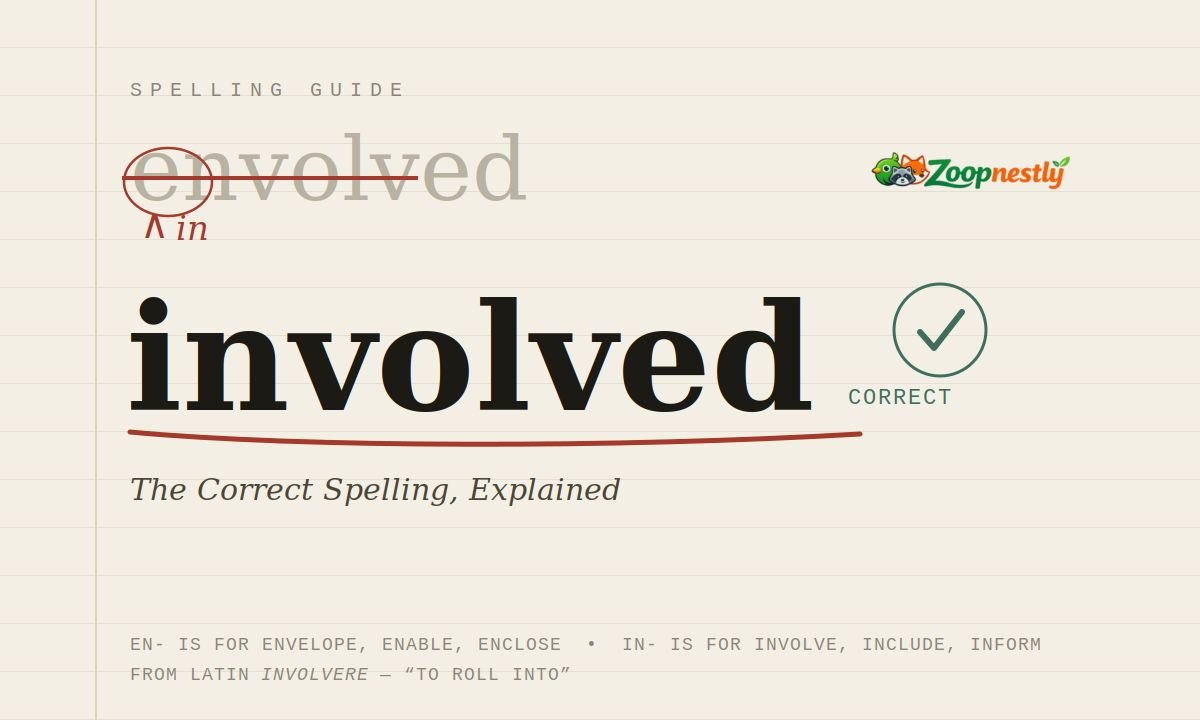
Envolved vs Involved: The Correct Spelling Explained
You’re halfway through an email, typing fast, and suddenly you stop. Is it “envolved” or “involved”? Your fingers want to type one thing, but your gut says something’s off. This tiny hesitation happens to more people than you’d think, and it can quietly chip away at how polished your writing looks. The good news: the fix for envolved or involved takes less than a minute to learn, and you’ll never second guess it again.
Quick Answer
Involved is the correct spelling. Envolved is not a real English word, it’s simply a common misspelling caused by mixing up the prefixes “en-” and “in-.” If you’re describing someone taking part in something, or something being connected or complicated, always write involved.
Why “Envolved” Isn’t a Real Word
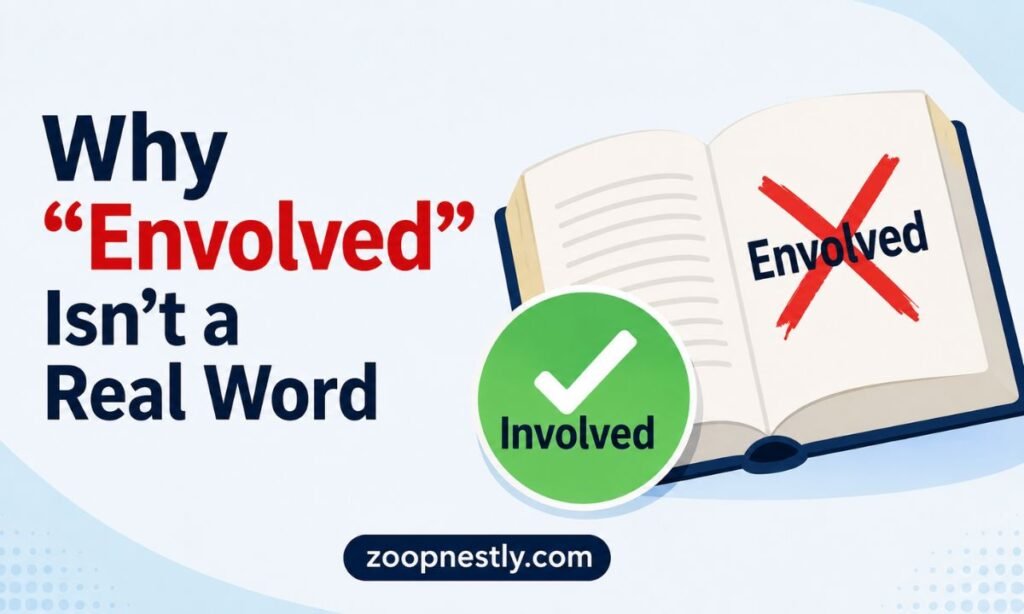
“Envolved” doesn’t appear in any standard English dictionary, including Merriam-Webster or Oxford. It’s not a variant spelling, a regional form, or an outdated version of a word. It’s simply an error that happens when writers confuse the prefix “en-” with “in-.”
Both prefixes are common in English. “En-” shows up in words like enclose, enable, and envelope. “In-” shows up in words like include, inform, and involved. Because the two prefixes sound similar and appear in visually similar words, it’s easy for your brain to autocorrect the wrong one, especially when typing quickly or relying on muscle memory from a similar-looking word like “envelope.”
If you type “envolved” into a spell checker, it will flag it every time. That’s a reliable signal on its own: no legitimate word behaves that way.
Envolved or Involved: What “Involved” Actually Means
Involved is the past tense and past participle of the verb involve. At its core, it means to include someone or something as a necessary part of an activity, situation, or relationship.
Depending on context, “involved” can describe:
- Participation — taking part in an activity, project, or event
- Connection — being linked to a situation, often one with consequences
- Complexity — something that is detailed, complicated, or hard to follow
- Emotional or personal investment — being closely tied to someone, often romantically or personally
This range of meaning is exactly why the word shows up so often in everyday speech and writing. It’s flexible, but the spelling never changes no matter which meaning you’re using.
Where “Involved” Comes From
Understanding the word’s origin makes the correct spelling easier to remember. “Involved” traces back to the Latin word involvere, meaning “to roll into” or “to envelop.” Over time, the meaning shifted from a literal wrapping or rolling motion to the more abstract sense of being wrapped up in a situation, task, or relationship.
The “in-” prefix in this case means “into,” which is why the word describes something being drawn into an activity or circumstance. Once you connect the prefix to its meaning, the spelling starts to feel logical instead of arbitrary.
How to Use “Involved” Correctly
Correct Usage Examples
- She got involved in the school fundraiser last month.
- The project became more involved than we originally expected.
- He wasn’t involved in the decision-making process.
- Their families have been involved with each other for years.
Incorrect Usage Examples
- She got envolved in the school fundraiser. (Incorrect spelling)
- The situation is very envolved. (Incorrect spelling)
- Please keep me envolved in the updates. (Incorrect spelling)
Any sentence that uses “envolved” instead of “involved” is grammatically wrong, regardless of the surrounding context.
Context Variations
“Involved” changes tone slightly depending on the sentence:
| Context | Example | Meaning |
| Casual | “Are you involved in any clubs?” | Simple participation |
| Professional | “She is heavily involved in the merger negotiations.” | Active role or responsibility |
| Emotional | “They’ve been involved for two years.” | Romantic relationship |
| Technical | “The repair process is more involved than expected.” | Complex or detailed |
“Involved” vs “Complicated”: Are They the Same?
Not quite, though they’re often used interchangeably. “Involved” can mean complex, but it usually implies that many parts, people, or steps are connected together. “Complicated” focuses more on difficulty or confusion, without necessarily implying multiple connected pieces.
For example, “The recipe is involved” suggests many steps. “The recipe is complicated” suggests it’s hard to follow. The two overlap, but they’re not perfect substitutes.
DISCOVER MORE : That’s vs Thats: What’s the Correct Spelling and Usage?
Common Synonyms for “Involved”
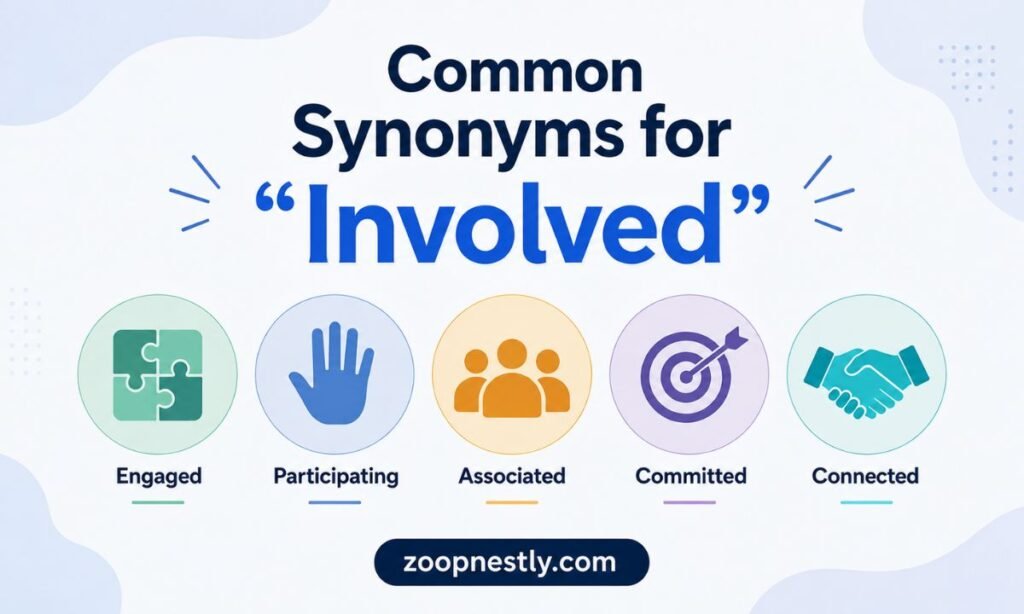
Depending on the meaning you’re going for, these words can work as substitutes:
- Participating — for describing active involvement in an activity
- Connected — for describing a link between people or events
- Engaged — for describing focused participation or attention
- Complex or intricate — for describing something detailed or hard to untangle
- Committed — for describing personal or relational investment
Choosing the right synonym depends on which sense of “involved” you’re using in a given sentence.
Common Mistakes Beyond “Envolved”
Misspelling “involved” as “envolved” is the most frequent error, but a few related mistakes show up too:
- “Invovled” — letters swapped due to fast typing
- “Involed” — a missing letter, often from autocorrect skipping a keystroke
- “Envolved” — a shortened, incorrect blend of “envolved” and “involved”
None of these are valid spellings. If you’re ever unsure, typing the word into a search engine or spell checker will confirm “involved” as the only correct option.
How to Remember the Correct Spelling of “Involved”
A few simple memory tricks can help the spelling stick:
- Think of the word “in” hiding inside “involved,” since the meaning relates to being drawn in to something.
- Remember that “envelope” starts with “en-” because you put things inside it, but the verb you’re looking for is a completely different word with “in-.”
- Break it down as in + volve + d, where “volve” relates to rolling or turning, just like in “revolve” or “evolve.”
If you associate “involved” with other “in-” words like include, inform, or insert, the correct spelling becomes second nature.
Why This Mistake Is So Common
Autocorrect and predictive text tools sometimes contribute to this error, especially on mobile keyboards where the “n” and “en” combination gets typed quickly. Non-native English speakers may also mix up the prefixes since some other languages use “en-” as a more common prefix pattern than English does. Neither reason makes the spelling correct, but understanding why the mistake happens can make it easier to catch before you hit send.
“Involved” in Different Contexts

The word adapts naturally across settings:
- Workplace: “All departments are involved in the new rollout.”
- Legal: “Three parties were involved in the contract dispute.”
- Personal relationships: “They’ve been involved since college.”
- Academic: “The research involved over 200 participants.”
- Everyday conversation: “I don’t want to get involved in the drama.”
Across all these contexts, the spelling stays exactly the same. Only the meaning shifts based on the surrounding sentence.
Frequently Asked Questions
Is “envolved” ever correct in British English?
No. “Envolved” is not accepted in British English, American English, or any other standard English variety. “Involved” is the only correct spelling everywhere.
Why do people confuse “envolved” with “involved”?
The confusion usually comes from mixing up the “en-” and “in-” prefixes, which look and sound similar. Words like “envelope” may also influence the mistake, since they share a similar visual pattern.
What part of speech is “involved”?
“Involved” functions as both a verb (the past tense of involve) and an adjective, as in “an involved process” or “she was involved.”
Can “involved” describe a romantic relationship?
Yes. “Involved” is commonly used to describe two people who are dating or emotionally connected, such as “They’ve been involved for a few months.”
Is there a noun form of “involved”?
Yes, the noun form is involvement, used to describe the state or act of being involved, such as “Her involvement in the project increased over time.”
Final Takeaway
“Envolved” is simply an incorrect spelling with no place in standard English. Involved is the word you want, whether you’re talking about participation, complexity, connection, or personal relationships. Once you link the spelling to its Latin root and its family of “in-” words, the mistake becomes easy to avoid for good.

James Walker is a content writer and language researcher with over 5 years of experience in meanings, definitions, and language-related topics. He enjoys simplifying complex terms into clear, easy-to-understand explanations. Through ZoopNestly.com, he helps readers find accurate and reliable information.