That’s vs Thats: What’s the Correct Spelling and Usage?
You’re typing a text, you pause, and your fingers hover over the keyboard. Is it “that’s” or “thats”? It happens to almost everyone, even confident writers. The missing apostrophe looks small, but it changes whether your sentence is grammatically correct or just plain wrong. If you’ve ever hit send and then wondered whether that’s or thats was the right call, you’re not alone, and the fix is easier than you think.
Quick Answer
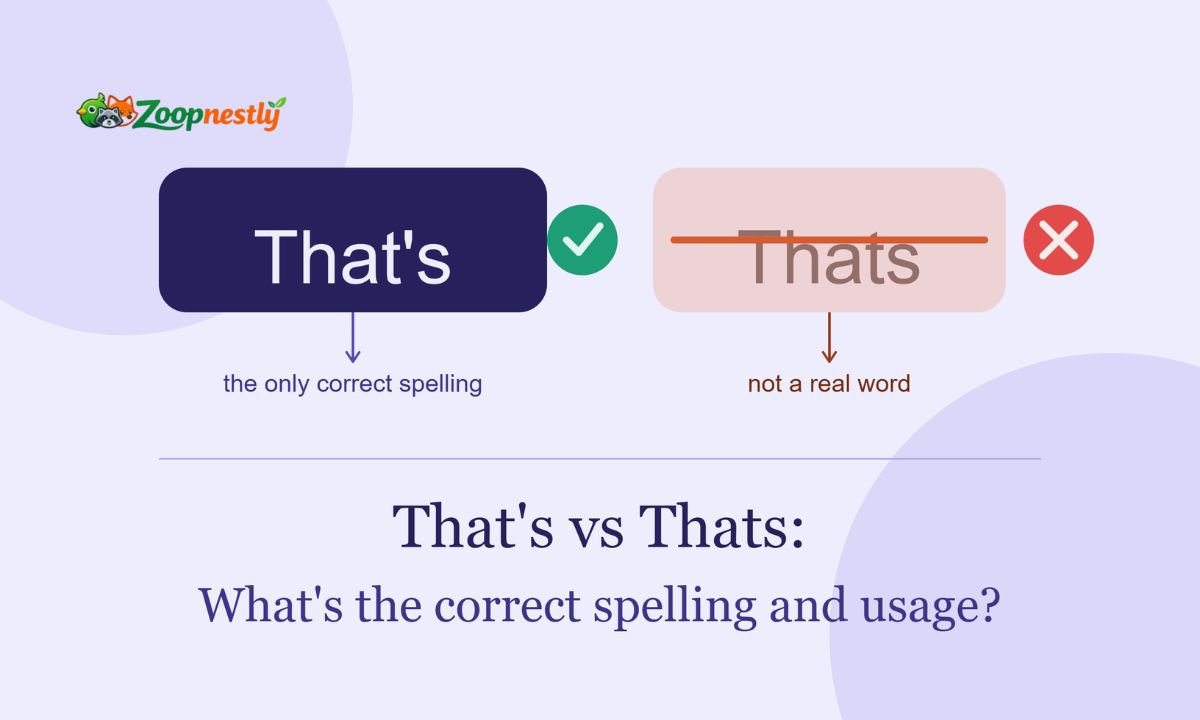
That’s is the only correct spelling. It’s a contraction of “that is” or “that has,” and it always needs an apostrophe. Thats, without the apostrophe, is not a real word in standard English and is considered a spelling error in any context.
What Is “That’s” Short For?
“That’s” is a contraction, which means it’s two words squeezed into one with an apostrophe standing in for missing letters. It can mean either:
- That is — “That’s my favorite song.”
- That has — “That’s been a long day.”
The apostrophe isn’t decorative. It tells the reader exactly which letters were dropped, so the sentence still makes sense when you expand it back out.
Why “Thats” Is Never Correct
“Thats” simply doesn’t exist as a word in English. There’s no version of the language, formal or informal, where dropping the apostrophe from “that’s” is acceptable. It’s not a shorter or more casual form either. It’s just a typo.
This mistake usually happens for one of three reasons:
- Typing too fast and skipping the apostrophe key
- Autocorrect silently removing it on some keyboards
- Confusion with possessive words like “cats” or “hats,” which don’t use apostrophes
Knowing the reason behind the slip can help you catch it before you hit publish or send.
That’s vs. Thats: Side-by-Side Comparison
| Feature | That’s | Thats |
| Grammatically correct | Yes | No |
| Meaning | “That is” or “that has” | None (not a word) |
| Use in formal writing | Acceptable | Never acceptable |
| Use in casual texting | Acceptable | Common typo |
| Apostrophe required | Yes | N/A |
How to Use “That’s” Correctly
“That’s” works as a subject-verb combination, so it needs to be followed by the rest of a complete thought, just like “that is” or “that has” would be.
Correct examples:
- That’s exactly what I meant.
- That’s the restaurant we talked about.
- That’s been sitting in my inbox for a week.
- I think that’s a great idea.
- That’s why she left early.
Incorrect examples:
- Thats a good movie.
- I don’t think thats right.
- Thats the one I want.
If you can mentally expand the word into “that is” or “that has” and the sentence still reads naturally, “that’s” is the correct choice.
That’s vs. Thats’ vs. That’s’: Avoiding Apostrophe Confusion
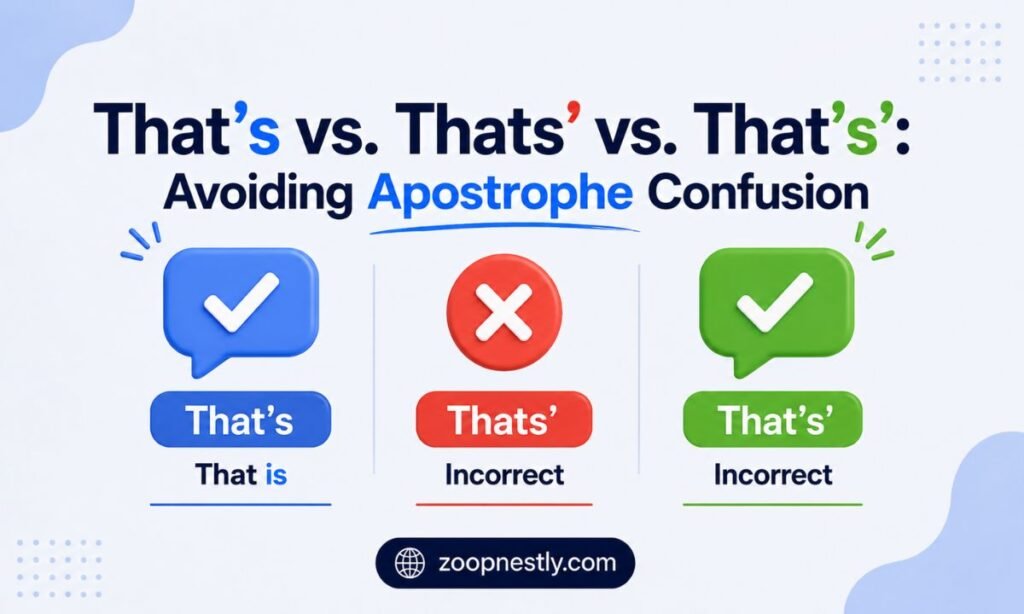
Some writers get tangled up trying to make “that’s” possessive or plural, which leads to odd forms like “thats'” or “that’s’.” Here’s the simple rule: “that’s” is already a complete contraction. It doesn’t take an extra apostrophe, and there’s no plural or possessive version of it, because “that” itself doesn’t pluralize this way.
If you need a possessive idea, rephrase the sentence instead of forcing an apostrophe onto “that’s.” For example, instead of trying to write “thats’ meaning,” say “the meaning of that.”
DISCOVER MORE : All Is Well vs All Is Good: The Complete Usage Guide
Common Mistakes Beyond the Apostrophe
Dropping the apostrophe isn’t the only slip-up people make. Watch out for these related errors:
- Confusing “that’s” with “thats” — covered above, and the most frequent mistake.
- Confusing “that’s” with “that is” in overly formal writing where the full form reads better, such as academic papers.
- Using “that’s” when you mean “those” — “that’s my shoes” should be “those are my shoes,” since “that’s” pairs with singular ideas.
- Overusing “that’s” as a filler at the start of too many sentences in a row, which can make writing feel repetitive.
Does It Matter in Texting or Casual Writing?
Even in texts, DMs, and social posts, “thats” without the apostrophe still reads as a typo, not a stylistic choice. Autocorrect on most phones actually adds the apostrophe automatically, which is part of why the error is less common in texting than in typed documents or hasty comments. If you’re writing quickly and skip the apostrophe, it’s worth a second glance before you send.
Does “That’s” Change in Formal Writing?
In academic papers, business reports, and other formal documents, some style guides prefer you spell out “that is” or “that has” instead of using the contraction “that’s.” This isn’t because “that’s” is incorrect. It’s a tone choice. Contractions in general read as more conversational, so formal writing sometimes avoids them. If you’re following a specific style guide for school or work, check whether it has a rule against contractions before deciding which form to use.
A Simple Trick to Remember the Apostrophe
Here’s an easy way to check yourself: say the sentence out loud and replace “that’s” with “that is” or “that has.” If the sentence still makes sense, the apostrophe belongs there.
- “Thats my book” → “That is my book” ✓ makes sense → use “that’s”
- “The cats toys” → “The cat is toys” ✗ doesn’t make sense → no apostrophe needed here, since this isn’t a contraction situation at all
This quick substitution test works almost every time and takes less than a second once it becomes a habit.
“That’s” in Different Sentence Positions
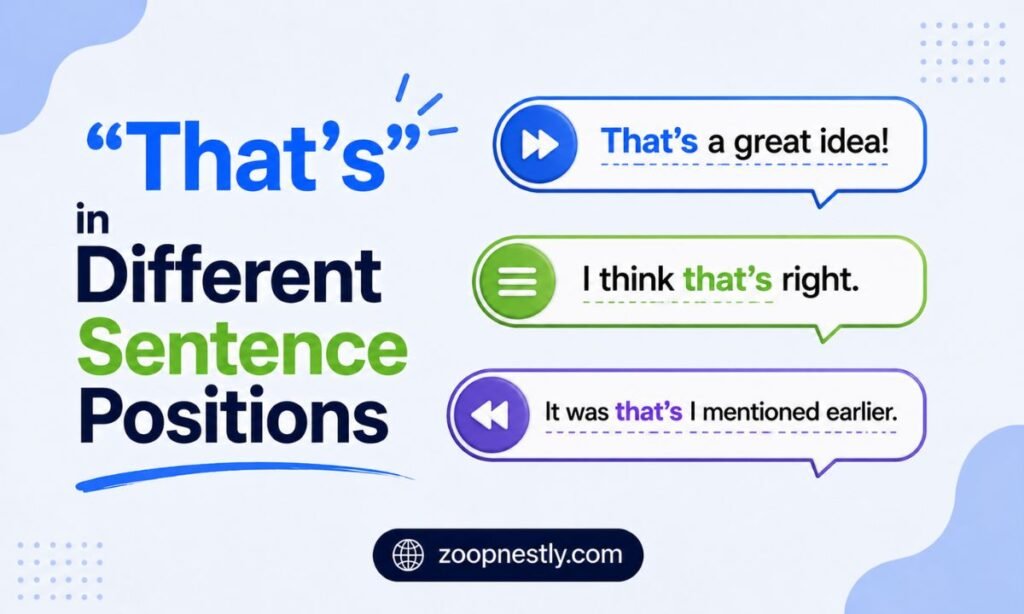
“That’s” can appear at the start, middle, or end of a sentence, and the apostrophe rule never changes based on position.
- Start of a sentence: “That’s not what I expected.”
- Middle of a sentence: “I heard that’s the plan for tomorrow.”
- Answering a question: “Why did you leave? That’s a fair question.”
No matter where it lands, “that’s” always keeps its apostrophe.
Frequently Asked Questions
Is “thats” ever correct in English?
No. “Thats” is not a recognized word in standard English at any level, formal or informal. The correct form always includes an apostrophe: “that’s.”
What does the apostrophe in “that’s” actually represent?
The apostrophe marks where letters were removed when “that is” or “that has” got shortened into one word. It replaces the missing “i” in “is” or the missing “ha” in “has.”
Can “that’s” mean something other than “that is” or “that has”?
No. Those are the only two expansions of “that’s.” Context tells you which one applies, based on the rest of the sentence.
Is it okay to use “that’s” in professional emails?
Yes, in most everyday professional emails “that’s” is perfectly fine and reads naturally. Only more formal documents, like academic writing, might call for the full “that is” or “that has” instead.
Why does autocorrect sometimes miss the apostrophe in “thats”?
Autocorrect relies on common patterns, and some keyboards or apps are less consistent about catching missing apostrophes than others, especially with fast typing. It’s still worth proofreading before sending anything important.
Conclusion
Between that’s or thats, only one is a real word, and it’s “that’s.” The apostrophe isn’t optional. It marks the contraction of “that is” or “that has” and keeps your writing grammatically correct. Once you get in the habit of mentally expanding “that’s” to check it, the mistake becomes easy to catch and even easier to avoid.

James Walker is a content writer and language researcher with over 5 years of experience in meanings, definitions, and language-related topics. He enjoys simplifying complex terms into clear, easy-to-understand explanations. Through ZoopNestly.com, he helps readers find accurate and reliable information.