Tear vs Tare: What’s the Difference and When Do You Use Each?
You’re filling out a shipping form, and it asks for the “tare weight” of your box. Or maybe you just watched a movie ending that brought a tear to your eye. Same sound, completely different words. If you’ve ever paused mid-sentence wondering whether you’re spelling tear vs tare correctly, you’re not alone. Mixing them up is an easy mistake, but the fix is simpler than you think.
Quick Answer
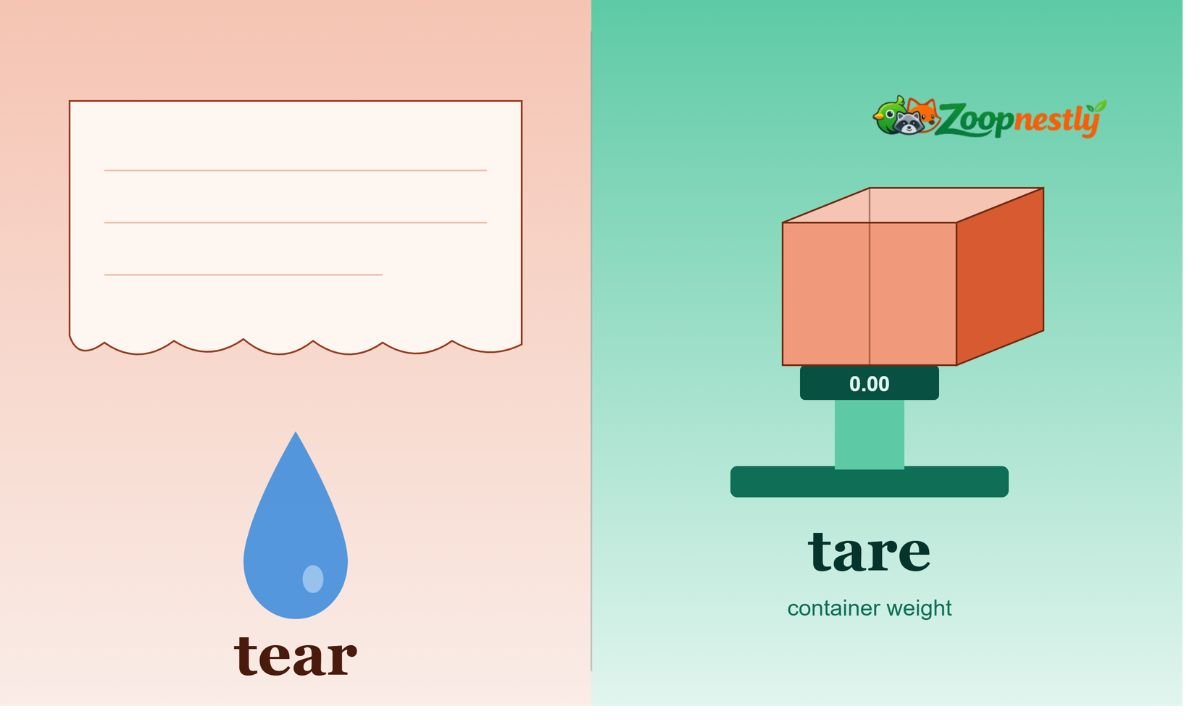
Tear means to rip something apart, or it refers to a drop of liquid from your eye. Tare is a noun and verb used mostly in shipping, science, and cooking to describe the weight of an empty container, which gets subtracted to find the true weight of its contents. They sound alike but share no meaning or origin.
Tear vs Tare: The Core Difference
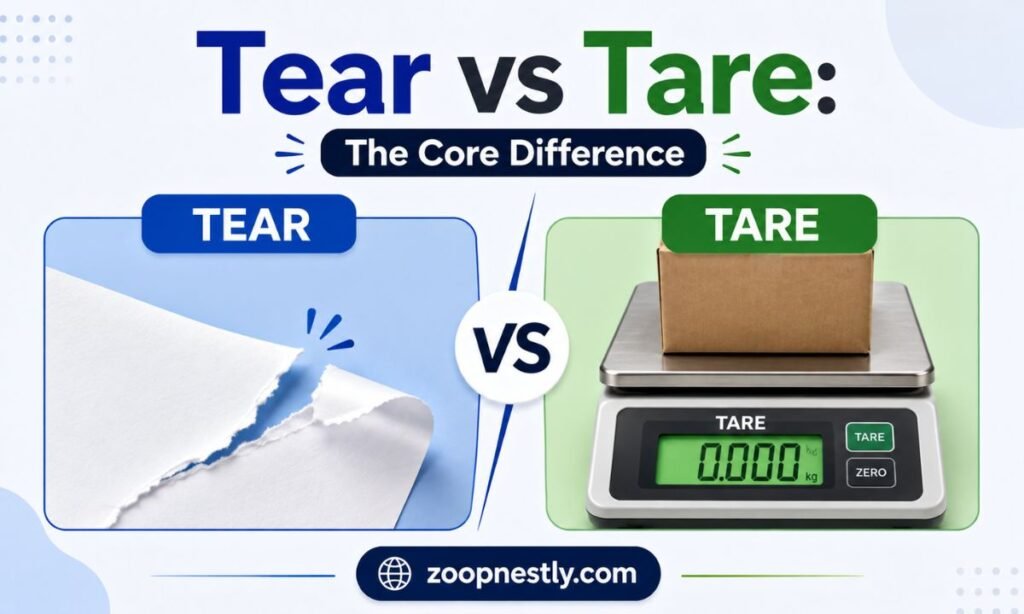
The confusion between these two words comes down entirely to sound, not meaning. English has plenty of homophones like this, but tear and tare are two of the most commonly mixed up because both show up in everyday and professional writing.
Tear works two ways:
- As a verb: to rip, pull apart, or damage something (rhymes with “care” or “hair” depending on meaning, more on that below)
- As a noun: a drop of liquid released from your eye, usually from crying or irritation
Tare only really has one core meaning:
- A noun or verb referring to the weight of an empty container, used to calculate net weight
There’s no overlap in meaning, no shared root, and no situation where you could correctly swap one for the other. The only thing they have in common is how they sound when spoken casually.
How Do You Pronounce Tear and Tare?
This is where things get genuinely tricky, because tear has two different pronunciations depending on its meaning, and one of them sounds exactly like tare.
| Word | Pronunciation | Meaning |
| Tear (rip) | /tair/ — rhymes with “hair” | To rip or pull apart |
| Tear (eye) | /teer/ — rhymes with “here” | A drop from crying |
| Tare | /tair/ — rhymes with “hair” | Container weight |
So tear meaning “to rip” and tare are true homophones. They sound identical. But tear meaning “a drop from the eye” sounds different, closer to “tier.” This is why context matters so much when you’re reading the word out loud, and why writers need to lean on spelling to avoid confusion in text.
Where Do These Words Come From?
Understanding the origin of each word makes the difference easier to remember, because they come from completely unrelated language families.
Tear Has Old English Roots
Both meanings of tear trace back to Old English. The “rip apart” sense comes from teran, a Germanic verb meaning to tear or lacerate. The “eye drop” sense comes from tear or teagor, also Germanic, referring to a drop of fluid. These two meanings developed side by side in English for over a thousand years, which is part of why they share spelling despite sounding different.
Tare Comes from Trade and Commerce
Tare entered English much later, through French tare and ultimately from Arabic ṭarḥ, meaning “thing deducted” or “waste.” It arrived through medieval trade and shipping terminology, where merchants needed a word for the weight of packaging that had to be subtracted from a shipment’s total weight. That commercial origin is exactly why tare still shows up mainly in shipping, science, and industry today.
Tear vs Tear Up: Same Word, Different Feel
One more wrinkle worth mentioning: tear up doesn’t always mean “to rip into pieces.” Depending on context, it can also mean to become emotional or start crying.
- “She teared up during the speech” means she started to cry a little.
- “He tore up the letter” means he physically ripped it apart.
Same phrase structure, different meaning, and the correct interpretation depends entirely on context and the verb tense used. Note also that the past tense of “tear” (rip) is “tore,” not “teared,” except in this specific emotional sense of “teared up.”
Using Tear and Tare in Real Sentences
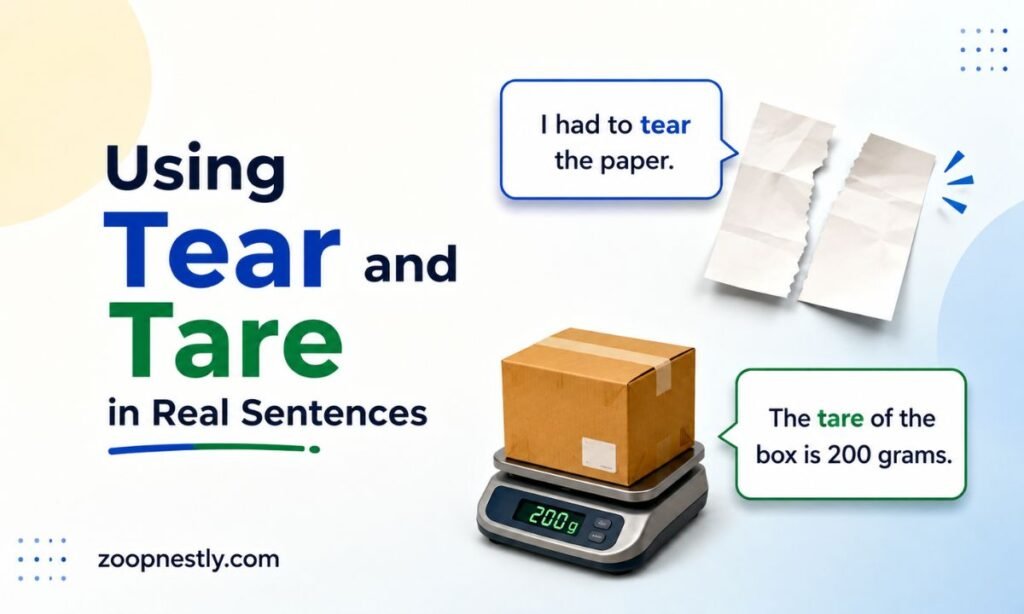
Seeing these words in context makes the distinction much easier to lock in.
Tear (to rip):
- Please don’t tear the wrapping paper yet.
- The old book’s cover started to tear at the spine.
- I need to tear this coupon along the dotted line.
Tear (eye drop):
- A single tear rolled down her cheek.
- His eyes filled with tears during the farewell.
Tare (container weight):
- The scale’s tare function subtracts the bowl’s weight automatically.
- Shipping labels must list both the gross weight and the tare weight.
- After taring the container, place your ingredients on the scale.
Where You’ll Actually See Tare Used
Because tare is a more specialized word, it helps to know exactly where it shows up so you recognize it in the wild.
| Field | How Tare Is Used |
| Shipping and logistics | Calculating net cargo weight by subtracting container weight |
| Cooking and baking | Zeroing out a kitchen scale before adding ingredients |
| Chemistry and lab work | Taring a scale before measuring a sample |
| Vehicle weighing | Determining a truck’s empty weight before loading cargo |
| Retail scales | Grocery store scales that “tare” the bag before weighing produce |
If you’ve ever pressed the “zero” or “tare” button on a kitchen scale, you’ve already used this word in practice, even if you never thought about the spelling.
Common Mistakes to Avoid
A few patterns cause most of the confusion between these words.
- Writing “tare” when you mean an emotional tear. This usually happens because “tare” looks like it could be the plural or verb form, but it never applies to crying.
- Writing “tear” in a shipping or scale context. If you’re talking about container weight, “tear weight” is incorrect. It should always be tare weight.
- Using “teared” instead of “tore” for the ripping meaning. “Teared” is only correct in the phrase “teared up” for crying.
- Assuming they’re related words. Since they sound alike, some writers assume one derived from the other. They didn’t. Different roots, different centuries, different purposes.
A quick trick: if the sentence involves weight, scales, or shipping, it’s tare. If it involves ripping or crying, it’s tear.
Words That Mean the Same Thing
Expanding your vocabulary around each word can help reinforce the difference.
Synonyms for tear (to rip): shred, rip, split, sever, rend
Synonyms for tear (eye drop): teardrop, weeping (as a general concept)
Synonyms for tare (weight): container weight, packaging weight, empty weight, unladen weight
Notice that tare doesn’t have many casual synonyms, because it’s a technical term with a specific, narrow function. That specificity is actually useful for spotting the correct word to use.
DISCOVER MORE : City vs Town vs Village: What’s the Real Difference Explained
Is There a British vs American Difference?
No meaningful difference exists here. Both tear and tare are spelled and used the same way in American and British English. Pronunciation of “tear” (rip) versus “tear” (eye) follows the same pattern in both dialects. The word tare keeps its trade-and-commerce meaning globally, since shipping and scale terminology is largely standardized across English-speaking countries.
Memory Tricks to Keep Them Straight

A few simple associations make this permanent:
- Tare has an “A” for cArgo. Think of the “A” in tare standing for cargo, container, or calculation.
- Tear has an “E” for Eye. The “E” in tear can remind you of the eye, since that’s the emotional meaning.
- Picture a shipping label: tare weight is printed right there in commercial paperwork, never in a personal or emotional context.
Once one of these tricks sticks, the mix-up tends to disappear from your writing for good.
FAQs
Is “tare” a real word?
Yes. Tare is a legitimate English word used mainly in shipping, cooking, and science to describe the weight of an empty container or packaging, which is subtracted to find the actual weight of the contents.
Do tear and tare sound exactly the same?
Only in one sense. Tare and tear meaning “to rip” are true homophones, both pronounced like “hair.” But tear meaning “a drop from the eye” is pronounced differently, closer to “here.”
What does “tare weight” mean on a package?
Tare weight is the weight of an empty box, bag, or container before anything is added. Subtracting it from the total gross weight gives you the net weight of the actual contents.
Why does my kitchen scale have a “tare” button?
The tare button resets the scale to zero after you place an empty bowl or container on it. This lets you measure only the weight of the ingredients you add, not the container itself.
Can “tare” ever mean an emotional tear?
No. Tare never refers to crying or eye drops. That meaning belongs exclusively to tear, spelled with an E and pronounced like “here.”
Final Thoughts
Tear and tare may sound alike, but they belong to entirely different corners of the English language. One is emotional and physical, tied to ripping and crying. The other is practical and technical, tied to weight and measurement. Once you connect each word to its actual use, whether that’s a torn piece of paper, a tear on your cheek, or a tare weight on a shipping label, the confusion clears up fast and stays gone.

James Walker is a content writer and language researcher with over 5 years of experience in meanings, definitions, and language-related topics. He enjoys simplifying complex terms into clear, easy-to-understand explanations. Through ZoopNestly.com, he helps readers find accurate and reliable information.