Stich vs Stitch: Common Spelling Mistake Explained
You’re typing a caption about your new embroidery hobby, or maybe you’re double checking a homework assignment, and suddenly you freeze. Is it “stich” or “stitch”? Autocorrect isn’t helping, and a quick glance at both words leaves you second guessing your own spelling. This mix up trips up more people than you’d expect, especially with Stich vs Stitch looking so close on the page. The good news: there’s one clear answer, and it takes less than a minute to understand.
Quick Answer
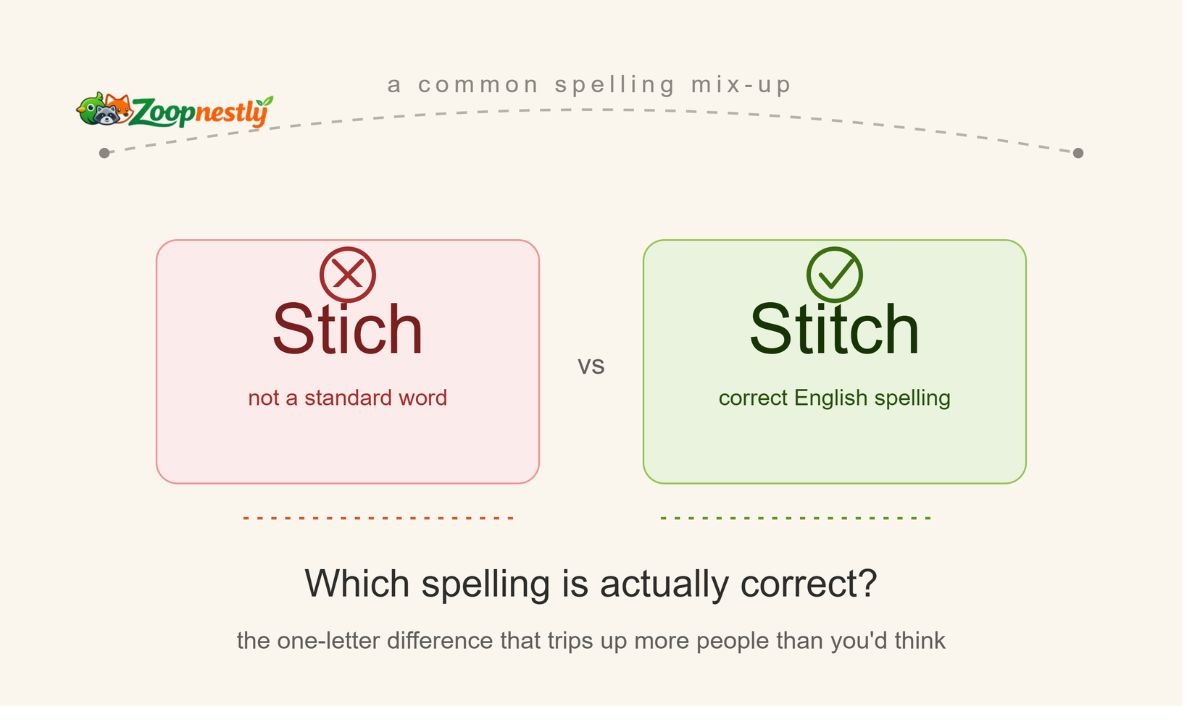
Stitch is the correct English word. It means a single loop of thread in sewing or knitting, a sharp pain in your side, or the act of sewing something together. “Stich” is not a standard English word; it’s simply a common misspelling of “stitch” (missing the letter “t”), though it is also a real surname and the name of a Disney character.
Once you know that, everything else is just detail. Let’s break down where the confusion comes from and how to never make this mistake again.
What Does “Stitch” Actually Mean?
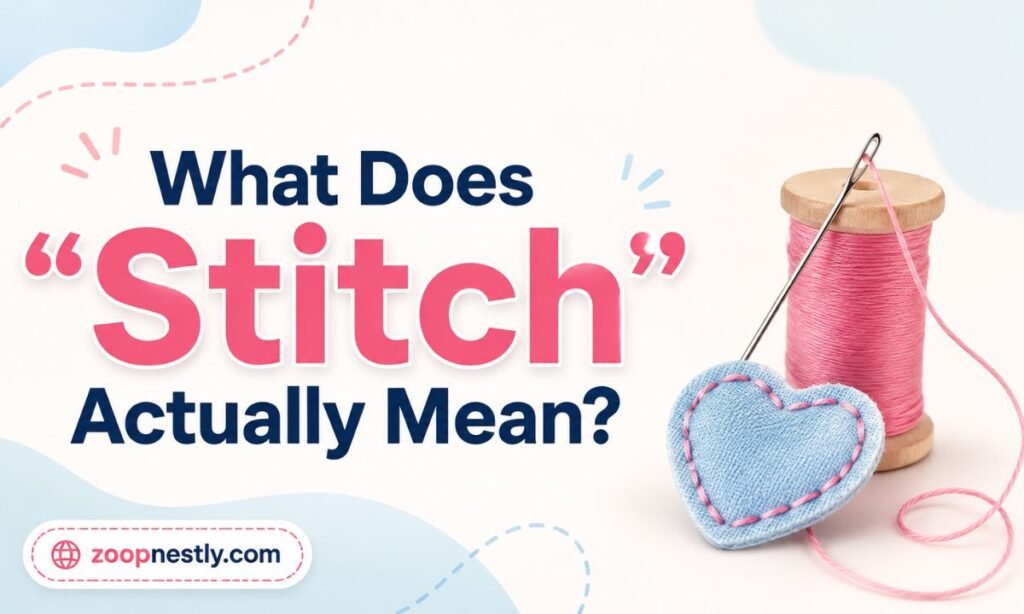
“Stitch” is a real, everyday English word with several meanings depending on context. Understanding these uses helps explain why the word shows up so often in casual writing.
Stitch as a Noun
As a noun, a stitch is one complete loop of thread made during sewing, knitting, or crocheting. It also refers to:
- A sudden, sharp pain in your side, often from running (“I got a stitch during my morning jog”)
- A single piece of surgical thread used to close a wound
- An informal way of saying “the smallest bit,” as in “he didn’t do a stitch of work”
Stitch as a Verb
As a verb, to stitch means to join, mend, or decorate fabric using thread and a needle. For example: “She stitched the torn sleeve back together in ten minutes.” It’s also used loosely to describe piecing anything together, like “stitching a story from bits of evidence.”
Where Did “Stich” Come From?
“Stich” isn’t a made up word out of nowhere. There are a few real explanations for why you keep seeing it.
- A simple typo. Dropping the second “t” is one of the most common typing slips in English, especially on mobile keyboards where letters sit close together.
- A surname. Stich is an actual last name of German origin, most notably associated with soprano singer Rosalind Elias Stich and a handful of other historical figures.
- Disney’s Stitch. The blue alien from Lilo & Stitch is spelled with two T’s, but fans searching for merchandise or fan art often mistype it as “Stich,” which fuels the confusion online.
- Foreign language influence. In German, “Stich” is a real word meaning “sting,” “stab,” or “prick.” Non-native English speakers sometimes carry that spelling over by habit.
None of these make “stich” a correct English word for sewing, pain, or joining fabric. It’s simply a lookalike.
Stich vs Stitch: Key Differences at a Glance
| Feature | Stitch | Stich |
| Valid English word | Yes | No (except as a surname) |
| Part of speech | Noun, Verb | Not applicable in English |
| Common meanings | Sewing loop, side pain, to sew | German word for “sting/stab”; a surname |
| Correct spelling | ✅ Always correct | ❌ Misspelling in standard use |
| Used in Disney’s Lilo & Stitch | Yes, official spelling | No, common misspelling |
Why This Mix-Up Happens So Often

A few patterns explain why “stich” keeps showing up, even from careful writers.
Autocorrect isn’t always reliable. Some autocorrect tools don’t flag “stich” as an error because it matches a recognized surname in their dictionary database.
Fast typing skips letters. Double consonants (like the “tt” in “stitch”) are among the easiest letters to accidentally drop while typing quickly.
Visual similarity. The words differ by just one letter, so a quick skim of the page often misses it entirely.
Cross-language confusion. Since “Stich” is a legitimate word in German, bilingual speakers or translated content sometimes carry the spelling into English by mistake.
DISCOVER MORE : Holliday vs Holiday: What Is the Difference?
Common Mistakes and How to Avoid Them
Here are the slip ups people make most often, along with the fix.
| Mistake | Why It Happens | Fix |
| Writing “stich” for the sewing term | Missed double “t” while typing | Always double check for “tt” in the middle |
| Assuming “stich” is a valid alternate spelling | Confusion with the German word or surname | Remember: in English, only “stitch” works |
| Misspelling the Disney character’s name | Fast typing or muscle memory | Picture the character’s name as “sti-TCH” |
| Using “stitch” and “sew” interchangeably in every context | Overlap in meaning | Use “sew” for the general activity, “stitch” for one loop or a quick fix |
A Simple Memory Trick
Think of the phrase “a stitch in time saves nine.” That idiom always uses the correct spelling, and picturing it can help lock the right version into memory. If you can recall that sentence, you’ll never write “stich” by mistake again.
Stitch vs Sew: What’s the Real Difference?
These two words often get treated as identical, but there’s a subtle distinction worth knowing.
Sew is the broader action, the overall process of using a needle and thread to make or repair something. Stitch refers to the individual movement or loop within that process, though it’s also used casually to describe smaller, quicker mending jobs.
Think of it this way: you sew a whole quilt, but you might stitch a small hole in your sock. One is the full activity; the other is a single step or a small fix within it.
Real World Example Sentences
Seeing the word in context makes the correct usage stick.
- “My grandmother taught me how to stitch a button back onto a shirt.”
- “After the surgery, the doctor said the stitches would dissolve on their own.”
- “He got a stitch in his side halfway through the race.”
- “The tailor stitched the hem in under five minutes.”
- “Lilo and Stitch remains one of Disney’s most beloved animated films.”
Stitch in Pop Culture
The word gets extra attention thanks to Disney’s Lilo & Stitch, where “Stitch” is the name of the mischievous blue alien experiment. Because the film is so widely searched and referenced, the correct two-T spelling has become even more visible online, which paradoxically also increases how often people mistype it as “stich” while searching or typing quickly.
Quick Rules to Remember
- Stitch is always the correct word in English for sewing, knitting, pain, or joining things together.
- Stich is not a standard English word; treat it as a typo unless you’re referring to the surname.
- The double “t” is the part most people forget, so slow down when typing it.
- When in doubt, picture the idiom “a stitch in time saves nine” to confirm the spelling.
Key Takeaways
Getting Stich vs Stitch right comes down to one simple fact: “stitch” is the real, dictionary recognized English word, and “stich” is almost always a typo. The confusion usually comes from fast typing, autocorrect gaps, or crossover from German or a surname. Once you remember the double “t,” you’ll spell it correctly every time.
Frequently Asked Questions
Is “stich” ever correct in English?
Not for sewing, pain, or joining fabric. “Stich” only appears correctly in English as a surname or as a borrowed reference to the German word meaning “sting” or “stab.”
What does “stitch” mean in sewing?
In sewing, a stitch is a single loop of thread made by a needle when joining or decorating fabric. Multiple stitches in a row create a seam.
Why do I get a “stitch” when running?
A side stitch is a sharp cramping pain, usually near the ribs, caused by stress on the muscles and ligaments around the diaphragm during physical activity. It typically fades with rest or slower breathing.
Is it “Stitch” or “Stich” in Lilo & Stitch?
The official spelling is Stitch, with two T’s. “Stich” is a common misspelling fans and shoppers accidentally use when searching for the character.
What’s the difference between “stitch” and “sew”?
“Sew” describes the overall activity of using thread and a needle to make or repair something. “Stitch” refers to a single loop or a smaller, quicker mending action within that process.
Conclusion
When it comes to Stich vs Stitch, only one spelling belongs in standard English writing: stitch. Whether you’re talking about sewing, a side cramp, surgical thread, or Disney’s favorite alien, the double “t” is non-negotiable. Keep the idiom “a stitch in time saves nine” in your back pocket, and you’ll never second guess this spelling again.

James Walker is a content writer and language researcher with over 5 years of experience in meanings, definitions, and language-related topics. He enjoys simplifying complex terms into clear, easy-to-understand explanations. Through ZoopNestly.com, he helps readers find accurate and reliable information.