Choosing vs Chosing: The Ultimate Grammar Guide
You’re halfway through an email, typing out a sentence about choosing the right option, when your fingers stumble and “chosing” comes out instead. It looks almost right. Spell check might even hesitate for a second. But one of these words doesn’t exist in standard English, and using it in a resume, a school paper, or a client message can quietly undercut your credibility. Here’s the simple fix, once and for all.
Quick Answer
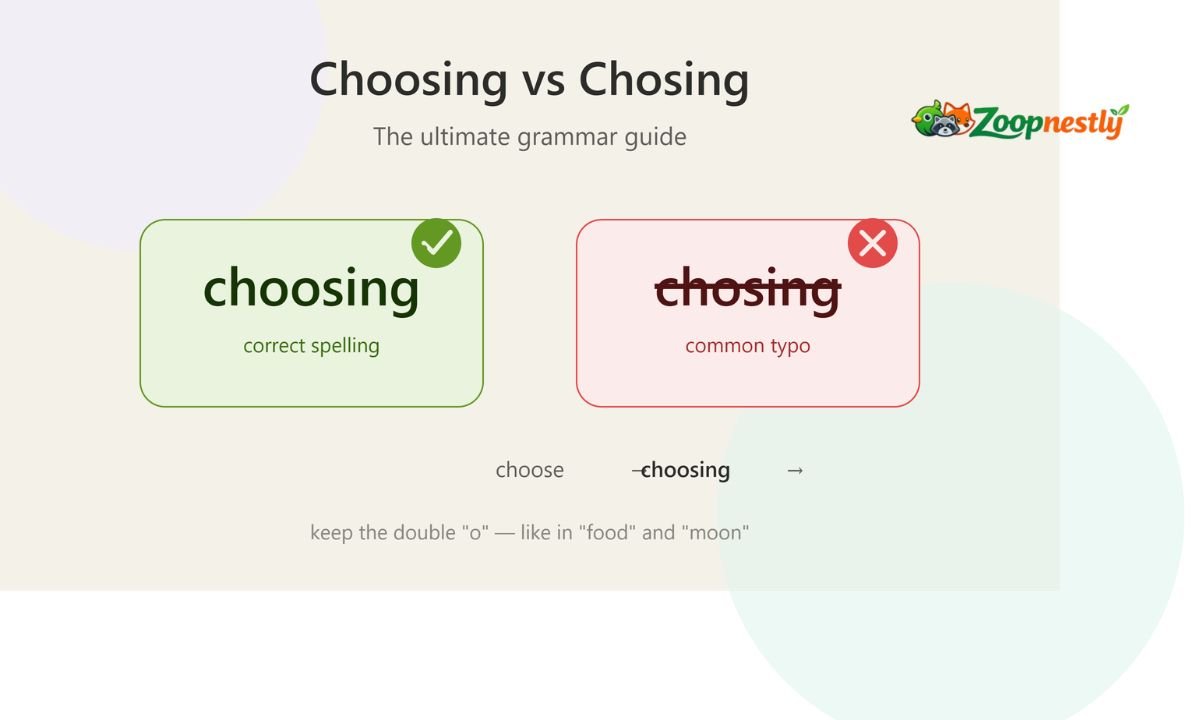
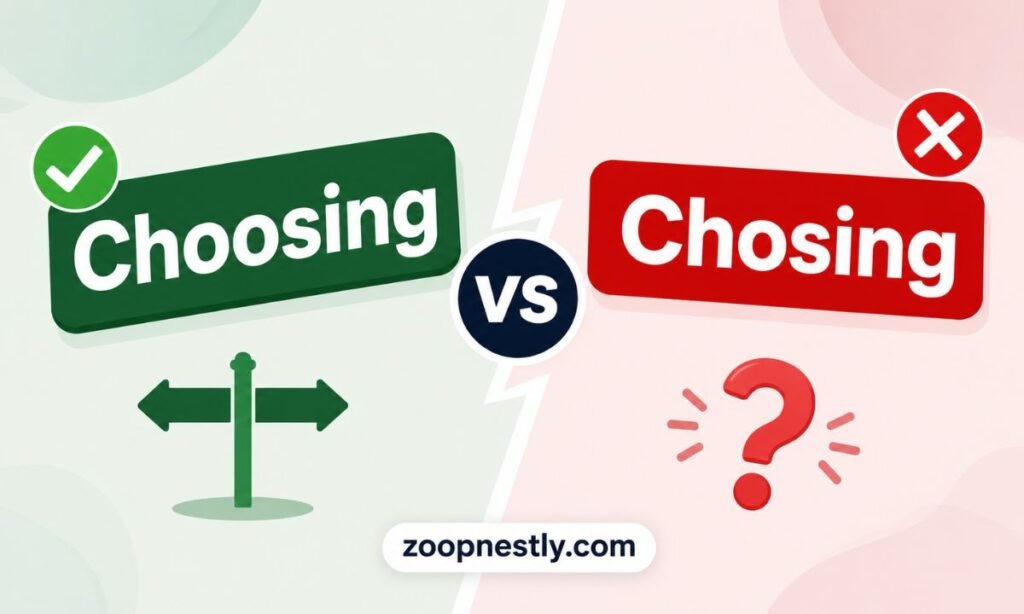
Choosing is the correct spelling. It’s the present participle (the -ing form) of the verb “choose.” Chosing is a common misspelling and is not a recognized word in English. The mistake usually happens because writers drop the silent “o” incorrectly when adding “-ing,” instead of keeping it: choose → choosing.
Choosing vs Chosing: The Short Explanation
The verb “choose” already ends in a silent “e” before “-ing” would normally be added. Normally, English drops a silent “e” before adding “-ing” (like “make” becoming “making”). But “choose” is an exception because of its double “o” sound.
When you add “-ing” to “choose,” you keep the second “o” and simply attach “-ing” directly:
choose + ing = choosing
“Chosing” happens when someone mistakenly treats “choose” like “chose” (the past tense) and adds “-ing” to that instead, or drops a letter by accident while typing quickly. Either way, “chosing” is not standard in any dictionary, style guide, or grammar reference.
Why “Chosing” Feels Right (But Isn’t)
If “chosing” looks somewhat plausible, you’re not imagining things. English has plenty of words where a silent “e” disappears before “-ing”:
- write → writing
- come → coming
- hope → hoping
Your brain applies that same pattern to “choose” and produces “chosing.” The problem is that “choose” doesn’t follow the usual silent-e rule because removing the “e” here doesn’t just drop a silent letter, it changes the whole spelling pattern of the word. Keeping “oo” intact is what preserves the correct pronunciation and meaning.
Verb Forms of Choose: A Complete Breakdown
Understanding all the forms of “choose” makes it much easier to avoid mixing them up.
| Form | Word | Example |
| Base form | choose | I choose this option every time. |
| Present participle / gerund | choosing | She is choosing between two job offers. |
| Past tense | chose | He chose the blue shirt yesterday. |
| Past participle | chosen | They have chosen a new leader. |
A quick way to remember it: “choose” and “choosing” both keep the double “o.” “Chose” and “chosen” drop one “o” because the vowel sound shortens in the past forms. There is no version of this verb spelled with “chosing.”
How to Use “Choosing” in a Sentence
“Choosing” works as a gerund (acting like a noun) or as part of a continuous verb tense.
As a gerund:
- Choosing a college major can feel overwhelming.
- Choosing wisely often takes more time than people expect.
As part of a verb phrase:
- I am choosing the second design for the logo.
- We were choosing between three restaurants before deciding on sushi.
Common surrounding phrases:
- when choosing
- the process of choosing
- choosing between
- choosing to + verb (e.g., “choosing to stay home”)
Common Mistakes Beyond “Chosing”
“Chosing” isn’t the only error people make with this verb. Here are a few related mix-ups worth knowing:
- Chose vs choose: “Chose” is past tense. “I choose you” is present tense, “I chose you” is past.
- Chosen vs chose: “Chosen” needs a helping verb (has, have, was). “She has chosen” is correct, not “she has chose.”
- Choosen: Another frequent typo, mixing “choose” and “chosen.” This word doesn’t exist either.
- Choosing vs Choosing’s: Adding an apostrophe-s to “choosing” is rarely correct, since it’s a verb form, not a possessive noun.
A simple test: if you can swap in “selecting” and the sentence still makes sense, “choosing” is almost always the word you want.
Choosing vs Selecting vs Picking: What’s the Difference?
These three words are close in meaning but carry slightly different tones, which matters if you want your writing to sound natural rather than repetitive.
| Word | Tone | Best Used In |
| Choosing | Neutral, general-purpose | Everyday writing, formal and informal contexts |
| Selecting | Slightly more formal, deliberate | Business, academic, or technical writing |
| Picking | Casual, quick decisions | Conversational or informal writing |
Example comparison:
- The committee is choosing a winner. (neutral)
- The committee is selecting a winner. (formal)
- I’m just picking whichever one looks good. (casual)
None of these words are interchangeable in every context, but understanding the shades of difference helps you pick the right tone for your audience.
How to Pronounce “Choosing”
“Choosing” is pronounced CHOO-zing (/ˈtʃuːzɪŋ/). The key details:
- The “oo” makes a long “u” sound, like in “food.”
- The “s” is pronounced like a “z,” similar to the sound in “please.”
- Stress falls on the first syllable.
Saying the word out loud, slowly, often helps writers catch the spelling error before it happens. If you can hear the long “oo” sound, your fingers are less likely to drop it while typing.
DISCOVER MORE : Triple vs Tripple: The Right Spelling You Need to Know
Memory Tricks to Remember the Correct Spelling
If “chosing” keeps slipping into your writing, try one of these tricks:
- Double “O,” double check. “Choose” has two O’s, and “choosing” keeps them both. If you only see one O, stop and fix it.
- Link it to “food.” Both words share the same “oo” sound and spelling pattern.
- Say it slowly. Stretching out “chooo-sing” in your head reinforces the correct letters.
- Compare to “losing.” “Lose” drops its silent “e” the normal way to become “losing,” but “choose” is the exception that keeps its extra “o” instead. Noticing that difference helps the correct spelling stick.
Practice: Test Your Understanding
Try these short exercises to check whether the spelling has clicked.
Fill in the blank:
- She is _______ between two apartments this weekend.
- He has already _______ his outfit for the interview.
- We _______ the smaller car because it was easier to park.
Answers: 1. choosing, 2. chosen, 3. chose
Spot the error:
- “I am chosing a new laptop.” → Incorrect. Correct: “I am choosing a new laptop.”
- “They are choosing the venue for the wedding.” → Correct as written.
Key Takeaways
- Choosing is the only correct spelling of this word.
- Chosing is a common typo, not an alternate spelling.
- The verb “choose” follows an irregular pattern, unlike most silent-e verbs.
- Full verb forms: choose, chose, choosing, chosen.
- “Choosing,” “selecting,” and “picking” are related but carry different tones.
Frequently Asked Questions
Is “chosing” ever correct in any context?
No. “Chosing” is not recognized in any standard English dictionary or style guide. It is always considered a misspelling of “choosing.”
Why does “choose” keep both O’s in “choosing” but not in “chose”?
Because “choose” and “chose” are different verb forms with different pronunciations. The present forms (“choose,” “choosing”) use the long “oo” sound, while the past forms (“chose,” “chosen”) use a shorter vowel sound and drop one “o” accordingly.
What part of speech is “choosing”?
“Choosing” can function as a gerund (a verb form acting as a noun, like “Choosing is hard”) or as part of a continuous verb tense (like “I am choosing”).
Is “choosing” the same as “choose”?
No. “Choose” is the base form, used for present-tense actions (“I choose”). “Choosing” is the -ing form, used for ongoing actions (“I am choosing”) or as a gerund.
How can I quickly check if I’m spelling “choosing” correctly?
Look for the double “oo” followed directly by “sing.” If your word reads “chosing” with only one “o,” it’s misspelled. A quick mental check against “food” or “moon” can help confirm the correct spelling.
Conclusion
The rule here is straightforward once it clicks: choosing keeps the double “o” from its base verb “choose,” while chosing is simply an incorrect variation that doesn’t belong in standard English. Keep the verb forms straight (choose, chose, choosing, chosen), lean on the pronunciation as a memory cue, and you’ll spell it correctly every time without having to think twice.

James Walker is a content writer and language researcher with over 5 years of experience in meanings, definitions, and language-related topics. He enjoys simplifying complex terms into clear, easy-to-understand explanations. Through ZoopNestly.com, he helps readers find accurate and reliable information.