Symptomatology or Symptomology: Which Term Is Correct?
You’re reading a clinical note or drafting a research paper, and suddenly you pause: is it symptomatology or symptomology? Both terms pop up in medical writing, textbooks, and even casual health blogs, and the overlap makes it easy to second-guess yourself. Using the wrong one in a professional document can make your writing look careless, even if your meaning stays clear. The debate over symptomatology vs symptomology really comes down to accepted usage, not personal preference. Here’s what actually separates the two, and which one belongs in your writing.
Quick Answer
Symptomatology is the correct, medically recognized term for the study or overall pattern of symptoms linked to a disease or condition. Symptomology is a nonstandard variant that shows up often in informal writing and online content but isn’t recognized in clinical, academic, or dictionary-standard usage. When comparing symptomatology vs symptomology, always choose symptomatology in professional or medical contexts.
What Is Symptomatology?
Symptomatology refers to the branch of medicine concerned with symptoms, or more specifically, the full collection of symptoms that characterize a particular disease or condition. Doctors, medical writers, and researchers use it in two main ways:
- As a general term for “the symptoms of a condition” (example: “the symptomatology of migraine includes light sensitivity and nausea”)
- As a reference to the study of symptoms as a diagnostic tool
You’ll find symptomatology in peer-reviewed journals, clinical charts, medical textbooks, and diagnostic manuals. It’s the term recognized by major dictionaries, including Merriam-Webster, and it’s the one taught in medical school.
What Is Symptomology?
Symptomology is essentially a shortened, informal version of symptomatology. It means the same thing in practice, a set or study of symptoms, but it isn’t considered standard medical terminology. Most major dictionaries either flag it as nonstandard or don’t list it at all.
That doesn’t mean the word is meaningless. Language evolves, and symptomology has become common enough in everyday speech and online writing that people instantly understand it. But if you’re writing for a medical journal, a clinical record, or an academic paper, symptomology isn’t the term reviewers or editors expect to see.
Symptomatology vs Symptomology: Key Differences
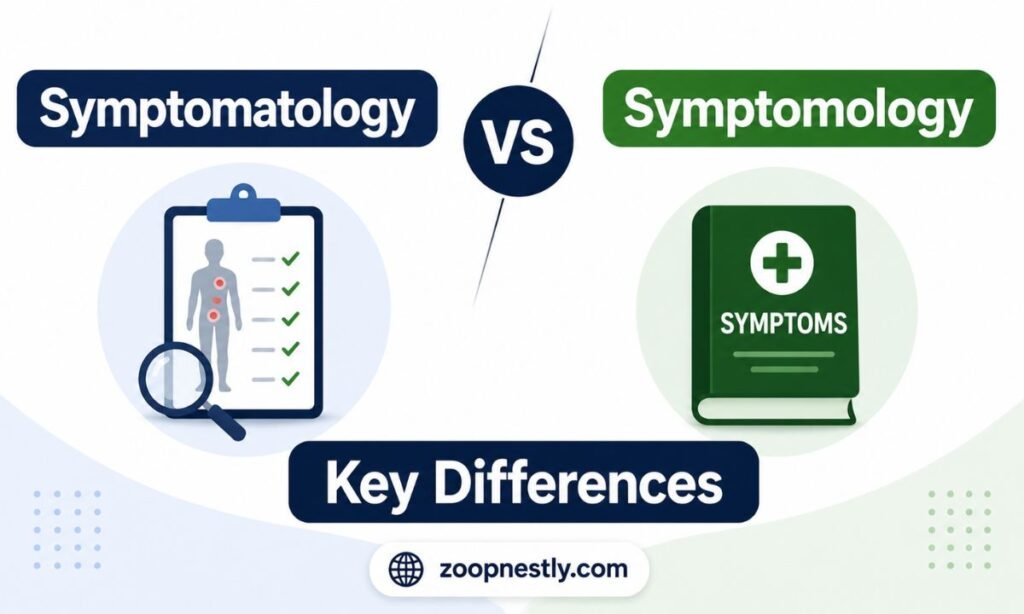
Here’s a side-by-side look at how the two terms compare:
| Feature | Symptomatology | Symptomology |
| Standard usage | Yes, recognized in medical and general dictionaries | No, considered informal or nonstandard |
| Used in clinical/academic writing | Yes | Rarely, and usually flagged in editing |
| Origin | Older, more established medical term | Later, informal shortening |
| Meaning | Study/pattern of symptoms | Same intended meaning |
| Best context | Medical charts, research, textbooks | Casual writing, informal health content |
The meanings overlap almost completely. The real difference is one of acceptance and formality, not definition.
Why the Confusion Between the Two Terms Exists
The mix-up happens for a simple reason: both words look and sound alike, and both seem to follow a logical pattern based on the word “symptom.” People naturally shorten longer medical terms in speech, and over time, symptomology slipped into casual use without going through the same vetting as terms coined through formal medical Latin and Greek roots.
Spell checkers and autocorrect tools also don’t always flag symptomology as incorrect, since it’s grammatically well-formed and appears often enough online. That reinforces the idea that both words are interchangeable, even though only one carries formal recognition.
Word Origin and Etymology
Symptomatology comes from a combination of “symptom” and the Greek suffix -logy, meaning “the study of.” The connecting form uses “symptomat-,” which reflects the Greek root symptōma (a “happening” or “occurrence”), rather than a direct shortening of the English word “symptom.” This is the same pattern seen in terms like pathology or physiology.
Symptomology, by contrast, drops the “-at-” piece and attaches “-ology” directly to “symptom.” It looks like a natural shortcut, but it doesn’t follow the traditional Greek word-building pattern that gave us the original medical term. That’s part of why language experts and style guides treat it as a variant rather than a parallel, equally valid word.
DISCOVER MORE : Togather vs Together: Correct Word, Meaning, and Examples
Symptomatology in Clinical Practice

In real clinical settings, symptomatology plays a specific role. Physicians use it to describe the complete symptom profile of a patient, which helps guide diagnosis and treatment decisions. For example, a doctor might document that a patient’s symptomatology is “consistent with early-stage rheumatoid arthritis” based on joint pain, stiffness, and swelling patterns.
Medical researchers also rely on symptomatology when comparing how a disease presents across different patient groups. This is especially useful in conditions where symptoms vary widely, such as depression, anxiety disorders, or autoimmune diseases.
Examples: Symptomatology vs Symptomology in a Sentence
Seeing both words in context makes the difference easier to remember.
Correct (formal/medical):
- “The patient’s symptomatology included fatigue, joint pain, and low-grade fever.”
- “Researchers studied the symptomatology of long COVID across 300 participants.”
Informal (commonly seen, but not standard):
- “Her symptomology got worse over the weekend.”
- “The article breaks down the symptomology of seasonal allergies.”
If you’re writing a blog post for a general audience, symptomology likely won’t confuse anyone. But if you’re submitting to a journal, writing clinical documentation, or aiming for professional credibility, symptomatology is the safer, more accurate choice.
Signs vs Symptoms: A Related Distinction
Since symptomatology deals with symptoms specifically, it helps to know how symptoms differ from signs, another term that gets confused in clinical writing.
- Symptoms are what the patient reports feeling, such as pain, nausea, or fatigue. They’re subjective.
- Signs are what a clinician can observe or measure, such as a fever reading, rash, or abnormal heart rate. They’re objective.
Symptomatology focuses on the patient-reported side of the picture, though it’s often interpreted alongside clinical signs to reach a full diagnosis.
Limitations of Relying on Symptomatology Alone

Symptomatology is useful, but it has limits. Many conditions share overlapping symptoms, which means relying only on a symptom pattern can lead to misdiagnosis. Fatigue, for example, shows up in dozens of unrelated conditions, from thyroid disorders to depression to anemia.
That’s why doctors combine symptomatology with lab tests, imaging, patient history, and physical signs rather than diagnosing from symptoms alone. Recognizing this limitation is part of why medical training emphasizes symptomatology as one diagnostic tool among many, not a standalone answer.
Common Mistakes to Avoid
- Using symptomology in formal writing. It may be understood, but it can undermine credibility in academic or clinical documents.
- Assuming the words mean different things. They don’t. The difference is formality and acceptance, not definition.
- Confusing symptomatology with “symptoms.” Symptomatology refers to the overall pattern or study of symptoms, not a single symptom itself.
- Mixing up symptoms and signs when describing a patient’s condition.
How to Remember Which Term to Use
A simple trick: if you’d trust the word in a textbook, use symptomatology. If you’re writing casually and just want to sound conversational, symptomology will still get your point across, but it’s worth defaulting to the standard term whenever accuracy or professionalism matters.
Frequently Asked Questions
Is symptomology a real word?
Symptomology is understood and used informally, but it isn’t recognized as standard medical terminology the way symptomatology is. Most professional and academic writing avoids it.
Which term should I use in a medical paper?
Use symptomatology. It’s the dictionary-recognized, professionally accepted term expected in medical journals, clinical notes, and academic research.
Do symptomatology and symptomology mean the same thing?
Yes, both refer to the pattern or study of symptoms associated with a condition. The difference lies in formal acceptance, not meaning.
Why did symptomology become popular despite not being standard?
It likely developed as a natural shortening of symptomatology, and it spread through casual and online writing where formal terminology isn’t always required.
Is symptomatology only used for physical illnesses?
No. Symptomatology applies to mental health conditions as well, such as the symptomatology of anxiety, depression, or PTSD, in addition to physical diseases.
Conclusion
When it comes to symptomatology vs symptomology, the choice isn’t really about right or wrong meaning, it’s about professional accuracy. Symptomatology is the established medical term recognized in textbooks, journals, and clinical practice, while symptomology remains an informal variant that hasn’t earned the same acceptance. For everyday conversation, either word gets your point across. But for anything academic, clinical, or professional, symptomatology is the term worth using.

James Walker is a content writer and language researcher with over 5 years of experience in meanings, definitions, and language-related topics. He enjoys simplifying complex terms into clear, easy-to-understand explanations. Through ZoopNestly.com, he helps readers find accurate and reliable information.