Defence vs Defense: Which One Should You Use in Writing?
You’re halfway through writing an email, report, or essay, and your cursor stalls on one word. Is it defence or defense? Spellcheck flags one version, your memory insists on the other, and now you’re second-guessing a word you’ve used a hundred times. This mix-up trips up even confident writers, especially when switching between British and American sources. The good news: the defence or defense puzzle has a simple, reliable answer once you know the rule behind it.
Quick Answer
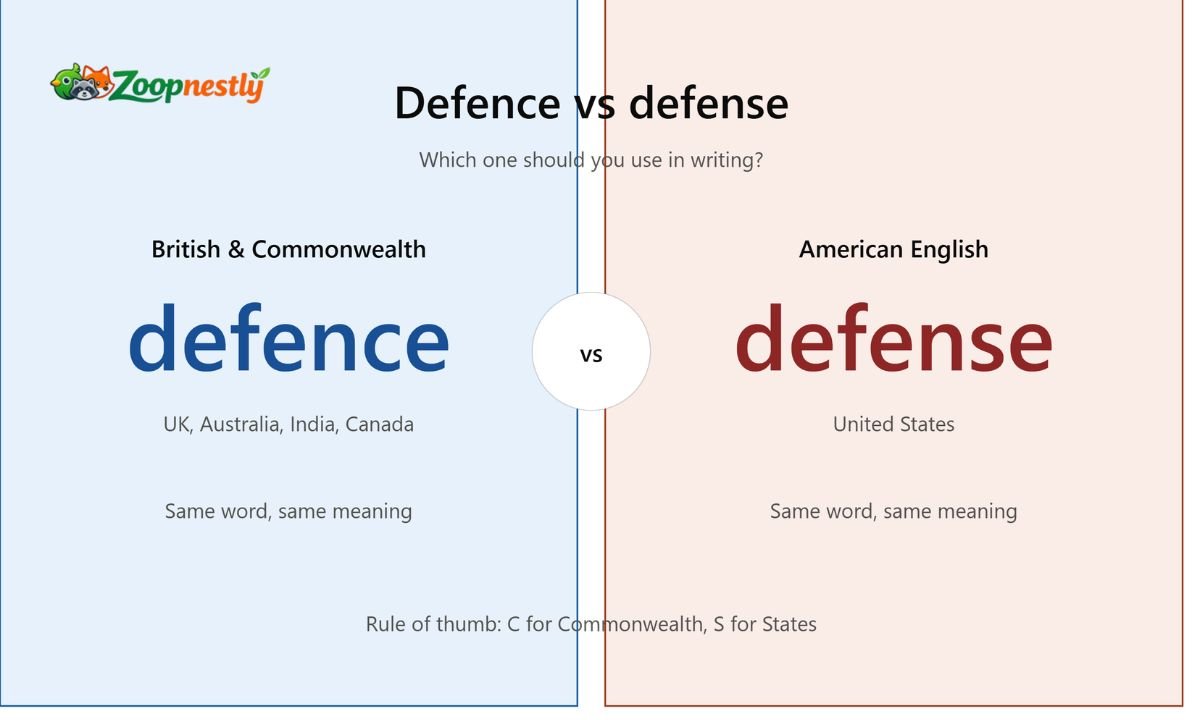
Defence and defense are the same word with two accepted spellings. Defence is the standard spelling in British English, Australian English, and most Commonwealth countries. Defense is the standard spelling in American English. Neither spelling is “wrong” globally, but using the wrong one for your audience can look like a typo.
What Is the Difference Between Defence and Defense?
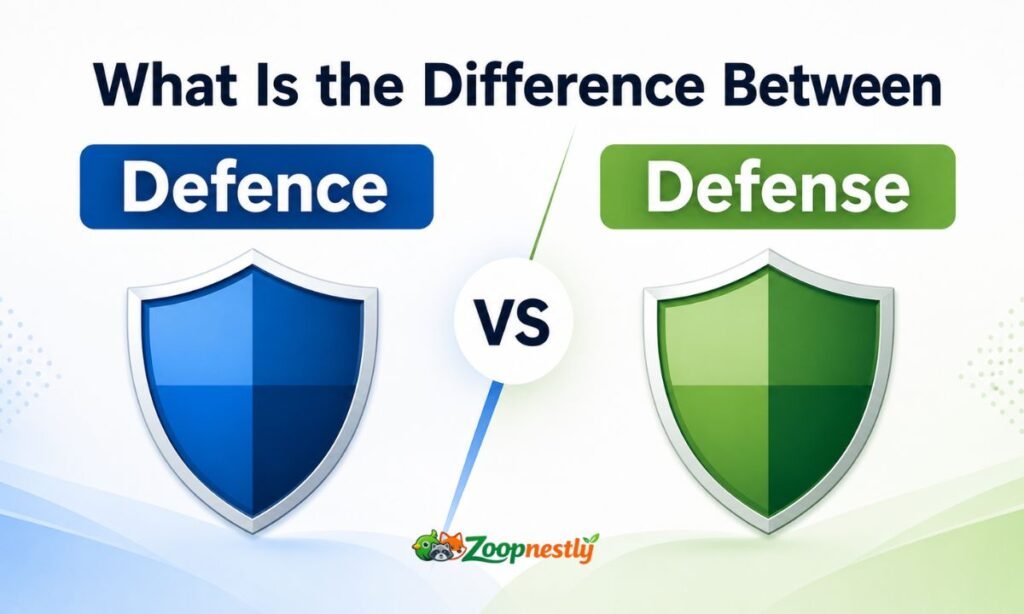
The difference isn’t in meaning, pronunciation, or grammar. Both words mean the act of protecting something from attack, criticism, or harm. The only difference is regional spelling convention.
- Defence — used in the UK, Ireland, Australia, New Zealand, India, South Africa, and most Commonwealth nations
- Defense — used in the United States and, informally, in Canada (though Canadian style often leans British)
Think of it the same way you’d think about colour vs color or organise vs organize. It’s a spelling variant, not a separate word.
Where the “C” and “S” Came From
Both spellings trace back to the same root, so neither one is a modern invention.
Latin and French Origins The word comes from the Latin defensa, filtered through Old French as defence. English inherited this French-influenced spelling first, which is why British English kept the “c.”
British Standardization British English largely preserved the French-derived spelling as dictionaries and formal grammar rules solidified in the 18th and 19th centuries.
American Spelling Reform American lexicographer Noah Webster pushed for simpler, more phonetic American spellings in the early 1800s. He standardized “defense” along with other changes like color and center, aiming to make American English more consistent and distinct from British norms.
Defence vs Defense: Quick Comparison Table
| Feature | Defence (British) | Defense (American) |
| Region | UK, Australia, most Commonwealth countries | United States |
| Word origin | Old French defence | Latinized by Webster’s reforms |
| Government use | UK Ministry of Defence | US Department of Defense |
| Common in | Academic, legal, government writing (UK) | Academic, legal, government writing (US) |
| Sports usage | “The defence held strong” (UK) | “The defense held strong” (US) |
| SEO/search volume | Lower in US-targeted searches | Higher in US-targeted searches |
When Should You Use Defence?
Use defence when your audience, publication, or organization follows British English conventions.
Academic and Formal UK Writing UK universities, journals, and style guides expect “defence” in essays, theses, and reports.
Government and Legal Documents Bodies like the UK Ministry of Defence use “defence” in all official material, and UK courts follow the same spelling in legal defence arguments.
International Audiences Following UK Standards Many former British colonies, along with international organizations based in the UK or EU, default to British spelling.
When Should You Use Defense?
Use defense when writing for American readers or US-based platforms.
US Academic and Business Writing American universities, employers, and publishers expect “defense” as the default spelling.
Government and Legal Use The US Department of Defense, American court filings, and US legal terminology all use “defense.”
Digital Content for US Audiences If your website, blog, or product targets US users, “defense” matches what people actually search for and expect to read. Mixing in “defence” can look like an error even though it isn’t.
Real-World Examples in Everyday Writing

Seeing the word in context makes the choice easier to remember.
Military Context
- UK: “The country increased its defence budget this year.”
- US: “The country increased its defense budget this year.”
Sports Context
- UK: “Their defence conceded only two goals all season.”
- US: “Their defense allowed just two touchdowns all season.”
Legal Context
- UK: “The defence argued the evidence was inadmissible.”
- US: “The defense argued the evidence was inadmissible.”
Personal Protection Context
- UK: “Pepper spray is a common form of self-defence.”
- US: “Pepper spray is a common form of self-defense.”
Notice the sentence structure never changes. Only the spelling shifts.
DISCOVER MORE : Career or Carrer: Which Word Should You Use?
Common Mistakes to Avoid
- Mixing spellings in one document. Pick one style and stay consistent from start to finish, even in headings and captions.
- Assuming spellcheck is always right. Word processors set to US English will auto-correct “defence” even in British-audience content.
- Ignoring brand or platform names. Proper nouns like “Department of Defense” keep their official spelling regardless of your document’s style, just like you wouldn’t rewrite “World Health Organisation.”
- Switching mid-project. If you start a report using “defence,” don’t drift into “defense” halfway through after copying text from a US source.
Is It Defence or Defense in Football?
It depends which football you mean. In American football, defense is the standard spelling, referring to the team preventing the opponent from scoring. In British football (soccer), defence is standard, referring to the players and tactics used to stop the opposing team from scoring. Both describe the same core idea: a team’s effort to prevent points or goals.
Defence or Defense in the Defense Industry
The global defense and defence industry, covering military technology, weapons systems, and national security contracts, uses whichever spelling matches the country of the organization involved. A US defense contractor and a UK defence contractor might work on similar projects, but each will spell the term according to their national standard in contracts, press releases, and job postings. If you’re writing about this industry for an international audience, match the spelling to whichever company or government body you’re referencing.
Defence vs Defense: Usage Trends Writers Should Know
Style guides and search behavior both reinforce the regional split. The Associated Press Stylebook, used by most US newsrooms, specifies “defense.” The Oxford Style Guide, used across UK publishing, specifies “defence.” If you write for international clients, checking which style guide they follow is often faster than guessing.
Search behavior follows the same pattern. People typing queries into Google from the US almost always type “defense,” while searchers in the UK, Australia, and India type “defence.” Matching your spelling to your audience’s search habits helps your content show up for the terms people actually type, and it signals to readers that the content was written with them in mind.
What This Means for Writers If you write for a specific regional audience, match their spelling. If you write for a global blog, decide early which version you’ll standardize on, note it in your style guide, and apply it consistently across every article, product page, and social caption.
How to Remember the Difference

A simple memory trick: C for Commonwealth, S for States. British and Commonwealth English keeps the “c” in defence, while American English swaps it for an “s” in defense.
If you’re still unsure which to use, let your audience decide. Writing for a US company, US-based readers, or American publication? Use “defense.” Writing for a UK, Australian, or Commonwealth audience? Use “defence.” When your audience is mixed or global, consistency matters more than which one you pick, so choose one and stick with it throughout.
Quick Self-Test
Try these before moving on:
- UK government agency: “Ministry of ___” (Defence or Defense?)
- US government agency: “Department of ___” (Defence or Defense?)
- True or False: Both spellings are grammatically correct in their respective regions.
- American football phrase: “Their ___ shut down the offense.”
- British football phrase: “Their ___ was solid all match.”
Answers: 1. Defence, 2. Defense, 3. True, 4. defense, 5. defence
Frequently Asked Questions
Is defence or defense correct in Canada?
Canadian English traditionally uses “defence,” following British spelling conventions, though American influence means “defense” also appears frequently in casual or US-linked writing.
Does Google penalize mixing defence and defense on a website?
No direct penalty exists, but inconsistent spelling can hurt readability and look unprofessional. It’s best practice to pick one spelling based on your target audience and use it consistently sitewide.
Which spelling should I use for a global audience?
For international or mixed audiences, many writers default to American English (“defense”) since it has wider global recognition in digital content, but British English remains common in formal international organizations.
Is “defensible” spelled with an “s” in both British and American English?
Yes. Words like “defensible,” “defensive,” and “defender” use “s” in both British and American English. The “c” versus “s” difference applies specifically to “defence/defense,” not to its derivatives.
Why does American English use “defense” instead of “defence”?
American English adopted “defense” following spelling reforms led by Noah Webster in the early 1800s, who aimed to simplify and standardize American spelling separately from British conventions.
Conclusion
Choosing between defence and defense comes down to one simple factor: your audience. British, Australian, and Commonwealth readers expect “defence.” American readers expect “defense.” Neither spelling is more correct than the other, and both trace back to the same word history. The key is consistency: pick the version that matches your audience and use it throughout your writing, from headlines to fine print.

James Walker is a content writer and language researcher with over 5 years of experience in meanings, definitions, and language-related topics. He enjoys simplifying complex terms into clear, easy-to-understand explanations. Through ZoopNestly.com, he helps readers find accurate and reliable information.