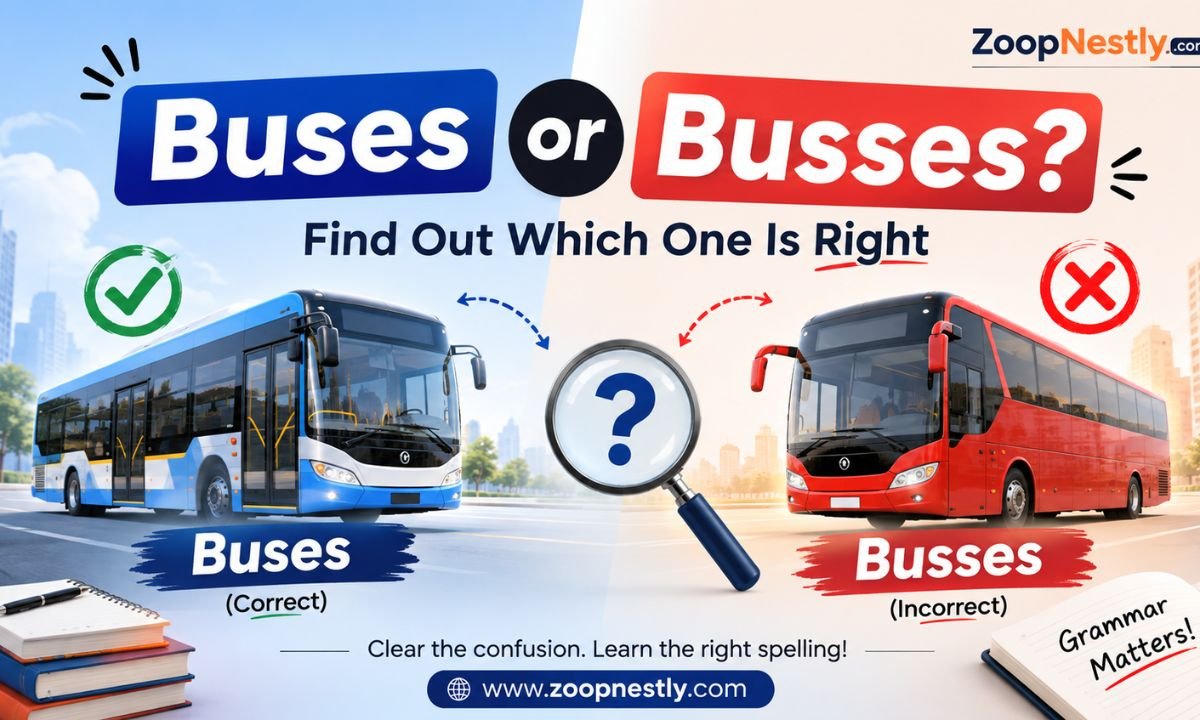
Buses or Busses? Find Out Which One Is Right
You typed a sentence about the school bus, paused, and suddenly the plural looked wrong. Is it two buses or two busses? Get it wrong in an email, a report, or a school notice, and you risk looking careless, even if your grammar is otherwise sharp.|
The good news is that the rule behind buses or busses is short, simple, and easy to remember once you see it laid out clearly.
Quick Answer
Buses is the correct and standard plural of bus in both American and British English. Busses is a rare alternate spelling that most style guides consider outdated or incorrect for vehicles, and it’s also the plural of the verb “buss,” meaning to kiss. For everyday writing, always choose buses.
Buses or Busses: The Short Answer
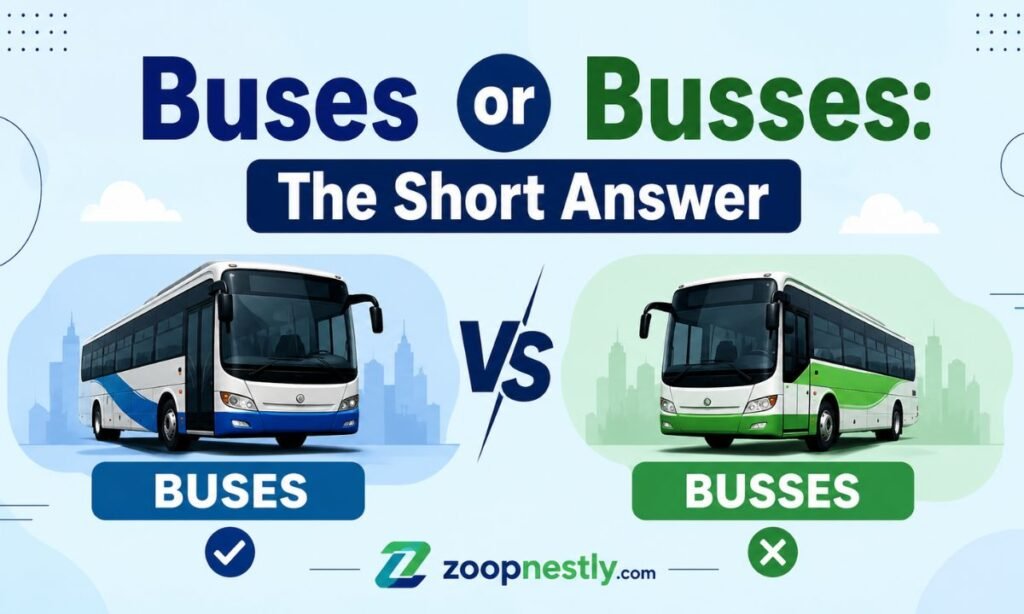
If you remember nothing else from this article, remember this: when you’re talking about vehicles that carry passengers, the plural is buses. Not busses. This is true whether you’re writing for a US audience, a UK audience, or anyone else.
Major dictionaries, including Merriam-Webster and the Oxford English Dictionary, list buses as the primary and preferred plural. Busses appears only as a secondary or historical variant, and it’s fading out of modern use entirely.
So a sentence like “The three buses arrived late” is correct. “The three busses arrived late” would raise eyebrows with most editors and readers today.
Where Does “Busses” Come From?
The confusion has a real linguistic root, so it’s not just a random typo pattern. The word “bus” itself is a shortened form of “omnibus,” a Latin word meaning “for all,” borrowed into English in the 1800s to describe horse-drawn public carriages.
When English speakers started pluralizing short words ending in a single vowel plus a consonant, the natural instinct was often to double the final consonant before adding “-es,” similar to words like “quiz” becoming “quizzes.” Early writers applied that same logic to “bus,” producing “busses.”
Over time, English usage settled on the simpler, more consistent form: buses. Doubling the “s” fell out of favor because it created confusion with an already-existing word, “buss,” an old-fashioned term for a kiss. Keeping the two words visually distinct helped buses win out as the standard spelling.
British English vs. American English Spelling
One thing that makes buses or busses confusing is the assumption that British and American English disagree here, the way they do with “colour” versus “color.” They don’t.
American English
American style guides, including AP Style and Chicago Manual of Style, use buses as the plural of bus. American dictionaries list busses only as a rare, secondary variant tied mostly to older or regional usage.
British English
British English also uses buses as the standard plural. The Oxford English Dictionary confirms this is the accepted spelling across the UK, Australia, Canada, and other English-speaking countries.
Quick Comparison
| Region | Preferred Plural | Notes |
| United States | Buses | Standard in AP Style, Chicago Style, and everyday writing |
| United Kingdom | Buses | Standard in Oxford and Cambridge dictionaries |
| Australia/Canada | Buses | Follows British and international convention |
There’s no regional debate here. Buses is universal.
DISCOVER MORE : Full Time or Fulltime: The Right Spelling and Meaning
When Should You Ever Use “Busses”?
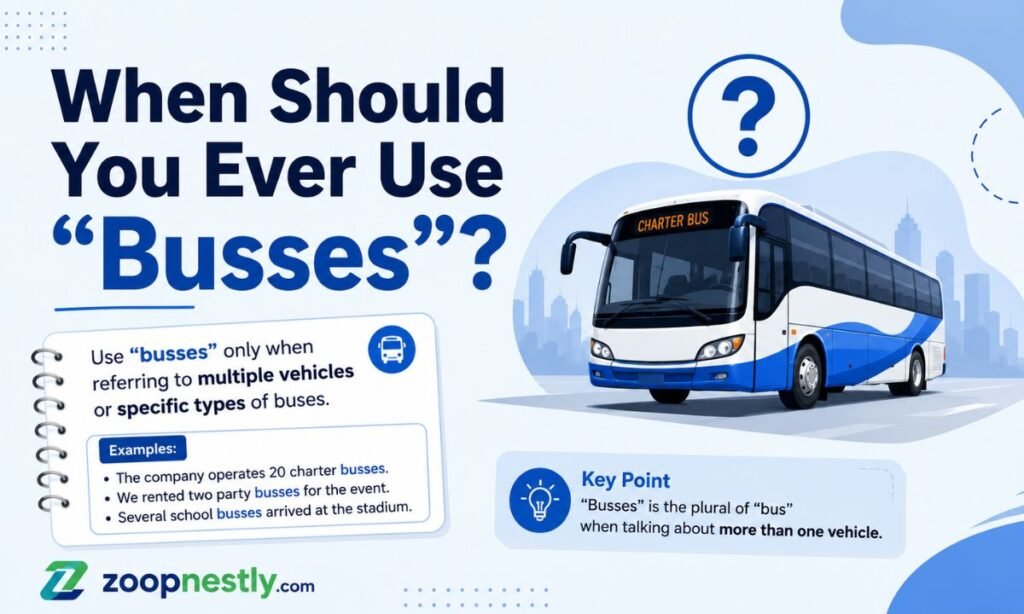
There is exactly one situation where “busses” is grammatically correct, and it has nothing to do with vehicles.
“Buss” is an archaic verb and noun meaning to kiss or a kiss itself. It’s rarely used in modern English outside of poetry, older literature, or intentionally old-fashioned writing. When you conjugate it in the third person, you get “busses”:
- “She busses her grandmother on the cheek before leaving.”
- “He busses his children goodnight.”
Outside of this narrow, old-fashioned usage, you should not use “busses” for anything, including the plural of the vehicle.
Buses or Busses: Comparison Table
| Word | Meaning | Example Sentence | Common Today? |
| Buses | Plural of the vehicle “bus” | “Two buses pulled up to the curb.” | Yes, standard |
| Busses | Third-person verb form of “buss” (to kiss) | “She busses him on the cheek.” | No, archaic |
| Busses | Rare alternate plural of “bus” | “The busses were full.” | No, outdated |
Common Mistakes with Buses or Busses
Even confident writers slip up here. These are the patterns worth watching for.
Mistake 1: Doubling the consonant automatically. Writers sometimes double the final consonant out of habit, the way they would with “stop” to “stopped.” Bus doesn’t follow that pattern in its plural form.
Mistake 2: Assuming busses is a British spelling. As shown above, British English does not use busses as the standard plural either.
Mistake 3: Confusing “bus” with similar-looking words. Words like “gas” (gases) and “quiz” (quizzes) follow different pluralization rules, which can create false patterns in a writer’s mind.
Mistake 4: Using busses in formal or business writing. Reports, school notices, and professional emails should always use buses. Busses can look like a typo to readers and editors alike.
Mistake 5: Not proofreading autocorrect changes. Some spell checkers or autocorrect tools may not flag “busses” as wrong, since it’s a real word, just not the one you meant. Always double check the context.
Buses or Busses in Everyday Examples
Seeing the word in real contexts makes the rule stick faster than any explanation alone.
Email: “Please note that the buses for the field trip will leave at 8 a.m. sharp.”
News: “City officials announced that ten new electric buses will join the public transit fleet next year.”
Social Media: “Missed two buses this morning and I’m still not okay about it.”
Formal Writing: “The transportation department is responsible for maintaining all school buses within the district.”
School Notice: “All buses will depart from the main entrance at 3:15 p.m.”
Business Report: “The company’s fleet includes 42 buses used for employee shuttle services across three locations.”
Every one of these examples uses buses, because every one of them refers to the vehicle.
Buses or Busses: AP Style and Other Guides
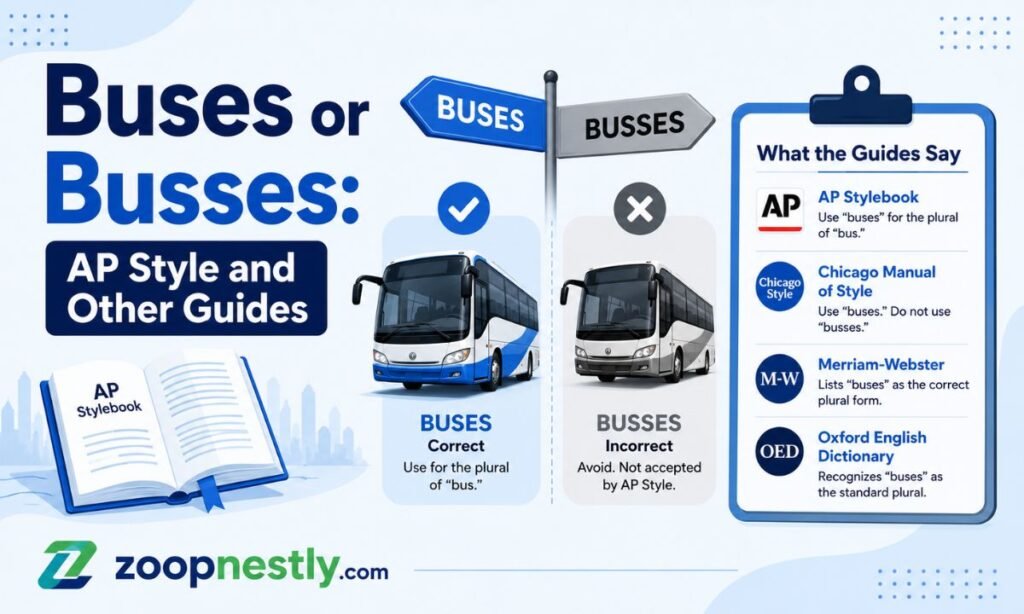
If you write professionally, style guides matter more than personal preference. Here’s where the major ones land:
- AP Style uses buses as the standard plural.
- Chicago Manual of Style follows the same rule.
- Merriam-Webster lists buses first, with busses as a secondary, less common variant.
- Oxford English Dictionary treats buses as standard across all forms of English.
If you’re writing for publication, a company, or a school, defaulting to buses keeps you aligned with every major authority on the subject.
How to Remember Which Spelling to Use
If you need a quick mental trick, try this: think of “bus” as a short, modern word that doesn’t need extra letters to make sense. A single “s” plus “-es” is enough. Save the double “s” for the old-fashioned kissing verb, “buss,” which almost never comes up outside of historical or poetic writing.
Another way to remember it: if you can picture the word next to a vehicle, wheels, a driver, or a bus stop, it’s buses. If you can picture it next to a cheek or a kiss, it’s busses.
Frequently Asked Questions
Is “busses” ever correct for vehicles?
Rarely, and only as an outdated or regional variant. Standard modern English, in both the US and UK, uses buses as the correct plural for vehicles.
Why do some spell checkers accept “busses”?
Spell checkers recognize “busses” because it’s a real word tied to the verb “buss,” meaning to kiss. It’s not flagged as an error, but it’s usually the wrong word for your sentence if you meant vehicles.
Does British English spell it differently than American English?
No. Both British and American English use buses as the standard plural. There is no regional split on this particular word, unlike many other US-UK spelling differences.
What is the difference between “bus” and “buss”?
“Bus” refers to the vehicle used for public or group transportation. “Buss” is an old-fashioned word meaning to kiss or a kiss itself. Their plural and verb forms look similar but mean completely different things.
What’s the plural of “bus” in a sentence?
The plural is buses. For example: “The buses were parked outside the stadium after the game,” or “Three buses arrived within ten minutes of each other.”
Conclusion
The debate over buses or busses comes down to one clear rule: use buses when you’re talking about vehicles, in any form of English, formal or casual. Save “busses” for the rare, old-fashioned verb meaning to kiss, and even then, expect most readers to find it unfamiliar. When in doubt, buses is always the safer, more accurate, and more widely accepted choice.

James Walker is a content writer and language researcher with over 5 years of experience in meanings, definitions, and language-related topics. He enjoys simplifying complex terms into clear, easy-to-understand explanations. Through ZoopNestly.com, he helps readers find accurate and reliable information.