Sisters or Sister’s: The Complete Guide to Getting It Right Every Time
You’re texting your mom about a weekend trip, or drafting an email at work, and you freeze. Should it be “sisters” or “sister’s”? One tiny apostrophe changes the entire meaning of your sentence, and getting it wrong can make a birthday card, a resume, or a business email look sloppy. The good news is that sisters or sister’s comes down to one simple question: are you talking about more than one sister, or something that belongs to one sister?
Quick Answer
Sisters is the plural form, used when talking about two or more female siblings. Sister’s is the singular possessive form, used to show that something belongs to one sister. If you’re describing ownership, use the apostrophe. If you’re just counting siblings, drop it.
Sisters vs Sister’s: What’s the Real Difference?
The difference is grammar function, not spelling difficulty. “Sisters” adds an -s to show there is more than one sister. “Sister’s” adds an apostrophe plus -s to show possession, meaning something belongs to a single sister.
Here’s the fastest way to check which one you need: ask yourself if you’re counting sisters or describing something that belongs to a sister.
- Counting: I have three sisters.
- Owning: That is my sister’s car.
If the sentence still makes sense after removing the word “sisters” and replacing it with “siblings,” you likely need the plural form. If you can replace it with “belonging to my sister,” you need the possessive.
Sister vs Sisters vs Sister’s: A Simple Breakdown
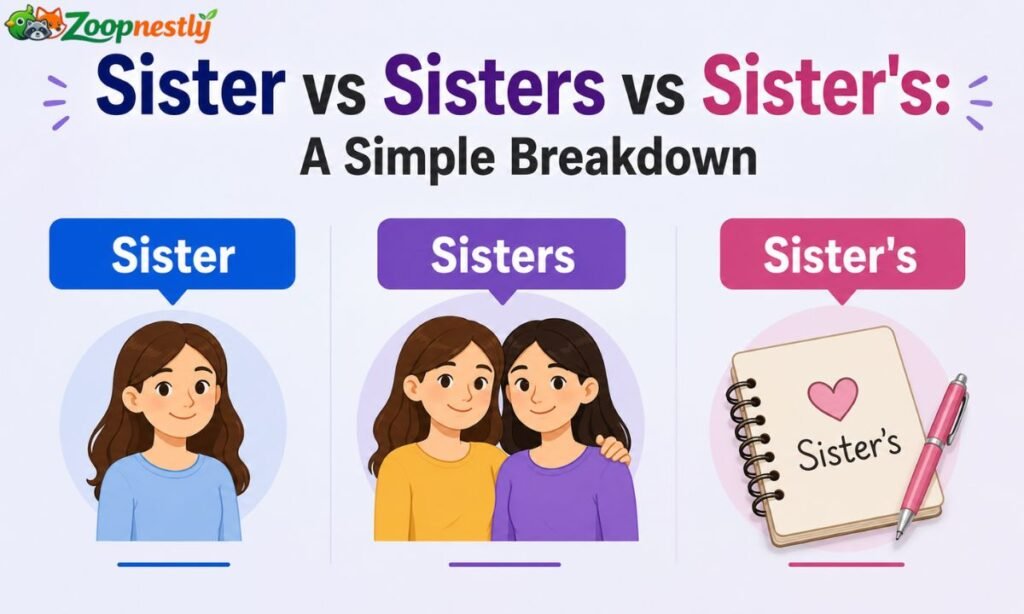
Many people mix up all three forms because they look so similar. Here’s how each one works in a sentence:
| Word | Type | Meaning | Example |
| Sister | Singular noun | One female sibling | My sister lives in Chicago. |
| Sisters | Plural noun | Two or more female siblings | My sisters live in Chicago. |
| Sister’s | Singular possessive | Something belonging to one sister | My sister’s apartment is in Chicago. |
| Sisters’ | Plural possessive | Something belonging to two or more sisters | My sisters’ apartment is in Chicago. |
That last row is worth noting. When more than one sister owns something together, the apostrophe moves after the final -s, becoming “sisters'” instead of “sister’s.”
Why the Apostrophe Matters So Much
English uses the apostrophe to signal ownership, and dropping it (or placing it wrong) genuinely changes meaning. Compare these two sentences:
- “I borrowed my sisters’ shoes.” (Shoes belonging to more than one sister.)
- “I borrowed my sister’s shoes.” (Shoes belonging to one sister.)
Both sentences are grammatically correct. They just describe different situations. This is why proofreading matters, especially in formal writing like emails, essays, or wedding speeches where family details need to be accurate.
Common Mistakes with Sisters or Sister’s
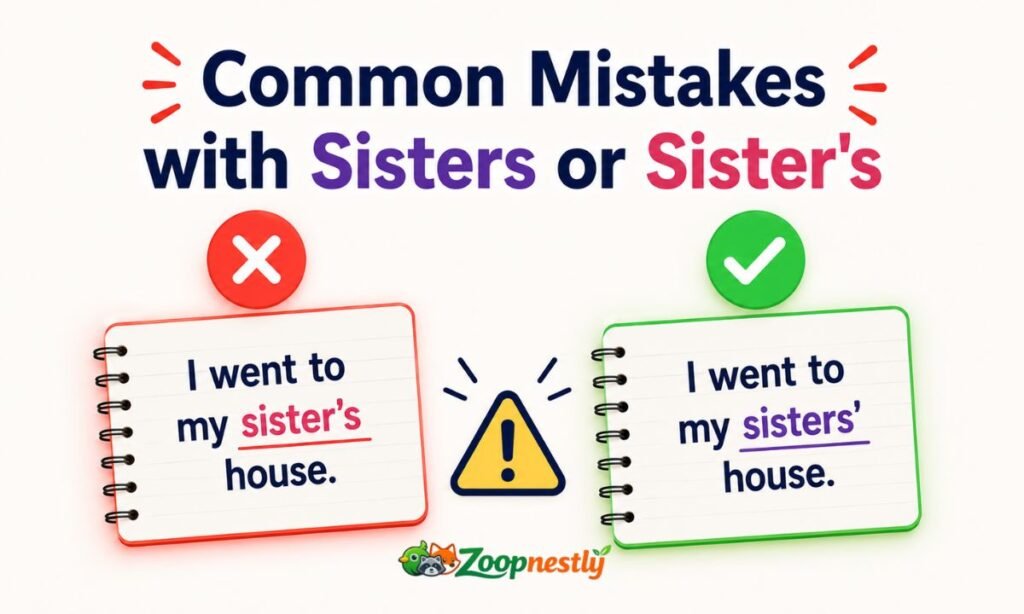
A few mistakes show up again and again in everyday writing:
1. Adding an apostrophe just because a word ends in “s.” Wrong: My sister’s and I went shopping. Right: My sisters and I went shopping.
There’s no ownership here, so no apostrophe is needed.
2. Forgetting the apostrophe when showing possession. Wrong: This is my sisters car. Right: This is my sister’s car.
3. Misplacing the apostrophe with multiple sisters. Wrong: My sister’s all agreed on the plan. Right: My sisters all agreed on the plan.
4. Confusing “sisters'” with “sister’s” when more than one sister owns something. Wrong: My sister’s houses are both in Texas. (implies one sister owns two houses, or is unclear) Right: My sisters’ houses are both in Texas. (two different sisters, each with a house)
If a sentence feels off, try reading it out loud and asking who owns what, if anyone. That usually clears up the confusion fast.
Sisters or Sister’s in Everyday Examples
Seeing the words in real context makes the rule easier to remember.
Using “sisters” (plural, no ownership):
- She has two older sisters.
- The sisters grew up in the same small town.
- My sisters are coming over for dinner tonight.
Using “sister’s” (singular possessive):
- My sister’s wedding is in June.
- I forgot my sister’s birthday last year.
- That is my sister’s favorite restaurant.
Using “sisters'” (plural possessive):
- The sisters’ business has grown every year.
- Both sisters’ names are on the lease.
DISCOVER MORE : Relieving or Reliving: Which Word Do You Actually Need?
Sister and Brother: How the Rule Applies to Other Family Nouns
The same possessive rule applies across family terms, not just “sister.” Once you understand the pattern for sister, it works everywhere else too.
| Singular | Singular Possessive | Plural | Plural Possessive |
| Sister | Sister’s | Sisters | Sisters’ |
| Brother | Brother’s | Brothers | Brothers’ |
| Mother | Mother’s | Mothers | Mothers’ |
| Cousin | Cousin’s | Cousins | Cousins’ |
Notice the pattern: add -s for plural, add apostrophe + s for singular possessive, and move the apostrophe after the -s for plural possessive.
Is “Sister’s” Ever Used as a Plural?
No. “Sister’s” is never a correct plural form, even informally. Some people mistakenly add an apostrophe before an -s just because a word ends in the letter “s,” but that’s a common punctuation error, not a grammar rule. If you’re talking about more than one sister and nothing is being owned, the correct word is always “sisters,” with no apostrophe.
British English vs American English: Any Differences?
There’s good news here. The rules for “sisters” and “sister’s” are identical in both American and British English. Possessive apostrophes work the same way on both sides of the Atlantic. The only spelling differences you’ll typically run into with family-related words involve unrelated terms like “mom” versus “mum,” not possessive or plural forms like this one.
How to Remember the Rule for Good
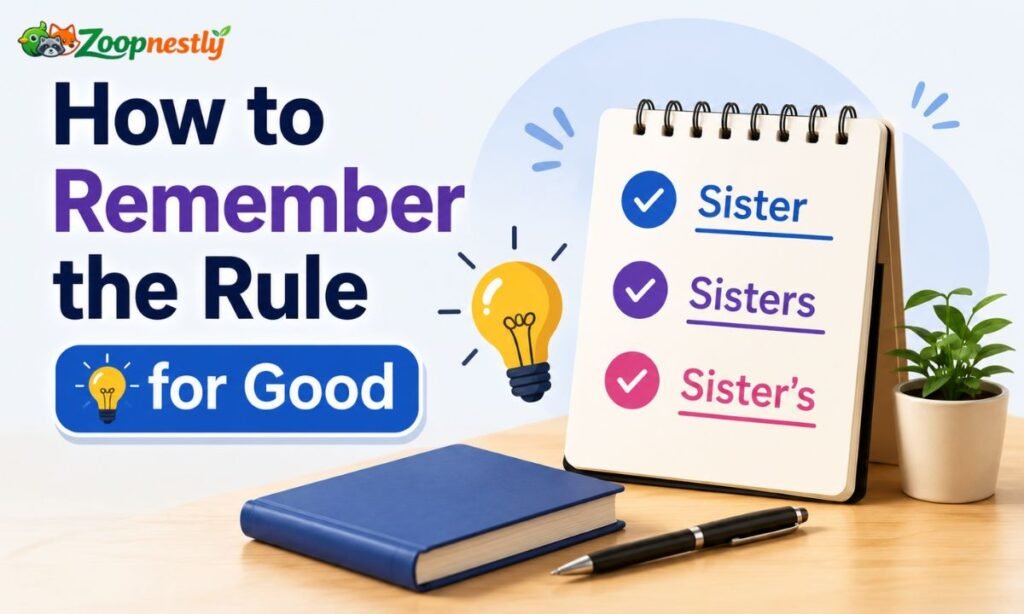
If you want a quick mental trick, try this:
- No apostrophe = more than one sister (sisters)
- Apostrophe before the s = one sister owns something (sister’s)
- Apostrophe after the s = multiple sisters own something (sisters’)
Another simple test: say the sentence out loud and ask, “Does something belong to a sister?” If yes, you need an apostrophe. If no, you don’t.
Frequently Asked Questions
Is it “my sisters” or “my sister’s” when I have more than one sister?
Use “my sisters” when simply referring to more than one sister with no ownership involved, such as “my sisters and I traveled together.” Use “my sister’s” only when something belongs to one specific sister, such as “my sister’s passport.”
What is the plural possessive form of sister?
The plural possessive form is “sisters’,” used when something belongs to two or more sisters. For example, “the sisters’ shared apartment” means the apartment belongs to more than one sister.
Do I use an apostrophe when talking about sisters in general?
No. When simply referring to sisters as a group with no ownership, there is no apostrophe. For example, “sisters often share a close bond” does not need an apostrophe.
Is “sister’s” singular or plural?
“Sister’s” is singular possessive. It refers to something owned by one sister, not more than one. If multiple sisters own something, the correct form is “sisters’.”
What’s an easy way to check if I need an apostrophe with sister?
Ask if something belongs to a sister. If yes, use an apostrophe. If you’re only counting sisters with nothing being owned, skip the apostrophe entirely.
Final Thoughts
Choosing between “sisters” and “sister’s” really comes down to one question: are you counting or are you claiming ownership? Once that clicks, the apostrophe stops being confusing and starts being a useful signal that tells your reader exactly what you mean. A little attention to this small mark goes a long way in making your writing clear, accurate, and easy to trust.

James Walker is a content writer and language researcher with over 5 years of experience in meanings, definitions, and language-related topics. He enjoys simplifying complex terms into clear, easy-to-understand explanations. Through ZoopNestly.com, he helps readers find accurate and reliable information.